
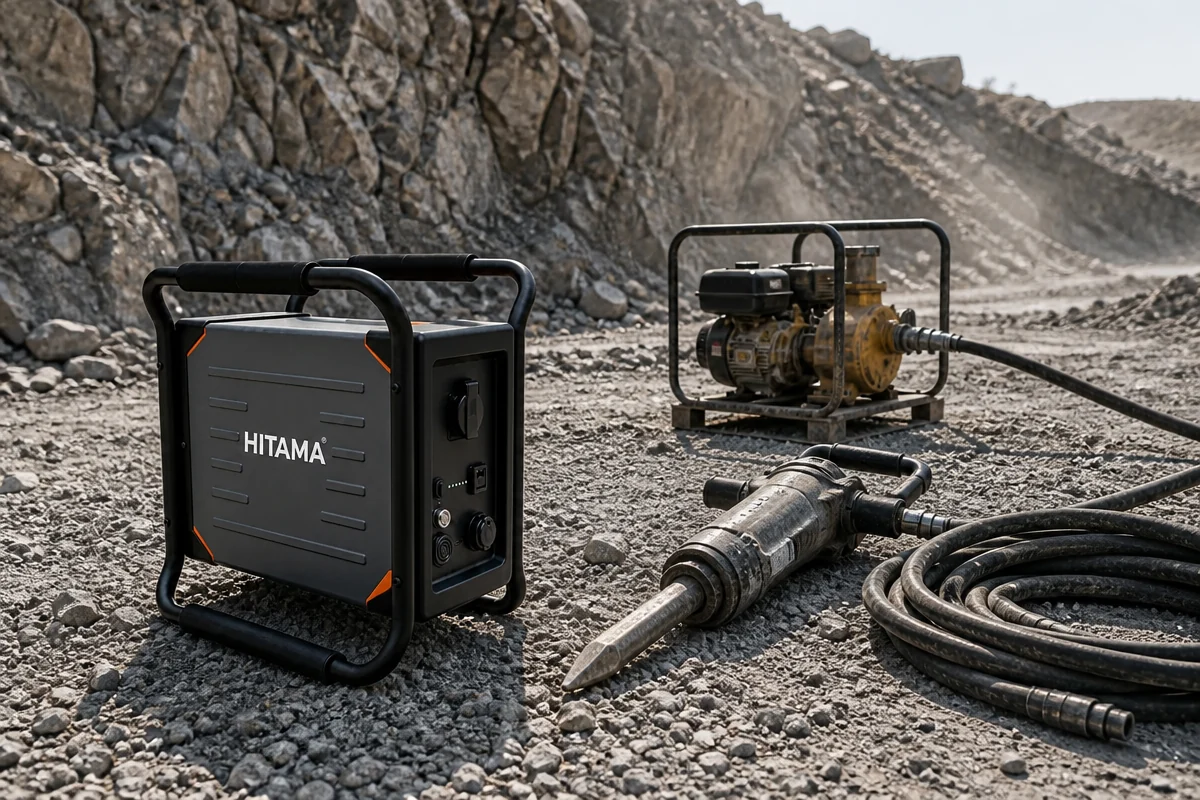
For a liner change, the deciding number is not the crusher's throughput but the hours the tools run inside it. A P25 carries 2.7 kWh at 2,500 W continuous: enough for a single-unit job with an impact wrench, a grinder and light — not for a window that runs into a second shift.
The isolation takes the sockets with it
Lockout is a boundary, not a pause. When a crusher is isolated, the circuits behind the lock are dead by design: the drive, the walkway lighting, the socket at the stair foot. The quarry's power layout follows the plant, not the job, and an extension lead from the live side would have to cross the exclusion zone to reach it.
1. Why not simply use the plant's own sockets?
Because they sit on the isolated side of the lock — not an inconvenience to work around, but the condition that makes the work safe. The window has a clock: every hour costs tonnage.
What a liner change actually draws
The list is short, the current is not. An impact wrench on a bolt seated for a year, a grinder, a floodlight into the housing, a small weld, tool batteries at shift end.
What sizes the unit is the start, not the run. A motor starting against load draws a multiple of its rated current for a fraction of a second. Light is the forgotten load: small, constant, quietly expensive.
2. Which load decides the size of the unit?
The one that starts under load, and the one that runs longest. The first sets the output, the second the stored energy.
Sizing the window, not the plant
The plant's rating plate says nothing about this job. A crusher is sized in tonnes per hour; the work inside it in tool-hours.
Stored energy is the budget, output the ceiling. One HITAMA P25 portable power station holds 2.7 kWh at 2,500 W continuous — 29 kg on a frame two people carry through a gate.
When one unit is not enough, the answer is usually a second. Two on the 230 V pair (P25-D) give 5,000 W and 5.4 kWh; three with the box (P25-T), 7,500 W and 8.1 kWh at 400 V.
| Configuration | Rated output | Stored energy | Charging input |
|---|---|---|---|
| P25 | 2,500 W | 2.7 kWh | 500–1,500 W at 230 V |
| P25-D (230 V pair) | 5,000 W | 5.4 kWh | 500–1,500 W at 230 V |
| P25-T (3 units, 400 V) | 7,500 W | 8.1 kWh | 500–1,500 W at 230 V |
Why not put an engine on the walkway
Exhaust goes where the fitters work. A housing and the walkway above are low, enclosed and unventilated, and a fan plus a filter would turn quarry dust into maintenance; the air that clears exhaust is the air the plant is not moving — hence the airway is the first load underground.
Fuel has to be carried in — up a tower, past a bund, to a store the site puts elsewhere, refuelled mid-window. Silence counts too: a stopped plant is the one quiet hour at the boundary.
What this is not
It is not the plant's supply. A unit inside the isolation feeds its own outlets, and cannot be wired into the fixed installation.
The energy is finite. Ten hours at a continuous 1.5 kW is past one P25 — which is why a dewatering job at the face is budgeted in days, a liner change in shifts.
IP54 is dust-protected and splash-proof — not permission to wash the unit down or leave it standing in water. It is not explosion-protected equipment either, and does not belong in a zone that requires one.
The site's rules still govern the job — isolation, permit, exclusion zone, rescue plan.
Questions we get before a shutdown
How long does 2.7 kWh last inside a crusher?
At a continuous 1,500 W draw, 2.7 kWh is gone in under two hours; at 500 W the same pack holds more than five. A liner job is mostly intermittent, which is why stored energy usually outlasts the shift and why the rate matters more than the total.
Is one unit enough for a jaw liner change?
Usually yes, if the wrench and the grinder do not start together. One P25 holds 2,500 W continuous and 2.7 kWh, which covers a single-unit job with light and a small weld. A second unit buys overlap, not a headline figure.
Can the unit sit inside the housing?
Where dust falls and spray does not reach — that is the limit IP54 describes, and it is narrower than the word weatherproof suggests. It should not be washed down with the housing at the end of the window, nor stand in slurry at the discharge end.
What does it need between two windows?
An ordinary 230 V socket, booked before the window rather than after it. The input draws 500–1,500 W, so a 2.7 kWh pack is full again across a working day, and the pack does not have to leave the plant to get there.
Send us the tool list for your next shutdown window — each tool, its run time, and how long the isolation lasts — and we will work out whether one unit carries it or two.