
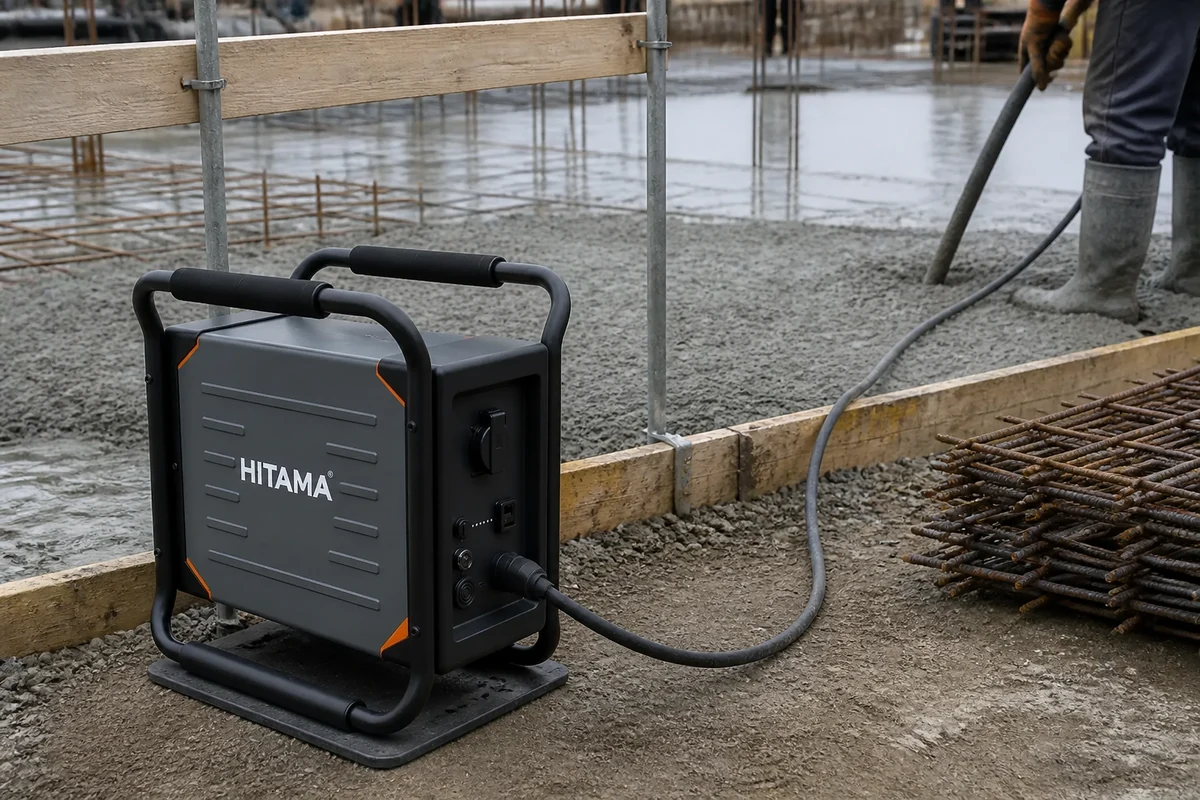
A placement day asks the power supply one question: will it still be there at four in the afternoon. Vibration is a light load. Continuity is the whole job, and it is decided before the first truck reverses up to the formwork.
The load is small, the window is not
A poker vibrator draws a fraction of what a breaker or a welder draws. That is the trap on a placement day: the load sheet looks easy, so the supply is chosen on watts and sited on convenience.
The work is not the risk. The interval is. Concrete that has started to set cannot be brought back by vibrating it again. The joint stays where the pour stopped, for the life of the structure.
Peak decides whether the unit is enough
A motor starts on current it does not draw once it is running. Vibrators, a wash-water pump or a small mixer each start with a surge, and several start together when a truck arrives and the crew works the whole section.
The P36 is rated 3,600 W continuous and 20,000 W peak; the P25 2,500 W and 5,000 W. Peak answers the surge, continuous answers the fourth hour. Output is pure sine wave with THD below 3 per cent, which matters for anything carrying a control board.
Where the unit stands is a placing decision
The corner of the slab is the worst place on site. It sits inside the hose arc, inside the boom radius and inside the barrow route, so it gets moved twice and every move is an unplug. Put it behind the barrier, outside the pour footprint, with the panel reachable without stepping into fresh concrete.
Handover is where continuity is actually lost. Three trades share a panel across a shift; the unit rarely fails mid-pour, someone unplugs it to charge a phone. Marked sockets, one rule, one named person who owns the panel.
Dust is the second load
On a pour site the air is abrasive, and a fan is an intake. The sealed case has no intake and no fan; heat leaves through the case wall, which is why the case has to stay clear.
A blocked case is an overheating unit that looks fine. Hose it down at the end of the shift, cover the panel, stack nothing against it.
The rated operating window is -10 to 65 °C, and that is the machine, not the air around it. A unit boxed into a steel container on a hot afternoon is not working at ambient. IP54 is a dust and water rating, not a licence to bury the unit.
The wait between trucks is the charging window
The gap between trucks is the only charging opportunity of the day, and it is usually fifteen minutes. A 230 V socket input takes 500 to 1,500 W; the P36 charges fully in about 1.5 hours, the P25 to 80 per cent in about 2 hours.
With no socket on site, the recharge belongs before the shift, not in the middle of it. Where the day runs longer than one charge, two or three modules parallel at 230 V single phase, and the second unit is reserve, not capacity.
What this is not
This is not a claim that a battery replaces the site supply. On a large placement the permanent connection is the right answer; the unit covers the period before it is energised, or the section it does not reach.
It is not a statement about any particular vibrator, pump or mixer, and not a promise about joint quality. We do not publish tool figures we have not measured, and a cold joint is a placing and curing decision made by the crew. Power removes one cause of a stoppage, and no more.
Send us the placement plan — pour volume, number of vibrators, shift length and whether a socket will be available — and we will return a configuration, the cable lengths it implies, and the recharge window it needs.