
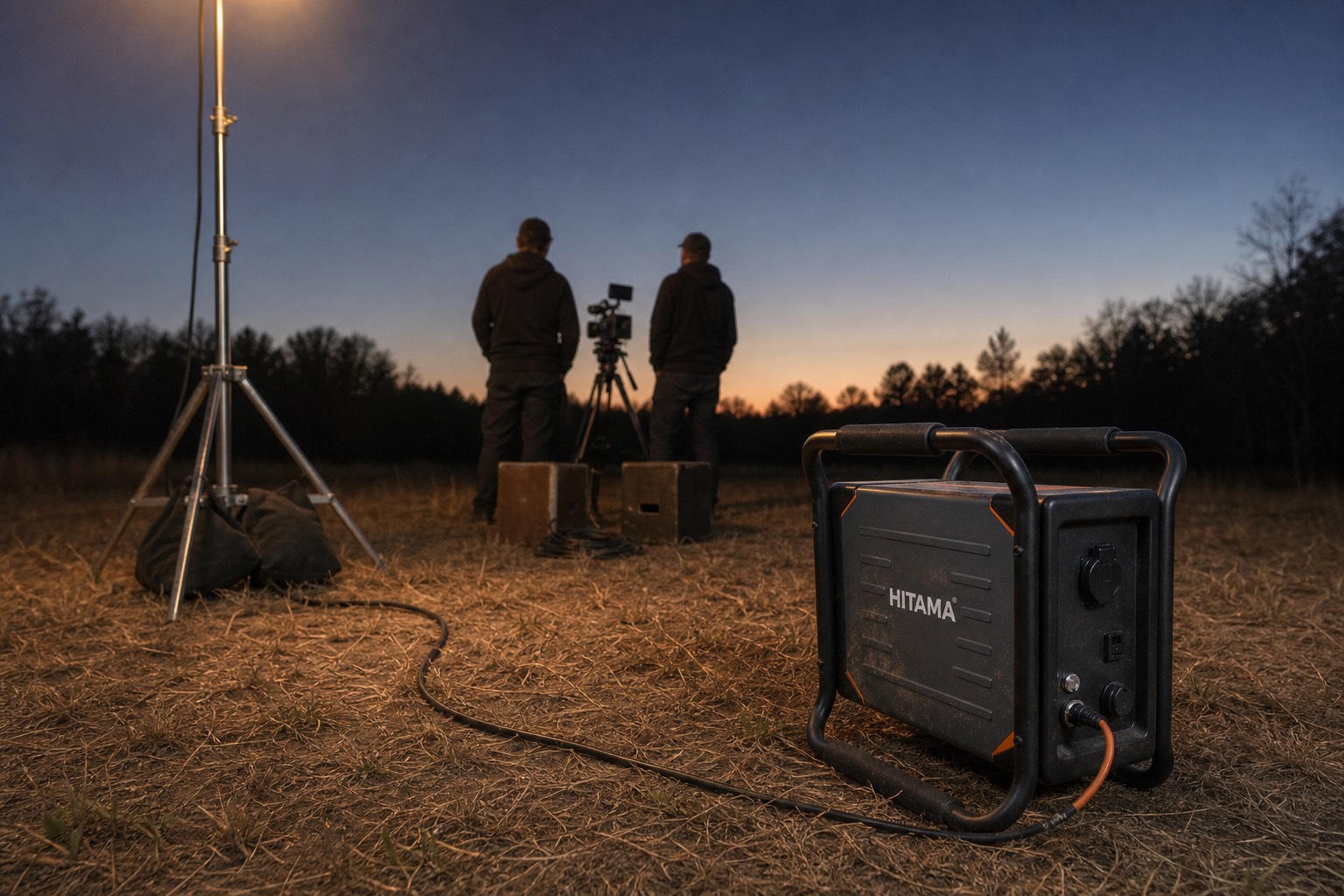
On a set or a stage, noise is not an annoyance — it is a contractual problem. A combustion generator on location means a cable run, a fuel run, and a sound department working around an engine all day.
What the load actually looks like
Lighting. The largest and most variable load, and the one you know about in advance.
Sound and monitoring. Small, continuous, and the load you cannot interrupt.
Camera and monitor carts. Mostly battery charging, on a schedule.
Crew devices. Phones, laptops, radios: small each, constant in total.
Why battery power suits production
No engine means no noise floor under a take, no exhaust drifting across a set, and no fuel stored where a dozen people are standing. One unit is 29 kg and moves in one hand, so the power can follow the shot instead of the shot following the power.
Sizing
A C24 starts at 2,048 Wh and grows to 10,240 Wh by stacking — usually the right shape for a lighting load, because capacity grows without a second unit to carry. For heavier or three-phase loads, the P25 family reaches 5,000 W (P25-D) and 7,500 W at 400 V (P25-T).
The limit
Capacity is finite: a full lighting day is a real load, and recharging takes hours from a 230 V socket at 500–1,500 W. Plan the turnaround between days, not only the day. IP54 covers dust and water spray; it is not a claim of weatherproofing for permanent outdoor installation.