
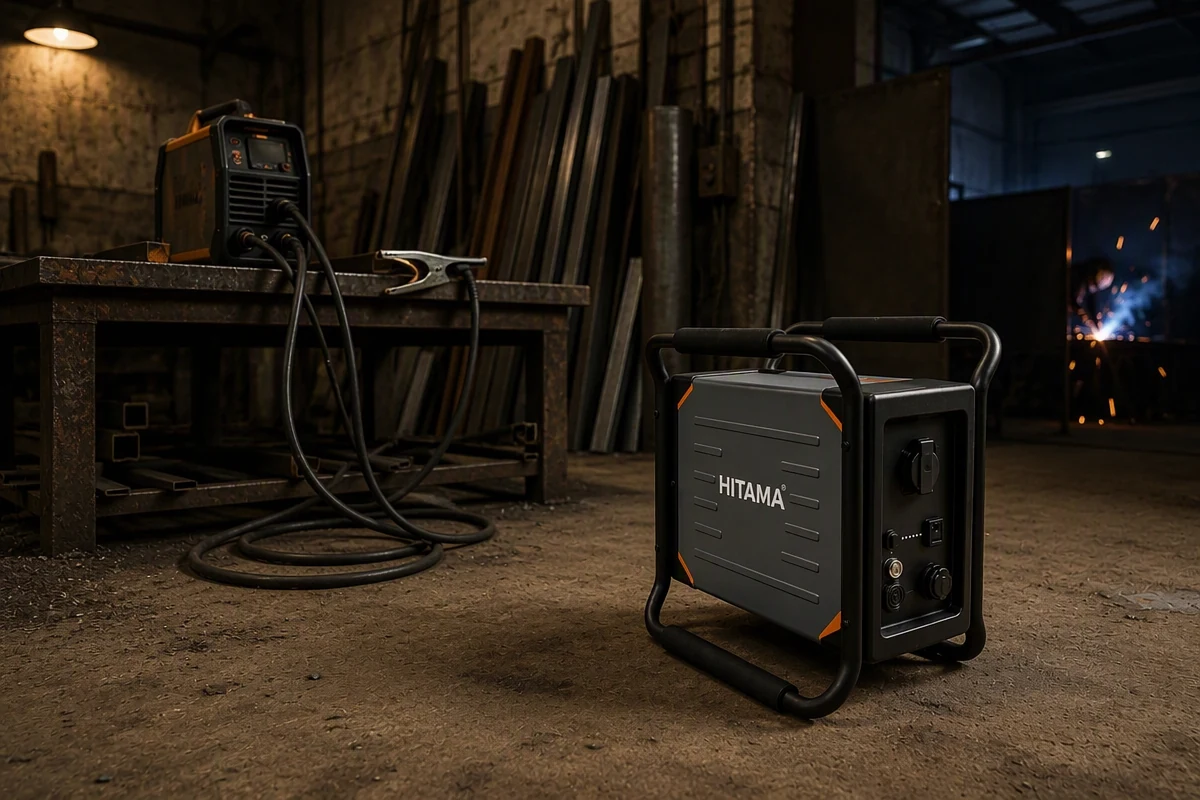
The return cable carries the same amperes as the electrode holder, and its route decides whether the weld, a bearing or a sling gets the current. On a 200 A weld that is 200 A through a clamp sitting on paint. On a bench with a dedicated return it hardly matters; on a steel frame whose nearest earth is a column, it decides the job.
Current leaves the machine and has to come back
The circuit is a loop, not a hose. The electrode holder is the half everyone watches; the return lead carries the same current the other way. At 200 A the clamp is a 200 A contact, and paint, mill scale or a tired spring turn it into a resistor that heats and drops voltage at the arc.
A bad clamp shows up in the weld first. The arc wanders, and the welder adjusts the machine while the fault sits behind him on a primed beam.
1. Where does the current go when the clamp is far away?
It takes the shortest electrical route available. If the clamp sits on a painted member and the joint is bolted to a frame, the current uses the bolts, the rebar or a sling instead of the cable you laid.
A unit at the joint shortens the return
No engine means the supply can stand where the work is. No exhaust, no fuel, no cable back to a generator: the P25 series goes within a few metres of the joint, inside a vessel or under a scaffold. A short return removes most of the parallel paths a long run invites.
What stays is placement. No intake and no fan, so no grinding dust through a filter, but the case stays clear of the spatter cone and off hot cut-offs; IP54 covers dust and splash, not a slag heap. A 160–200 A machine starts at the three-phase set in our welding supply section.
2. Is a portable supply the same as a distribution board?
Not in what it gives the current. A board sits inside the building's earthing system; the unit stands on its own. That does not remove the return path, it leaves the one planned path and a question — what is the workpiece bonded to? Ask the supervisor before the first arc.
What a wandering return current damages
Bearings and rams are the expensive ones. Current crossing a rolling element pits the race; crossing a hydraulic rod damages the seal surface. Neither fails that day, and neither appears in an inspection.
Slings and electronics are the quiet ones. A synthetic sling that carries current loses strength without changing shape; controllers on the same steel read the arc as noise, and the machine gets the blame.
The ten minutes that fix it
Clamp on the member being welded. Same component, clean bare metal, close to the arc, spring clamp closed by hand, return lead back to the unit without loops around structure.
| Figure | P25 | P25-D | P25-T |
|---|---|---|---|
| Continuous output | 2,500 W | 5,000 W at 230 V | 7,500 W at 400 V |
| Capacity | 2.7 kWh | 5.4 kWh | 8.1 kWh |
| Weight / protection | 29 kg / IP54 | IP54 | IP54 |
| Recharge at 230 V | 500–1,500 W | 500–1,500 W | 500–1,500 W |
Then walk the route once. Both ends, then anything that can carry current in parallel: slings, hoses, the structure's own bonding. Where the run cannot be short, the no-live-supply case comes first; where the joint needs preheat, that schedule sets the hours.
What this is not
Not a substitute for the site's earthing design. HITAMA builds the supply, not the installation. The return path and any bonding stay the site's decision and the supervisor's signature.
Not a claim that a short return removes the risk. It removes parallel paths, not poor practice, and changes no capacity: 2.7 kWh on one unit is a shift of light welding, not a day of 200 A passes.
FAQ
How much current returns through the clamp?
All of it, and the clamp has to carry it. The return lead conducts the same amperes as the electrode holder, so a 200 A weld is a 200 A contact at the jaw; paint, scale or a tired spring add resistance there, and the arc feels it before the welder does.
Can the steel structure be the return path?
Only by accident, never on purpose. A structure carrying weld current puts amps through bolts, bearings and slings that were never sized for it, and a 200 A arc will prefer that steel to a painted clamp every time it is offered the choice.
How long should the return lead be?
As short as the work allows, and routed by hand. Under 10 m at the joint usually keeps the clamp on the same member; every extra metre is another chance to loop the lead around structure, and every loop is a path the current may take instead.
Send the joint list and the bonding. Where the clamp will sit, what the workpiece is bonded to, whether the unit can stand a few metres from the arc. We will check one unit, two in parallel at 230 V, or three at 400 V.