
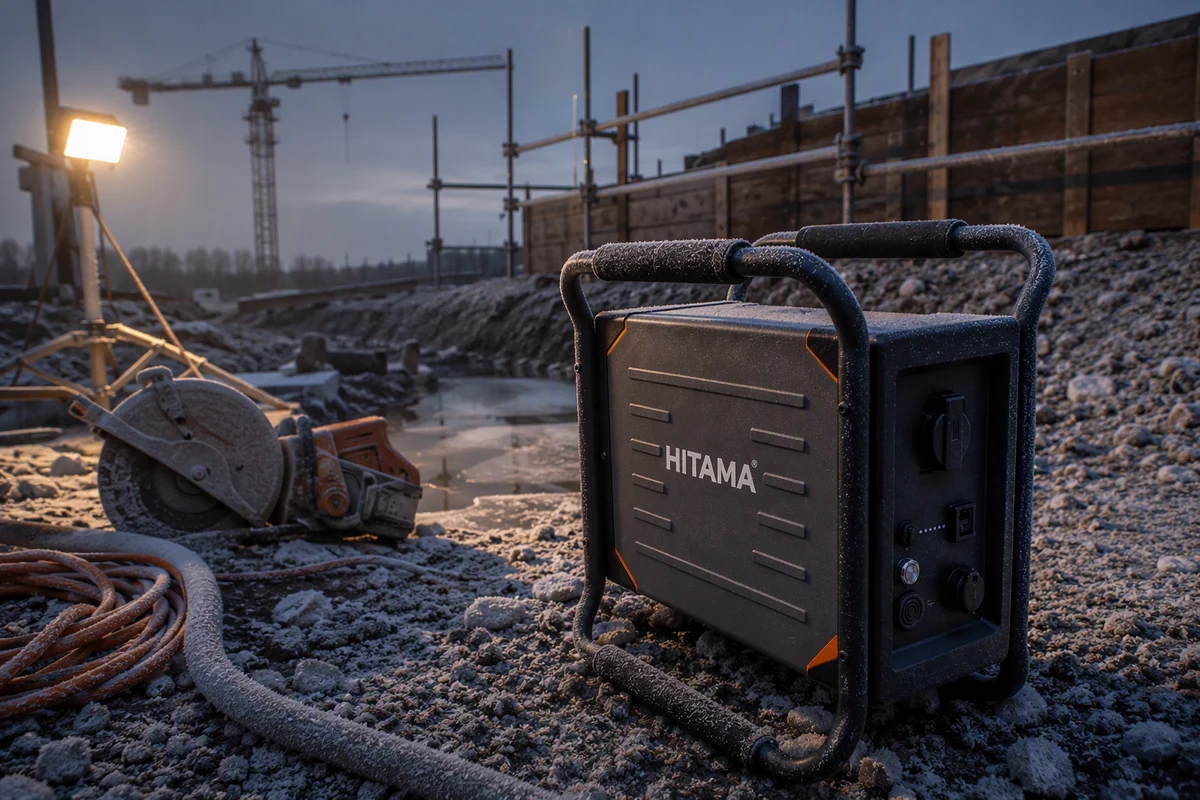
The gauge is not the problem
A pack that reads 40 percent at minus five really is at 40 percent. The chemistry deletes no stored energy when the mercury drops; a unit that ran six hours in October runs six hours in January on the same charge. What has changed is the other half of the cycle.
The failure is not a smaller tank, it is a closed valve. Lithium iron phosphate takes charge above freezing and not below; pushed colder, lithium plates onto the anode and does not come back when the weather improves. A unit that manages itself will not allow it, which is exactly why it refuses.
So the symptom reads like capacity and behaves like logistics. The machine works its shift, comes back at 30 percent and stands there overnight. Nothing is broken; a warm place and a few hours are missing.
What the charge path does at minus five
Below freezing the unit is not derating, it is locked. Cell temperature is measured first and current second; until the cells are above freezing the charge path stays shut, and the display may show a charging symbol with almost nothing going in. On a P25 the cycle is built on speed, and speed assumes room temperature: 80 percent in about two hours, a full pack in about 2.5 hours from a 500–1,500 W input.
The lock is deliberate, and it is why the pack lasts. Cells charged cold age early and unpredictably; cells kept above freezing hold capacity across thousands of cycles. What feels like a firmware restriction in January decides whether a fleet ages evenly.
The enclosure does not help here. Fanless means no intake, no filter, and no warm air path through the case either; heat comes in through aluminium and cold leaves the same way. A unit parked in wind at minus five is a cold block after eight hours.
Warmth is a building, not a feature
The cheapest heater on a winter site is a room you already pay for. At 29 kg and 2,500 W continuous, a P25 is a machine one person moves, and it can spend the night where the crew drinks coffee. Six hours indoors is a full charge; six hours in the yard is nothing.
Charging indoors changes the safety question, not the electrical one. The circuit is the same one; the surroundings are not. Keep the charge point clear, keep the cable out of the doorway, and assume the protection on that 230 V 16 A circuit belongs to the site.
Temperature decides what the unit gives back, too. The published range is −10 to 65 °C. At the warm end heat sets the limit, at the cold end the cells' willingness to deliver: 2.7 kWh holds a 5,000 W surge for ten seconds at minus ten, but not twice a minute all morning.
Two units are a winter configuration
In winter the second unit is not redundancy, it is the charger. A rotation, one on site and one warm and filling, turns a locked charge path into a whiteboard problem. Two P25 also parallel to 5,000 W, so the rotation costs no output; a P25-D at 5.4 kWh and around 60 kg does the same in one box.
Where the load is light, the smaller machine is the winter answer. A C24 at 2,048 Wh and 23 kg is full in about 1.5 hours and fits in a van.
A winter fleet needs a rule, not a habit. Units that come back below a quarter and go out cold are the ones that fail in February.
What this is not
This is not a claim that the unit works outside its published range. −10 to 65 °C is what we document. Our CE marking sits under the EMC Directive 2014/30/EU, test report A2409245-C01-R01-V1: electromagnetic compatibility, not a cold-weather approval.
It is not a capacity loss you can out-size. A P25-T at 8.1 kWh standing at minus five still cannot take charge; a larger pack helps only if there is somewhere warm to put the energy.
And it is not sealed. IP54 is an enclosure class for dust and splashing, not a claim about pressure washing or standing water.
Nor is it an engine replacement in every case. In the coldest weeks the arithmetic can favour keeping a small generator.
The January numbers
The configuration question is a calendar question. Shift start, the temperature in the yard at hand-over and the hours a unit stands still decide more in winter than the load list.
Send us the shift pattern you run in January and the tools that have to start cold, and we will work out where charging has to happen and how many units the rotation needs: https://www.hitama.net/en/contact