
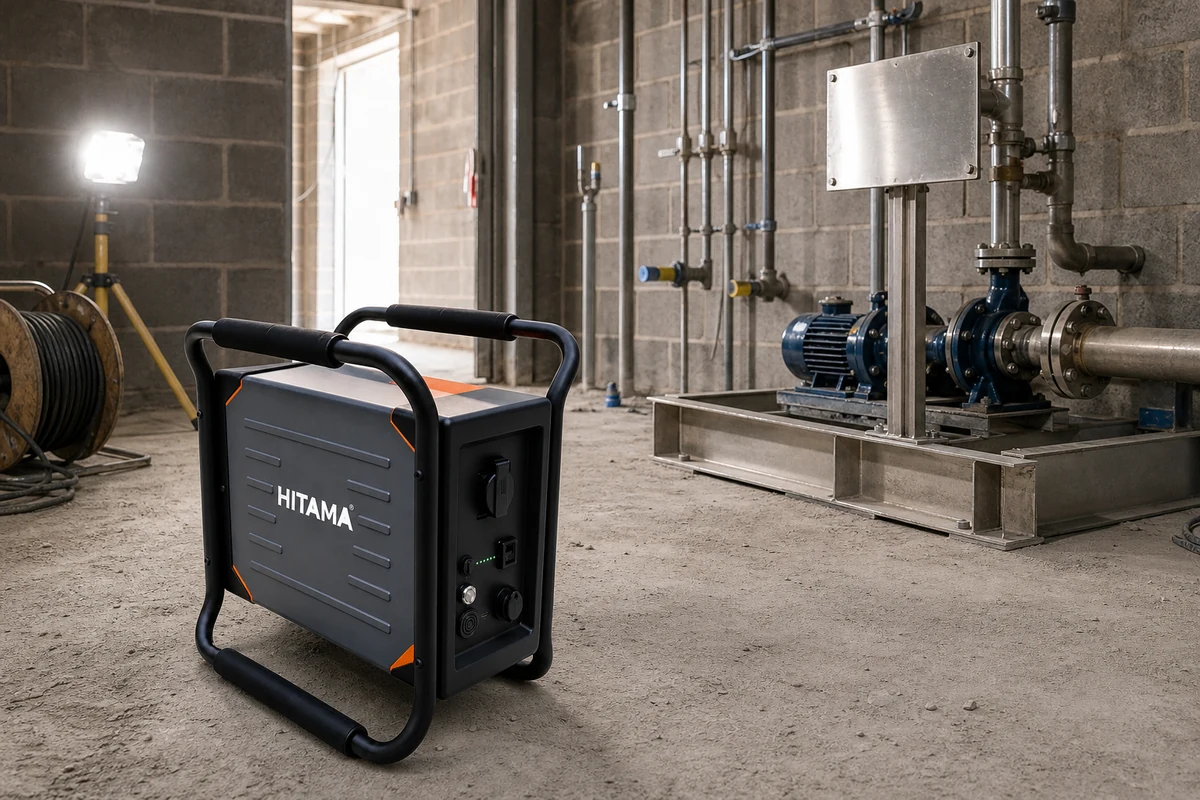
A commissioning day is the one shift where the load list is written before the number exists. The quotation came from a nameplate, the first run comes from a cold system, and the supply has to cover the distance between the two.
The plate is a ceiling, not a load
Every figure in the tender is a maximum. A motor is rated at full duty with the system at design condition; on the first start the water is cold and nothing has reached its working point.
Nobody has the running figure before the first run. That is not a planning failure, it is what the day is for.
So the day is planned as a range. The low end starts the test at nine, the high end carries it at eleven without a second trip to the yard.
What the day needs is a supply that can change
Adding a module is a decision; a phone call to the yard is a delay. One to three modules run in parallel at 230 V single-phase or 400 V three-phase, so a guess that turns out low is corrected in the plant room.
The steps are documented before you need them. P25 is 2,500 W rated and 5,000 W peak from 2.7 kWh; two modules as P25-D give 5,000 W and 10,000 W peak from 5.4 kWh at 230 V; three as P25-T give 7,500 W and 15,000 W peak from 8.1 kWh at 400 V three-phase.
Four hundred volts is a plant-list question, not a fault-finding question. If the pump or the drive under test is three-phase, no single-phase unit covers it at any rating, and that belongs in the van on the first morning.
A test is run more than once
The repeat is the duty. Churn, then load, then the run with the witness present; each one starts the motor from cold, and the gap between them is not long enough to charge anything.
Charging belongs to the evening. From an ordinary 230 V socket the input draws 500 to 1,500 W: a P25 reaches 80 percent in about two hours and full in two and a half. Two consecutive test days is a charging schedule before it is a capacity question.
Capacity is the boundary that does not negotiate. 2.7 kWh is the budget for the day, not a reserve behind it. Where the plant needs longer, that is a second module decided in advance.
The room is not finished either
No lift, no lighting, an unfinished floor. 29 kg is one person's lift; a P25-D is around 60 kg and a P25-T around 90, which is a route through a plant room door rather than a carrying job.
Heat leaves through the casing. With no intake, no fan and no moving parts, the case is the cooling surface: nothing gets stacked against it, in a room where every flat surface collects material by Friday.
Dust and splash, not water. IP54 covers the dust of an unfinished building and spray from any direction. It is not a waterproof rating, and a plant room with water on the floor is not a place to put the unit down.
What this is not
It is not the acceptance supply. Where the protocol governing the witnessed test names the permanent connection, a portable unit is not what that run is recorded against.
It is not a UPS. No changeover time is specified, because none is claimed; nothing here bridges the gap while a distribution is switched.
It is not part of the installation. It feeds its own outlets and cannot be wired into the fixed distribution; earthing and cable routing in the room stay with the installing contractor.
It is not cooling, and it is not the building's services. Fire detection, access control and anything that has to stay live after the crew leaves sit on the building's own provision.
Send the plant list and the test sequence — nameplate figures, which items are three-phase, how many runs the witness wants, and whether there is a socket in the building for the evening. We will size the day against those and tell you where it stops.