
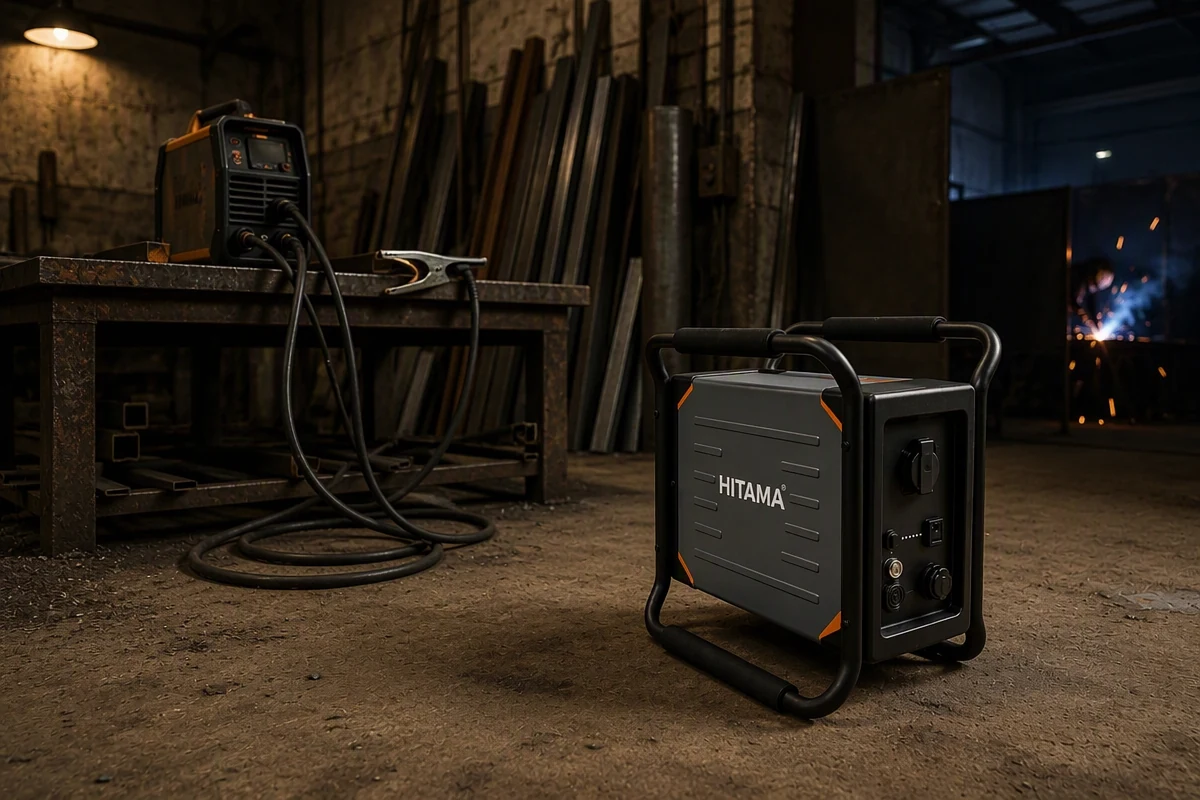
Three machines on one conductor
The complaint never arrives naming the welder. It arrives as a radio that hisses when an arc is struck, a charger that resets, or a laptop in the site cabin that drops its link twice an afternoon — and the welder is blamed because it is the loudest thing on the circuit.
What those loads share is the conductor. An inverter welder, a variable-frequency tool and a site radio can sit on the same 230 V 16 A run, and whatever returns from one of them returns through metal the others are connected to.
Coupling needs a loop, and a site builds one every day. Two leads laid side by side from the distribution point to the work face form a loop of known area; anything changing quickly in one conductor induces a voltage in the other. Nothing has to be faulty.
What the arc actually injects
The welding current is not the noise. Two hundred amps flowing steadily through a work lead produce heat and a voltage drop, and both are already in the calculation. The disturbance comes from the edges: the ignition burst, and the switching that builds the waveform.
An inverter welder switches tens of thousands of times a second. That is how a 29 kg unit reaches 5,000 W of peak output for ten seconds and still holds 2,500 W continuous. The switching is the mechanism, and its edge is a broadband emitter — small in joules, large in frequency.
A variable-frequency tool adds a second emitter. A drive that synthesises its own output draws current in pulses at its own switching rate, and two switching sources on one conductor do not add up politely.
The radio is the victim, not the cause. At the frequencies a site radio uses, interference shows up as a raised noise floor: the signal is there and it is buried. A handheld that is clear at the gate and hisses at the face is describing the wiring.
The cable run is the antenna
Thirty metres of bundled lead is an efficient antenna at these frequencies. The longer the run and the closer the conductors lie, the more switching energy leaves the welding circuit for everything sharing the route.
Bundling makes it worse, not distance alone. A signal cable taped to a welding lead for twenty metres is a coupling capacitor built by hand; a step or two of separation does more than any ferrite that survives a site.
The return path is part of the antenna. Clamped to a painted frame instead of the workpiece, the welding current returns through frame, earthing conductor and anything with lower impedance — a longer loop through more metal, coupling into more of the installation.
Why a bigger unit does not help
Sizing is about starting, not about noise. Peak output of 5,000 W for ten seconds is what lets a welder strike an arc on a 2,500 W continuous machine. It says nothing about what the arc injects, and no capacity increase removes an emitter from a circuit.
A second output separates what a filter would only mask. Welder on its own unit, radio and chargers on another: the coupling path is cut at the source. Two independent 230 V 16 A outputs cost less engineering than a week chasing a raised noise floor, and the fanless case removes a dust path, not an emitter.
What this is not
This is not an EMC approval for your site. The CE marking under the EMC Directive 2014/30/EU, with test report A2409245-C01-R01-V1 available on request, describes the unit. The installation is a separate question, and no certificate for a box covers the cables you run from it.
This is not an explosion-protected product. IP54 is an enclosure rating — dust-protected and splash-proof — and not an Ex rating. A welding bay with combustible dust is a different conversation, with a different document.
This is not a UPS. There is a gap between mains failure and output, and the unit supplies its own sockets only; it cannot be wired into a building's fixed distribution. Separation reduces coupling, and it does not abolish it.
Where the answer actually comes from
Three facts settle the layout before anyone buys anything. The run from the unit to the work face, the tools that are on at the same time, and which of them switch — those decide whether one output is enough or the welding circuit has to stand alone.
Send us the tool list and the cable lengths you actually use. We will work the same arithmetic on your numbers: which loads can share an output, where the separation belongs, and what the peak figure has to cover. Start at https://www.hitama.net/en/contact.
---