
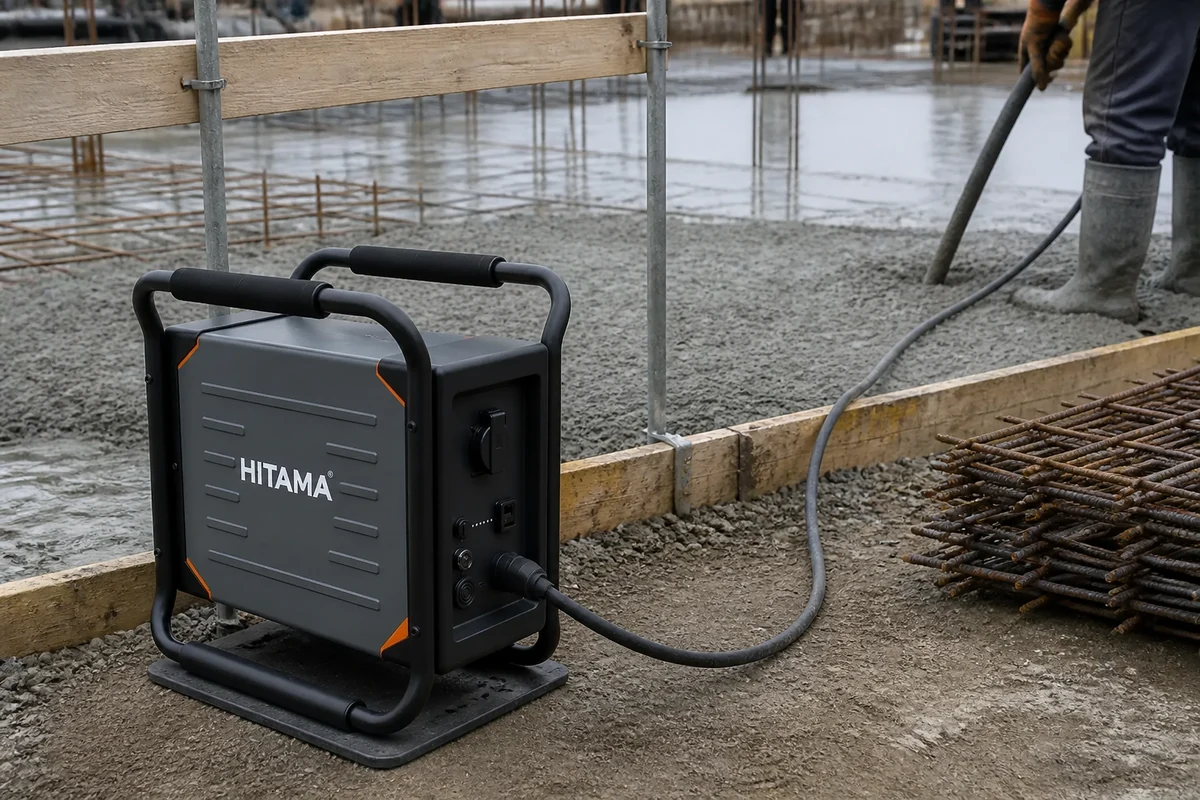
A lead is bought by the metre and chosen by the plug. What it does to the circuit is decided by its cross-section — and on a site with one 230 V outlet and a long run to the work, the cable can quietly take a tenth of the power before the tool sees anything.
A cable is a resistor that happens to be flexible. Copper resists, and the resistance grows with length and falls with cross-section: about 0.0175 ohm per metre and square millimetre at 20 °C. Every metre between the unit and the tool is therefore in the circuit, whether it appears on the tool list or not.
The lead is in the circuit whether you count it or not
Take 30 metres of 1.5 mm² at 16 amps. The loop resistance is about 0.70 ohm, the drop is 11.2 volts — 4.9 percent of 230 — and 179 watts are converted into heat along the cable. The unit delivers 2,500 W; the tool receives around 2,320 W, and the difference is lying on the floor getting warm.
Double the cross-section and the numbers halve. At 30 metres the same 16 amps through 2.5 mm² drop 6.7 volts, 2.9 percent, and 107 watts stay in the cable. Nothing else changed: same unit, same tool, same current.
The planning figure most European installations work to is five percent. Not because the tool stops at five, but because everything downstream adds to it. A 50-metre 1.5 mm² lead at 16 amps already drops 8.1 percent on its own — before a single socket strip, before the tool's own lead, before a warm conductor, whose resistance is higher than the 20 °C figure above.
Why the tool trips at thirty metres and not at five
A motor does not start on volts alone. An induction motor draws four to eight times its rated current as it comes up to speed. At reduced terminal voltage it needs longer to accelerate, and it draws that elevated current for longer. The overload window the unit protects against is measured in seconds — a longer start eats into it.
The trip is usually correct behaviour. The electronics sees a current above its rating for longer than its curve allows and shuts down. That is the protection working. The problem is upstream of the protection, in a cable that was chosen for its plug rather than its length.
The same arithmetic applies to the protective device. A long, thin lead raises the impedance of the earth-fault loop, and a loop impedance that is too high is what stops an RCD or a breaker from tripping in the time it is supposed to. A cable that is too long is not only a voltage problem; it is a protection problem.
The cheapest fix is a shorter cable
Moving the unit is cheaper than buying copper. The P25 weighs 29 kg, which one person can carry and one person can trolley. Put it two metres from the tool and the 30-metre lead stops existing — no drop to calculate, no coil on the floor, nothing to trip over.
That is the design decision, not a compromise. An industrial unit at 2,500 W continuous and 5,000 W peak in a 29 kg case, IP54 and fanless, is portable precisely so that the last thirty metres do not have to be bridged with cable. Where the work moves, the unit moves with it.
If the distance stays, the cross-section has to change. Ten metres of 1.5 mm² at 16 amps is fine; past 25 metres, 2.5 mm² is the sensible minimum, and one tool at a time. Two tools on one long lead is the case where the arithmetic stops being academic.
Where the tool is bigger, the platform scales instead of the cable. P36 is 3,600 W continuous with a 20,000 W peak at 21–23 kg; P25-D gives 5,000 W and 5.4 kWh from two units in parallel; the P25-T configuration delivers 7,500 W at 400 V three-phase for tools that will not run on 230 V at all.
What this does not solve
It is not a fixed installation. A portable unit feeds its own outlets. It cannot be wired into the building's distribution, and it is not a substitute for one.
It is not a UPS. There is a gap between the mains failing and the unit being connected, and equipment sees it.
IP54 is spray protection, not immersion. A lead lying in a puddle is still a lead in a puddle; the enclosure rating does not travel down the cable.
Parallel operation does not shorten the cable. Adding a second unit raises the power available at the distribution box. The drop between that box and the tool is unchanged, because it is a property of the copper.
What to measure before you order
Three numbers decide the configuration. The distance from where the unit can safely stand to where the tool actually works; the inrush of the largest tool on that run; and whether anything on the site needs 400 V.
Send those three, plus the tool list. We will work out the cross-section, the run and the configuration that keeps the tool starting — and tell you where the limit is.