
A hire unit rarely fails at the tool. It fails at the second person who touches it — the one who was told about the machine instead of reading it. Four languages on site are not the problem. The problem is that a spoken handover keeps the larger number and files off the condition attached to it.
The handover happens twice
The first handover is written, the second one is not. At the counter the unit leaves with a note and a signature: rated output, weight, what is in the case. On site the same machine changes hands again at the shift change, in one sentence in a corridor.
What survives the corridor is not the datasheet. A foreman who has run the unit for six hours describes it in three words, and those three words become the specification the next crew works from. Nothing about the hardware changed; the text did.
The number that survives is always the bigger one
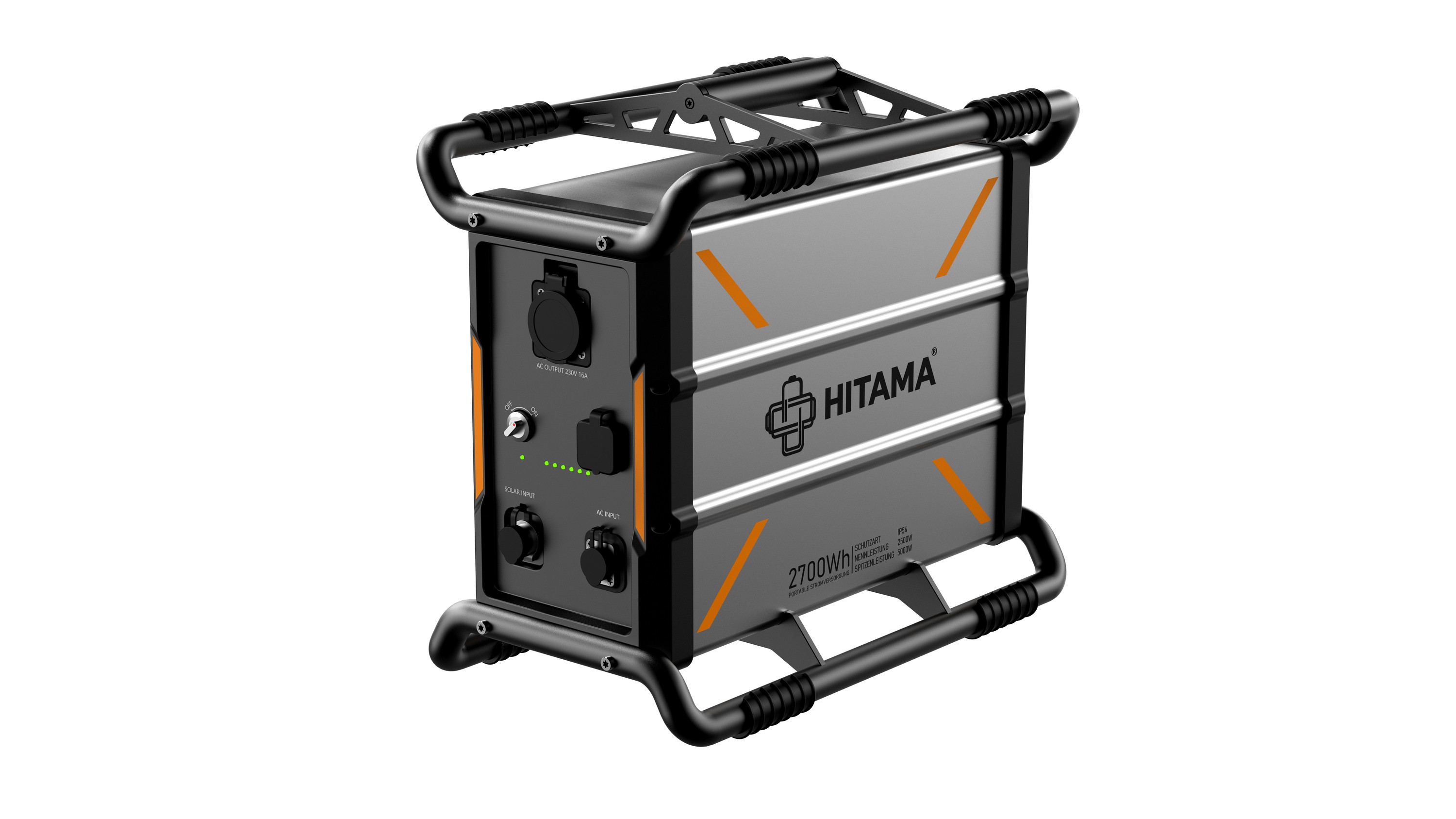
The P25 is rated 2,500 W continuous with a 5,000 W peak for up to 10 s. Both figures are on the housing, as NENNLEISTUNG 2500W and SPITZENLEISTUNG 5000W. In a spoken handover the second one travels and the ten seconds do not: the unit becomes "a five-kilowatt machine".
The bracket is the whole specification. Ten seconds covers a motor start, a welder striking an arc, a compressor kicking in. It does not cover an afternoon of 3,000 W, and the machine does not announce the difference at the moment it matters — it stops, with the tool in the cut.
A lost condition is not a lost fact. The crew that inherits "5 kW" is not careless; it was handed a number with the duration filed off. Verbal handovers degrade towards the rounder, larger figure, fastest where the crew works in a second language.
The words on the machine are in one language
This housing is printed in German: 2700Wh, NENNLEISTUNG 2500W, SPITZENLEISTUNG 5000W, IP54. A crew that reads no German still reads 2500 W and 16 A. Numbers cross a language boundary in a way that a word like Nennleistung does not.
So the marking has to be language-free and the paper has to be translated. A unit described only in the depot's language depends on one bilingual person being on shift. That is a staffing plan, not a handover — ratings and positions travel, adjectives such as "the big one" do not.
What the hand-back page has to carry
Three lines do more than a briefing. The next crew needs the state of charge, what ran and for how long, and where the unit is plugged in — the last one because the recharge draws 500–1,500 W and that socket belongs to another plan too.
The recharge is a time budget and belongs on the page. A P25 reaches 80 percent in about two hours from a 230 V socket and is full in 2.5 hours. A crew inheriting 40 percent at 18:00 has inherited a schedule problem, not a machine problem — and the page has to be in the language of the crew receiving it, on one sheet that travels with the unit.
What this is not
This is not a claim that a label replaces a briefing. The site's electrical instruction, the competent person and the permit still decide who connects what. What we document is narrower: 2,500 W continuous, a 5,000 W peak for up to 10 s, 230 V 16 A single phase, two or three units in parallel where the job needs more.
Nothing here turns a continuous rating into a peak, and IP54 is not a seal. A 2,500 W unit asked for 5,000 W all afternoon is not a bigger machine, it is an overheated one. IP54 is dust-protected and splash-proof as a housing property within −10 to 65 °C; the unit supplies its own sockets, is not a UPS, and does not feed a fixed installation.
If you hand units to crews that do not share a language with your depot, send us the tool list, the shift pattern and the languages actually spoken on site: https://www.hitama.net/en/contact