
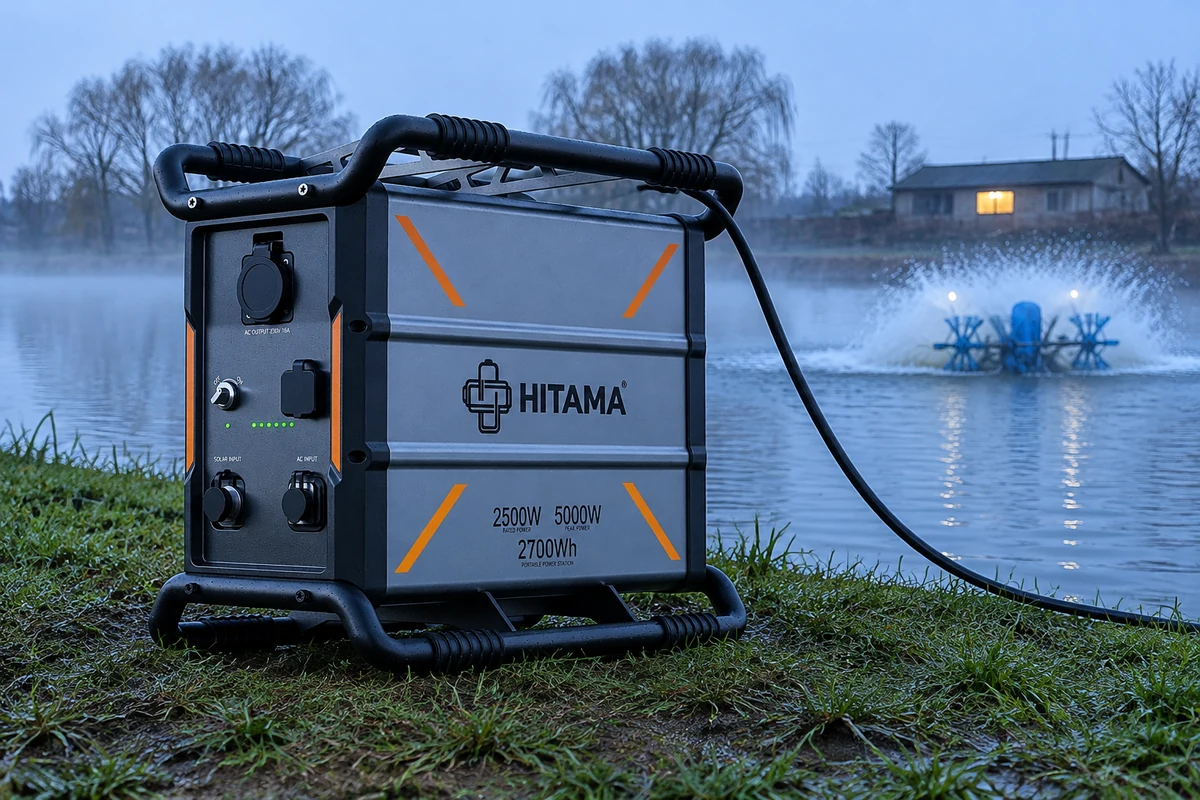
An aerator does not fail when the supply fails. It fails when the water has been still for hours and the sun is about to come up.
The deadline is dawn, not the switch
Dissolved oxygen is lowest in the hour before sunrise. The pond has consumed oxygen all night and nothing on it has produced any since dusk. That trough arrives whether or not anyone is on the bank.
An interruption at noon is an inconvenience; at four in the morning it is a kill. Nobody hears a contactor drop out from the house across the field, and by the time the water is checked the damage is done. So the question is not how many watts the aerator draws, but how many dark hours this bank can be trusted to run.
The unit of the calculation is hours
A pond aerator is a small motor running a very long time. One float, one motor, one switch, and a load that barely moves between start and stop. There is no peak to chase and no duty cycle to average.
The design case is the shortest day, not the average one. A bank sized against a mild week in September ends up a module short in the week that matters, because the same cold and cloud that shortened the daylight also stretched the run. Two ponds are then twice the count, not twice the size.
An engine on the bank is a different problem
Combustion at the water's edge brings three things nobody budgeted for. An intake that pulls spray and insects, a noise that carries flat across open water towards the nearest house, and a fuel can carried down the same track in the dark.
Sealed, no intake, no exhaust, no fan, no moving parts. The P25 sheds heat through its casing, so it stands on firm grass between the ponds and the only thing crossing the bank is the cable to the float. A bank is graded, wet and often fenced, so a unit that needs no air path can stand above the splash line rather than where a trailer could reach.
Spray, frost and the 400 V question
IP54 covers spray drift — not a floating platform and not a jet wash — and the working window is −10 to 65 °C. Above the splash line, off the mud, out of the arc of a hose; and the coldest weeks are the longest nights, when the run is longest and the recharge slowest.
If the aeration blower sits on a 400 V three-phase circuit, the first question is phases, not power. The P25-T delivers 7,500 W rated and 15,000 W peak on 400 V three-phase from 8.1 kWh, as three modules in parallel. That is settled at the cabinet, before anything is carried to the bank.
The charge window is daylight you were spending elsewhere
From a 230 V socket the P25 accepts 500–1,500 W and reaches 80 % in about two hours, full in about two and a half. On a farm that socket is usually in the workshop, so the unit spends part of the day away from the pond.
Which is why the count is rarely one. Two modules in parallel at 230 V single phase buy a rotation: one runs the floats, one charges, and the handover goes into the morning round instead of into memory — because the night it is forgotten is the still, warm, overcast one.
What this is not
It is not the pond's fixed installation. It cannot be wired into a farm distribution board, it does not replace a properly sized permanent supply, and it is not a substitute for the alarm or backup blower a stocked pond ought to have.
It is not a UPS. A clean sine at THD below 3 % describes the waveform, not how fast the unit takes over from a failed supply. Where the blower cannot tolerate a gap at all, that is a different device.
It is not certified for the water. CE under the EMC Directive 2014/30/EU and UN 3480 class 9 packaging for transport say nothing about immersion or explosive atmospheres, and neither does the ten-point test every unit leaves the factory through.
Send us the pond list — number of ponds, nameplate per aerator motor, the phase of the aeration circuit and the hours of darkness in your worst month. We will size the modules and the rotation against your darkest night.