
The day is spent before the first tool runs
A shift rarely fails at noon. It is emptied at seven, in the five minutes when nobody is counting. By the time the first tool goes on, the day already has an energy budget, and that budget was set overnight by whatever kept running. The check worth doing takes five minutes and asks about the day, not about the machine.
What the display shows at hand-over is a statement about last night. A P25 holds 2.7 kWh: the whole working day for a small crew, a fraction of a morning for a crew that adds a pump at ten. Whether you plan on 2.7 kWh or on what is actually left is settled before anyone has drawn a watt.
A unit that worked all night is not a full unit
The load that empties a shift is usually the one nobody switched on. Frost protection, a dehumidifier, a pump on a float switch and a charger left in a site hut all run without an operator and without appearing on any tool list. They spend the first hours of the budget while the crew is still in the site office.
Charging is an input, not a promise. A P25 reaches 80 percent in about two hours and full in roughly two and a half, but only when 500 to 1,500 W sit behind the charging input. On a 230 V 16 A site circuit shared with a heater, the same unit spends the whole evening doing it, and the next shift starts on the number nobody checked.
One load has no duty cycle
Two questions hide inside every load, and most crews answer the wrong one first. The surge decides which class of machine can start the tool at all: 5,000 W for up to ten seconds on a P25, against 2,500 W continuously. The duty cycle decides how many hours the machine carries, and it is the only one of the two that changes between seven and noon.
A thermostat is not a load, it is a percentage. A heater, a compressor or a pump on a float switch runs for part of the shift, and that part is unknown until somebody writes it down. The load with no duty cycle — lighting, a fan, an instrument that must stay live — sets the hours, because the peak is answered once and the continuous draw is answered every minute.
The second wave arrives without asking
Nobody adds load at seven o'clock. Loads arrive later, with the second crew, the second task and the tool that only comes out once the first one is finished. The number taken in the morning is usually the tool list from the office rather than the site.
A question about the afternoon, asked at the start, is arithmetic rather than planning. If the pump joins at ten, the remaining hours no longer divide across the loads present at seven. Asking who will plug in what, and when, costs one sentence and changes the configuration more often than a larger machine does.
Five answers that change the configuration
State of charge at arrival, and the hour it was last full. A percentage without a charging history says nothing about the shift that follows it. Which loads ran since the last person left. Anything on a thermostat or a float switch has already spent part of the budget before the shift begins. Which load cannot be interrupted. Continuity is a requirement rather than a wattage, and it decides whether one unit is enough or two are needed.
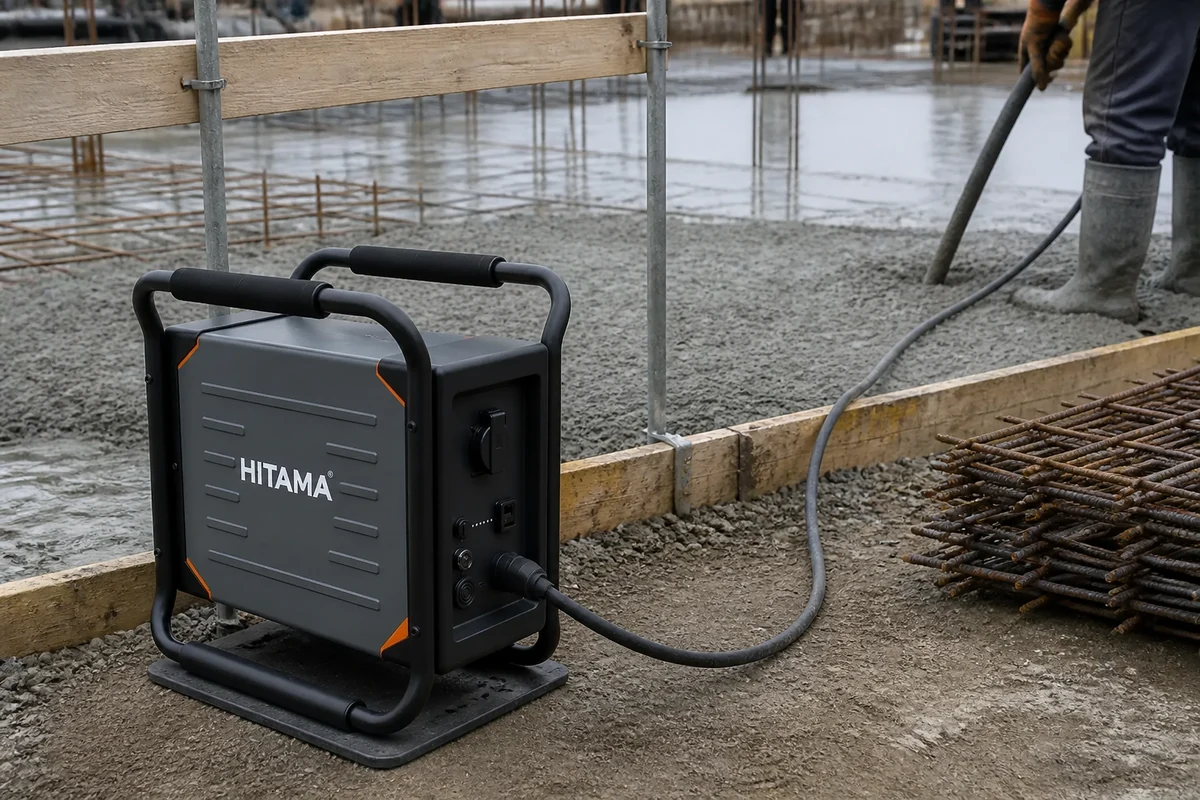
What will be plugged in later, and where the unit stands tonight. The second wave is the most common reason a correctly sized unit empties early, and the 29 kg case plus the site's 230 V 16 A circuit are the two physical facts behind tomorrow morning's budget.
None of these adds a kilowatt-hour. They only move the discovery from half past eleven at the work face to five past seven at the van, which is the one place where the answer can still be changed cheaply.
What this is not
This is not a machine inspection. The check described here does not test the unit; it tests the day. Insulation, earthing and the protective device belong to a different routine and to a different person.
It is not a substitute for a load profile either. A profile that can be defended comes from measurement across a shift, not from a form, and five questions at the start only tell you whether that profile is still reachable. A P25 is not a UPS, it does not feed the building's fixed distribution, and IP54 is a splash rating rather than a seal.
What it buys is time, not capacity. If your crew starts on a number that was created overnight, send us the tool list, the second wave and the charging window, and we will work out together what the shift actually needs: https://www.hitama.net/en/contact