
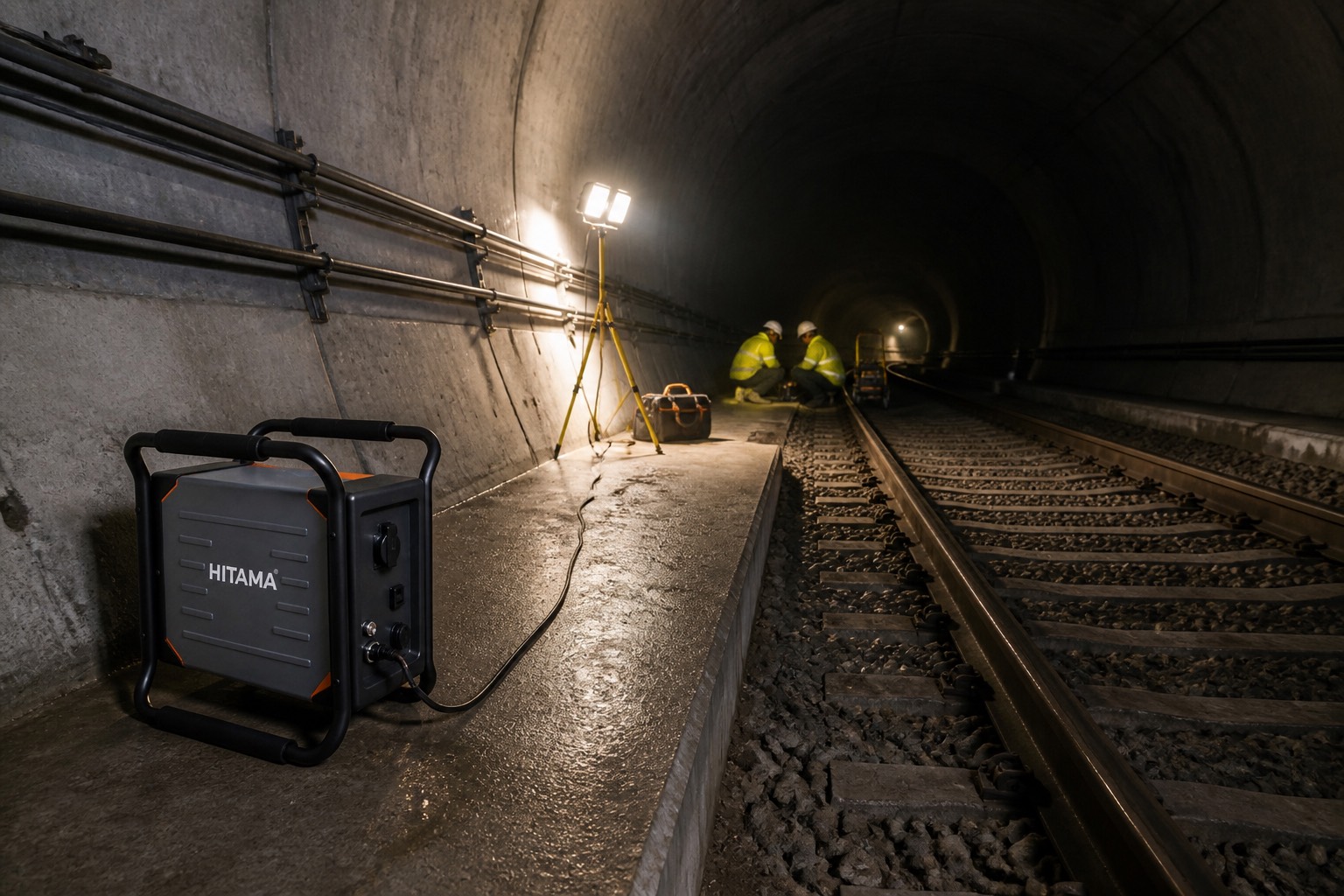
A possession window is fixed, and it is short. What eats into it is rarely the work itself: it is bringing a generator in, fuelling it, and dragging cables down a tunnel.
The loads in a tunnel
Lighting. The load that makes the shift possible, and the one with the longest run time.
Track and fastening tools. Impact wrenches and rail saws: short, heavy bursts, decided by starting surge rather than by running draw.
Ventilation and cable work. Where a fan is required, it runs for as long as people are in the section.
Why a battery instead of a generator
A tunnel multiplies sound. A unit with no engine lets the team talk without shouting and hear a warning. There is no exhaust in a place that is already hard to ventilate, and nothing to refuel at three in the morning on a site with no road access.
Sizing
One P25 is 2,500 W and 2.7 kWh; two in parallel (P25-D) give 5,000 W and 5.4 kWh; three with the P25-T distribution box give 7,500 W at 400 V and 8.1 kWh. Add the continuous loads, check the largest tool's starting surge, then compare against the length of the possession — the window, not the shift, is the number that matters.
The limit
Capacity is finite, and a unit is not tunnel infrastructure: it powers the work, not the signalling or the fixed lighting. IP54 means dust and water spray, not immersion. Everything is carried by hand — the operating manual forbids stacking and forbids lifting gear.