
A power unit rarely dies of capacity on site. It dies of inrush: the rebar cut-off saw pulls almost twice its rated power in the first instant, the welder pulls more at arc strike, and eventually the BMS shuts down — or worse, a MOSFET fails. That is exactly the moment we provoked for two weeks.
What was tested
Unit P25, 2.4 kWh (48 V / 50 Ah), serial P25-TEST-001, in factory-standard configuration with no DC contactor fitted — without the part many manufacturers place between the cells and the inverter to absorb current peaks. Two weeks — the record names a construction site as the test location — four documented load cases.
- Day 2 – rebar cut-off saw. 2,200 W rated, 4,250 W inrush peak, lowest voltage at start 46.2 V. Started normally, no protection tripped, BMS normal.
- Day 4 – small welder. 2,200 W rated, 4,680 W inrush peak, 44.8 V. Arc-strike surge at start, ran normally afterwards, no burnout.
- Day 7 – industrial vacuum. 1,800 W rated, 3,600 W inrush peak, 47.5 V. Continuous operation, stable.
- Day 10 – rebar cut-off saw plus lighting. 2,200 W + 500 W, 4,500 W inrush peak, 45.1 V. Mixed load, ran normally.
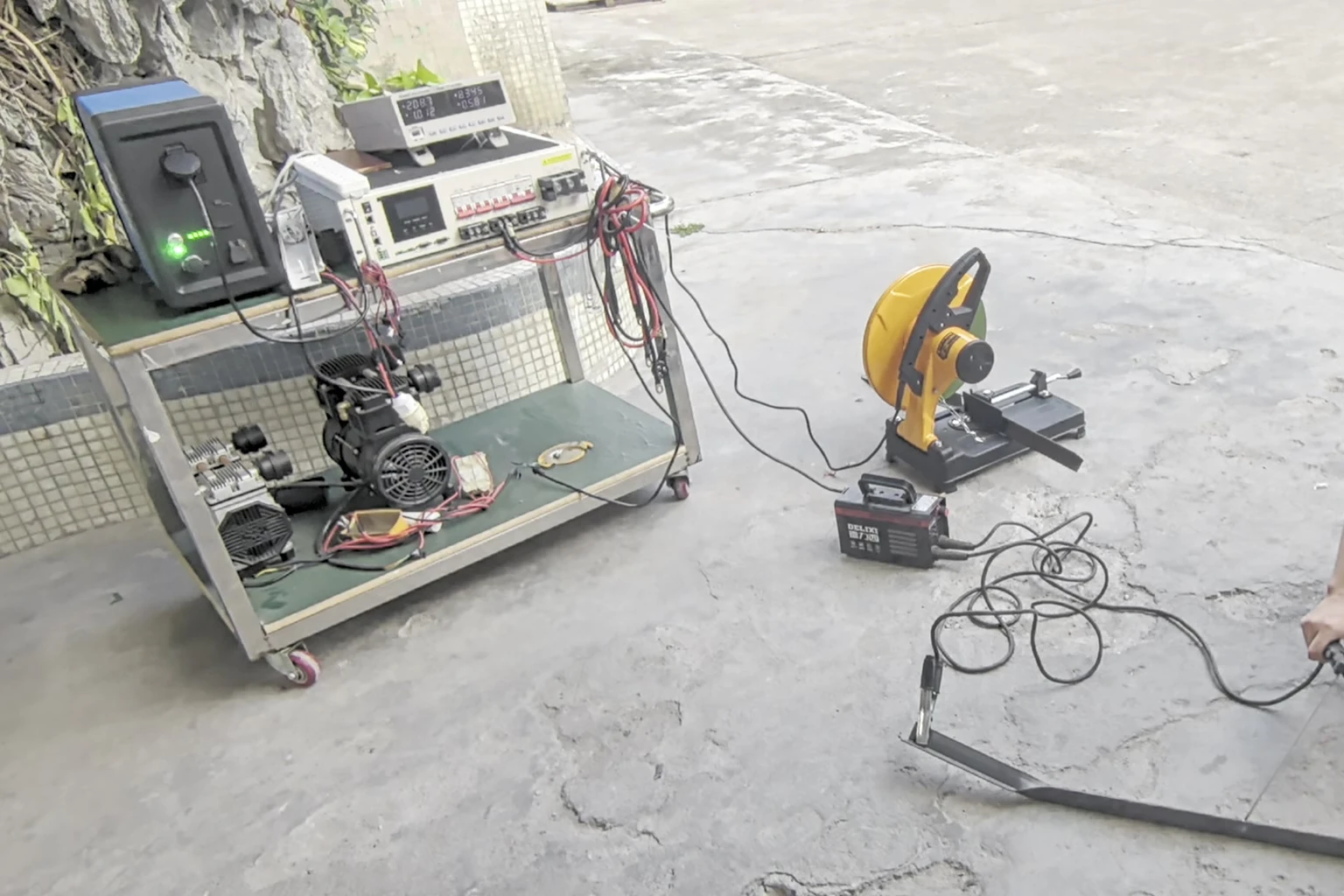
The bench in the yard: an AC source with metering, a load bank of motors and heating elements, the unit in between with its output live — and the cut-off saw as the actual load. The clip below is a segment of exactly this setup, not a reconstruction.
Inrush is the real test
Rated power is a number on paper. What matters is what happens in the first 200 milliseconds when the motor starts: voltage sags, current spikes, and the BMS has to decide whether that is a short circuit. Get that decision wrong and the site stops — and the rental company gets a complaint.
The critical figure is in those measurement lines: 44.8 V on the welder. That is the deepest sag in the whole test, at a 4,680 W peak — nearly double the rated power. A BMS set too sensitively would have tripped right there. It did not.
Two full cycles, temperatures in range
A unit that survives inrush but throttles in the heat is of no use. So it was discharged and charged completely twice — not on a bench supply, but on site.
- Cycle 1, 05 Nov 2026. 58 minutes from 100 to 5 percent, 2.26 kWh delivered, highest temperature at full load 41.5 °C, charge time on mains 2 hours 15 minutes.
- Cycle 2, 16 Nov 2026. 61 minutes from 100 to 5 percent, 2.35 kWh delivered, highest temperature 42.8 °C, charge time 2 hours 10 minutes.
Temperature stayed below 43 °C and no derating was triggered. What matters for a rental fleet: the second cycle came two weeks after the first and delivered more energy — 2.35 instead of 2.26 kWh. No cell degradation from the inrush events is measurable in that window.
No contactor means one wear part less
Contactors wear out. Every switching operation draws an arc that erodes the contacts; eventually the contactor sticks or fails to open. A design that omits it has to handle inrush another way — through the BMS and the dimensioning of the power stage — and gains a part that cannot fail.
The counter-check belongs to the job: fully charged, switched off, standing for seven days, the voltage fell from 54.6 V to 54.1 V — 0.5 V in seven days. Unwanted leakage through the absent contactor can therefore be ruled out.
What this means for procurement
1. Ask about inrush, not rated power. A unit rated 2,400 W that does not shut down at 4,680 W is worth twice as much on site as one that only looks good on a datasheet.
2. Ask about the configuration. Whether a DC contactor is fitted is not a detail: it decides one possible failure mode and one wear part in service.
3. Ask for the record. A number without measurement conditions is a claim. This record names load, inrush peak, voltage sag, cycle data and temperature for every test day.
About this record
The figures come from our own field verification record (unit P25-TEST-001, two weeks, a real construction site). It is not a report from an independent test institute, and we do not sell it as one. What it does show, it shows completely: more than 50 inrush events with peaks up to 4,680 W, no failure, no burnout, no MOSFET short circuit.
Anyone who wants the raw data before ordering gets it on request — with the same measurements shown here.