
The situation
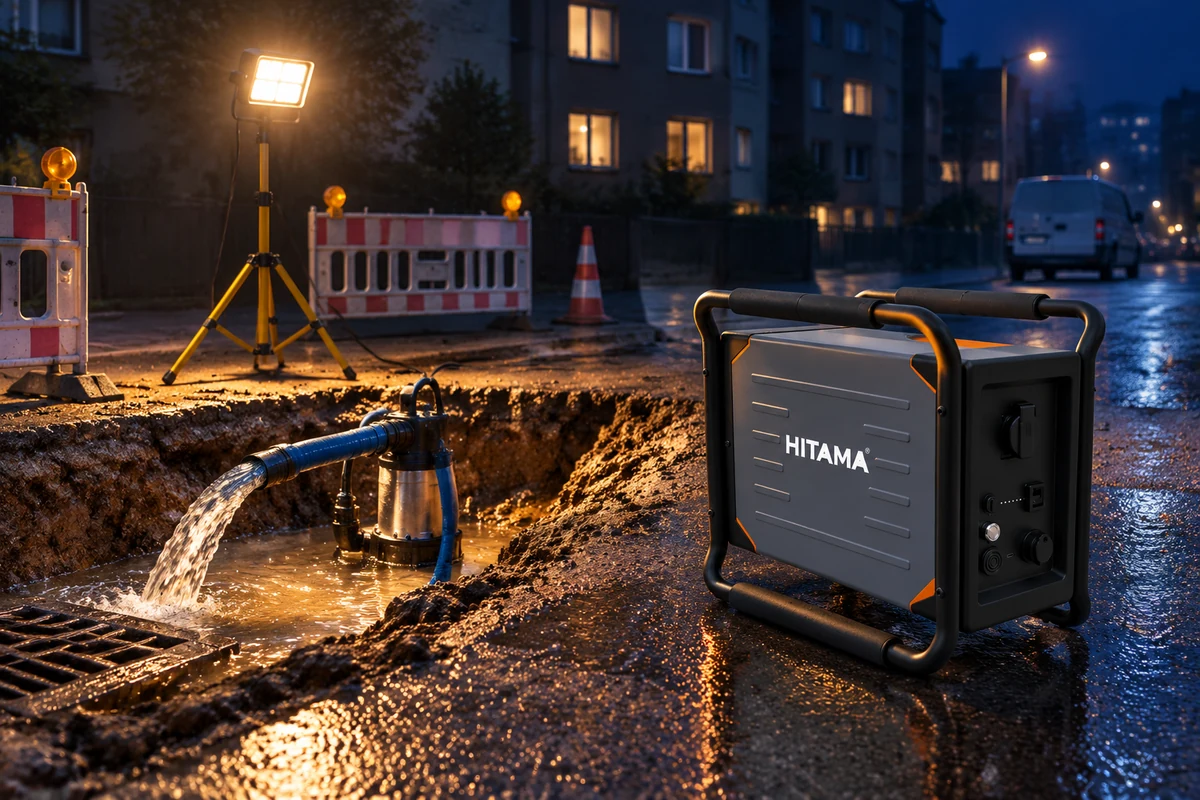
A street opening in a residential road. The trench is open, the shift runs into the night, and there is water on the bottom. Not much. But enough that by morning the bearing layers are soft and the pipe bedding has to be redone.
Anyone who knows this situation knows: the problem is not output. The problem is that the pump has to keep running when nobody is left on site.
Why the generator goes first
A combustion unit is the wrong neighbour for exactly this job. Three reasons, all practical, none technical:
- It is loud, and it is night. On a residential street with windows open, that is not a comfort issue, it is a phone call from the site manager.
- It needs an exhaust path. In the trench there is none. Beside the trench there is one only if the wind cooperates.
- It needs refuelling. A machine that runs eight hours unattended is a machine that needs someone to check on it after eight hours.
A battery has none of these three problems. It has a different one, and that is the actual point of this text: it holds a finite amount of energy, and nobody notices until it is gone.
What actually goes wrong
Not the pump. Three other things.
1. Suction head. A pump standing in the water does not lift from arbitrary depth. How deep it actually reaches depends on the pump type and the hose — and on almost all small site pumps that figure is lower than the one in your head during the site survey. Check the suction head or you will set the pump too high and wonder why it runs dry.
2. The discharge point. The water has to go somewhere. You cannot simply discharge into the sewer; discharged onto the road it runs back into the trench. This question decides pump size more than any curve, and it is usually settled last.
3. The route of the current. The pump is at the bottom, the supply is at the top. Between them: cable, a connection in the wet, and a kerb nobody should trip over. That is not an electrical question, it is a routing question — and it decides whether the pump is still running at two in the morning.
The checklist before you say yes
1. Where does the pump stand, and how deep does it really suck? Look it up, do not estimate.
2. Where may the water go? Settle discharge point and permission before the trench is open.
3. Who checks the unit? A battery running eight hours needs a person to look in after six. That person must be named, not assumed.
4. What else is on the supply? Work light, barrier lighting, charger for the survey gear. Every one of these is added to the pump, and none of them is in the quote.
5. What happens when the energy runs out? Not whether, but when. And what is standing in the trench at that point.
What we do not say about it
We have no measurement for this scenario. So we publish no runtime — no hours, no "up to". What we can state is the one figure that is in the datasheet: 2.7 kWh usable capacity on the P25.
What that becomes is your arithmetic, and it goes like this: usable capacity divided by the pump's input power. The input power is on the pump's nameplate, not in our brochure. Do that division and you get a number that applies to your pump — not to one we invented.
*All device figures from the datasheet. Runtimes depend on load and ambient conditions; no in-house measurement exists for this scenario. This checklist does not replace a risk assessment.*
The line that stays
Anyone who wants to keep a pit dry does not plan the pump. They plan the discharge and the way there.
Read next: Powerstation on site