
Walk through a city in autumn and you hear the problem before you see it. The Husqvarna 570BTS, a professional petrol blower, is quoted at 103 dB(A) at the operator's ear; the battery unit in the same class, the 570iBT, at 83 dB(A). At 15 metres the figures are 76 against 64 dB(A). That gap is not a matter of taste; it is the reason the regulation exists at all.
In Zurich the electorate voted to ban petrol-powered leaf blowers and to sharply restrict the hours in which electric units may be used. The stated grounds are noise, the environment and protection of small creatures — not the output of the machines. Manufacturers saw it coming: Stihl states that battery tools already account for well over 60 percent of the units it sells in the German market, and lists the BR 800 as the last petrol professional blower it introduced, in 2019.
For a depot or landscaping crew this does not change the result of the work, only the shape of the day. A petrol tool gets refuelled; a battery tool gets recharged. A team that used to carry three canisters in the van now needs charging infrastructure — and that infrastructure is not where the work happens, it is where the vehicles stand in the evening.
This is where conversions come apart. The tools get bought, the charging point gets planned up to the first week in which three vehicles come back at once. In a depot with one double socket, the socket is the bottleneck, not the blower. A crew that needs two sets of packs in the morning and wants a third charged overnight is calculating kilowatt-hours per shift, not machines.
Two numbers are enough for that calculation, and both are on the datasheet: the input power of the chargers, and the energy actually consumed across a shift. Everything between them is organisation — which tool comes back when, who swaps the packs, where the cables lie without becoming a trip hazard.
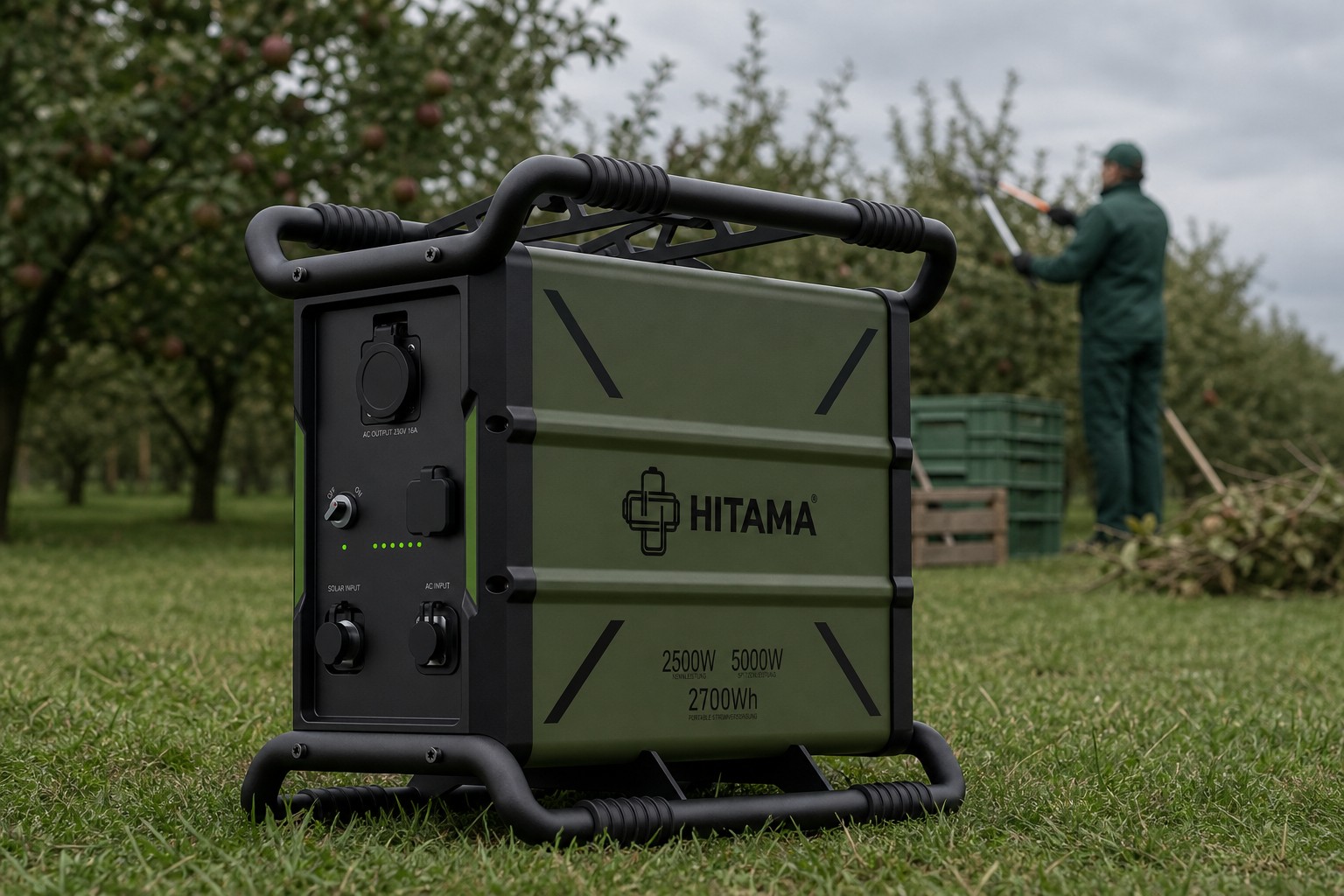
That is what the P25 is for: 2.7 kWh, 2,500 W continuous, 5,000 W peak, up to three units linkable. It does not replace planning the mains connection. It keeps charging running when the depot has no free circuit left, or when the site has no connection at all — the edge of town, the cemetery, the embankment along the county road.
Read the switch as a tool purchase and you buy twice. Read it as a load case and you buy once.
Sources: bau.bi, "Nach Züricher Verbot: So rüsten sich Laubbläser-Hersteller für die Zukunft" (2 April 2026, updated 15 July 2026) – https://bau.bi/galabau/maschinen/nach-zuericher-verbot-so-ruesten-sich-laubblaeser-hersteller-fuer-die-zukunft-g21459 ; P25 product data: https://www.hitama.net/en/p25