
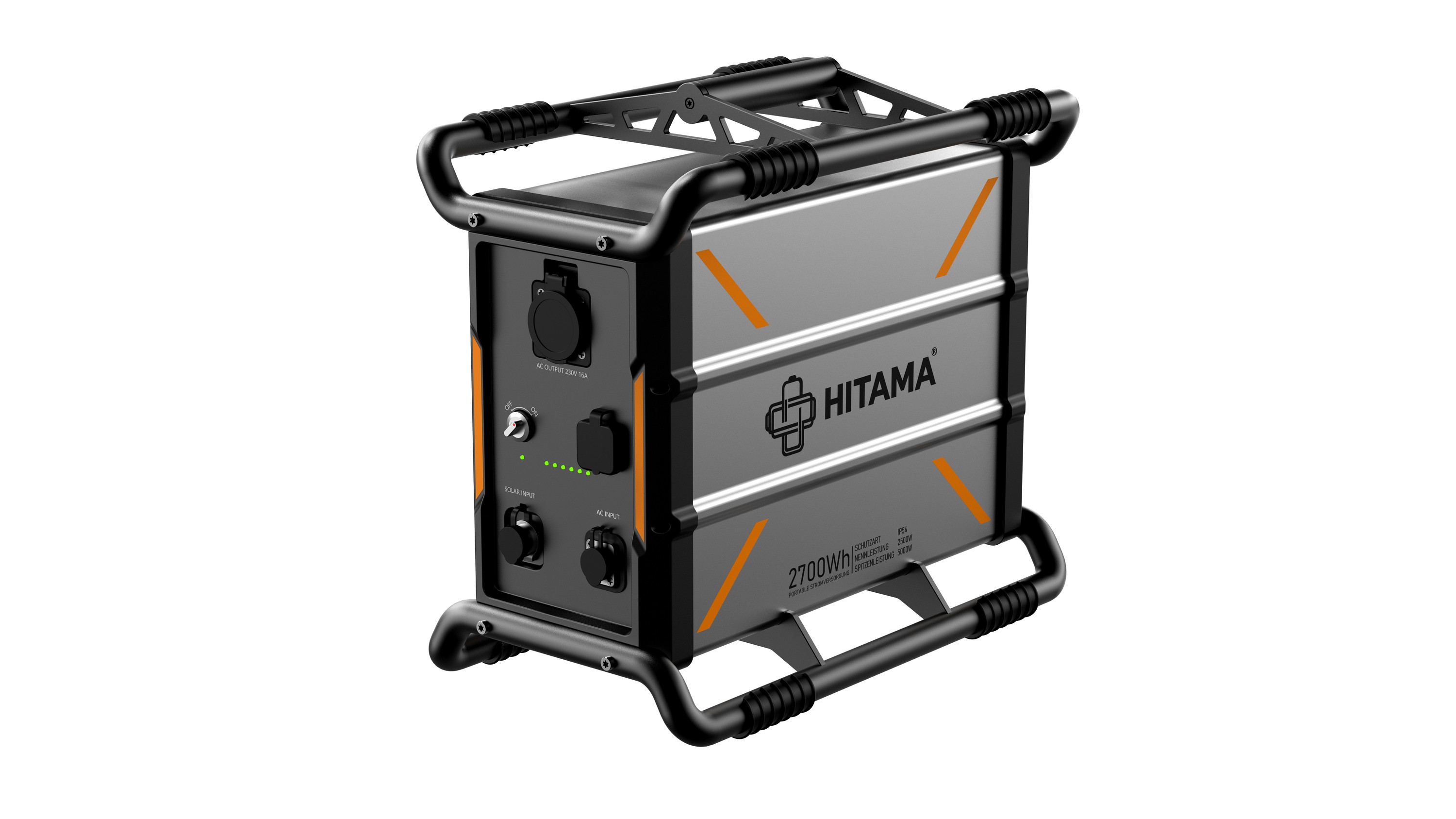
A used power station is not a worn machine; it is a machine whose file ended at the first resale. Two P25 units leave the same line, work the same three years and end up in the same yard. One sells for the price of a battery, the other for the price of a battery and a folder, and the calendar explains none of that difference.
The test everyone runs proves the least
A half-hour discharge at one kilowatt is the standard handover ritual and answers the easiest question in the room. On a 2.7 kWh pack that draws about a third of the stored energy, where a healthy and a tired unit behave identically: the inverter wakes up, the sockets are live, and nothing is proven about the second a 5,000 W load asks for current.
The protocol that qualified the unit tested harder, and two of its steps are the ones a buyer actually cares about. The factory sequence ran 1–1.5 kW as a basic function check, 2.7–3.0 kW for sixty seconds, above 5 kW for ten seconds as an immediate overload, 2 kW continuously for two hours, and tripped at 80 °C. None of it is reproducible on a pallet with a fan heater, so what a used unit lacks is resolution, not capacity: a pack still holding 2.6 of its 2.7 kWh can refuse the one job it was bought for, because an aged cell group declares itself under load and not under time.
What survives three years, and what disappears in an afternoon
Capacity fades slowly; the evidence of how it faded disappears in a single afternoon. A CE declaration under EMC directive 2014/30/EU with its test report number, the UN 38.3 summary and MSDS that make a Class 9 UN 3480 shipment legal, the serial-matched record from the line — those travel with the unit or never existed. The cells do not lose their history, the folder does, and missing papers mean an unpriced machine rather than a bad one.
Four checks that fit into ten minutes
Start with the serial number, not the terminals, then read the seal. The number on the case is the only key to the test record, and the firmware version belongs in the same question, because a unit that cannot be paired is worth less to a fleet. IP54 covers dust and splashing water through a closed case and an intact gasket; a housing opened for repair leaves a path no test shows you, and a fanless design gives you no filter to read as a history.
Then a real load, and then the charger. Ten minutes at 2,000 W plus one start of the heaviest tool on site separates a unit from its datasheet faster than any capacity figure, and the recovery tells you more than the first second: a tired pack sags and returns slowly. Charge acceptance finishes it: the input is rated 500–1,500 W, a healthy P25 reaches 80 percent in about two hours and full charge in two and a half, and a unit that takes a few hundred watts at half charge says where the money went.
Two identical units, two prices
The gap between two three-year-old units is set before either one is switched on. One ran a season in parallel, carries current firmware and comes with a record; the other was bought for a single job, stored at whatever charge, sold with a charger. Their cells may be equally healthy and their resale value is not: a documented unit enters a rental counter as a known quantity, an undocumented one is costed as risk, and risk is paid by whoever is least willing to carry it.
What this is not
This is not an accusation against private sellers, and not a claim that used equipment is unsafe. A fanless enclosure has no intake, no filter and no rotating part, so it carries fewer wear items into year four than a diesel generator into year two.
It is also not a state-of-health certificate, and it does not change what the device is. Ten minutes in a yard yields evidence, not a number an insurer will accept; that needs a documented load test, and even then it belongs to that day and its temperature. A used unit is still not a UPS, still feeds its own sockets and never a fixed distribution, still operates between −10 and 65 °C, and the discount does not improve the rating.
Send us the serial and the folder
Send the serial number, whatever paperwork came with it and the tool list you intend to run. With those three we can say which of the four checks decides your case, and whether the unit is a battery or a system. Write to https://www.hitama.net/en/contact.