
The comparison that is not one
One quote states 2.7 kWh. Another states a 5-litre tank. Both numbers stand for energy — and that is exactly why they get put side by side, even though they measure two different things. One is an amount of energy. The other is a container volume, whose energy content only comes into being through consumption.
What is already settled in the kilowatt-hour
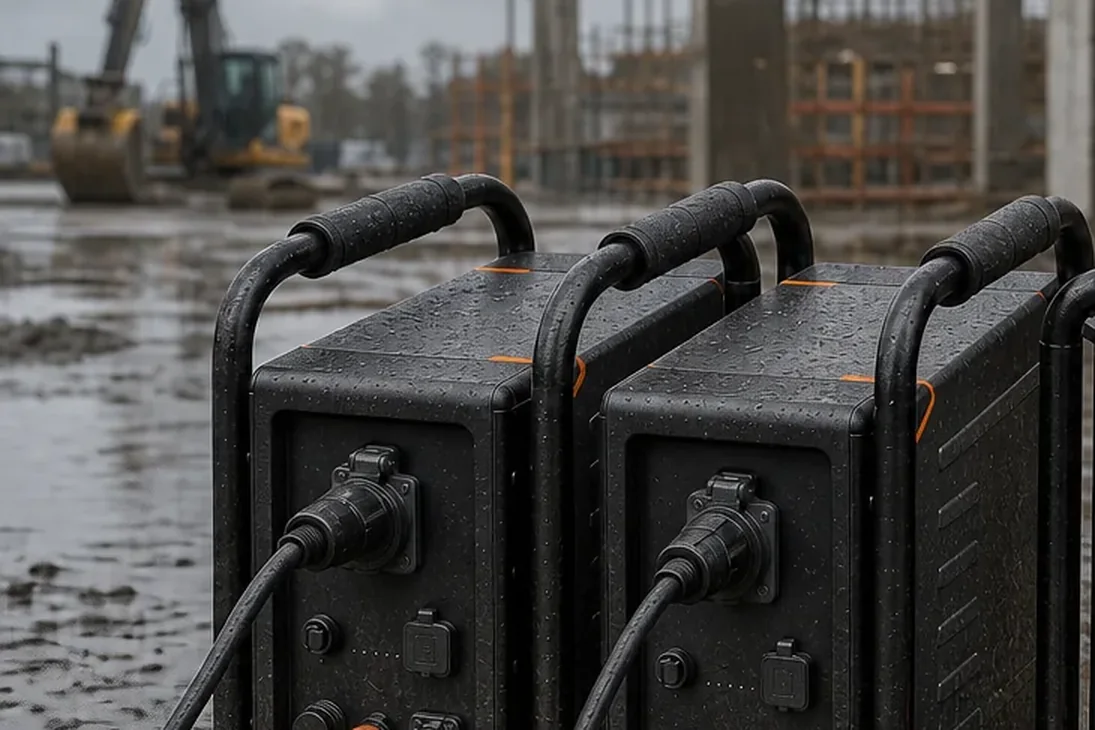
On our units the usable capacity is a fixed figure: 2.7 kWh per P25. It does not change with the weather, with the age of the cell, or with how full the tank was in the morning. Two units give 5.4 kWh, three give 8.1 kWh. Capacity adds in steps, because every unit keeps its own cell and its own protective device.
What is not yet settled in the litre
A litre of diesel contains energy. How much of it arrives as electricity at the socket depends on the efficiency of the genset — and on the load. A combustion genset burns fuel at idle too. Consumption per kilowatt-hour generated is therefore not constant: it depends on what fraction of its rated output the genset is running at.
This is why "consumption in l/h" without a load factor is not a number you can calculate with. It is a number with a missing condition.
The only common denominator: hours at your load
To compare the two sides, both have to be brought into the same unit — hours, at the load that actually runs. On the battery side that is a division anyone can check:
| Load | 1 × P25 (2.7 kWh) | 2 × P25 (5.4 kWh) | 3 × P25 (8.1 kWh) |
|---|---|---|---|
| 0.5 kW | 5.4 h | 10.8 h | 16.2 h |
| 1.0 kW | 2.7 h | 5.4 h | 8.1 h |
| 2.5 kW | 1.08 h | 2.16 h | 3.24 h |
The third row is the uncomfortable one: at rated output a single unit lasts a good hour, not a working day. Anyone drawing 2.5 kW at once needs three units for a shift — or a smaller load profile.
What this table does not contain
These figures are an upper bound, not a promise. Not included are conversion losses in the inverter, the temperature behaviour of the cells, and how deeply the capacity is actually discharged. In practice runtime sits below the table — how far below depends on the load profile and the ambient temperature.
For tools with inrush current there is one more point: the unit absorbs 5,000 W briefly, for up to ten seconds. A compressor or a circular saw starting up is covered by that — continuously it is not.
The third line missing from the quote
Besides kWh and litres there is a third item that appears in hardly any comparison: the way to the energy.
A genset needs a trip to refuel — with a vehicle, a person and time, in the middle of a shift. A battery unit needs a socket, and the socket is either there or it is not. Both are effort, but not the same effort: one costs journeys, the other costs a decision about where to stand.
Which is why the second question at the hire counter is not "how much capacity" but "where is there a 230 V socket in the evening".
The arithmetic at the counter
Two figures are enough to fix a configuration: which load in kW runs, and for how many hours per shift. The step-up follows — one unit, two with the P25-D, three with the P25-D, or three with the P25-T when the tools require 400 V three-phase and are not single units.
If the load is unknown, it can be measured: read it off the distribution board or the tool list for a week. That is more accurate than any rule of thumb.
Which number stands in your quote — kilowatt-hours, litres, or hours?