
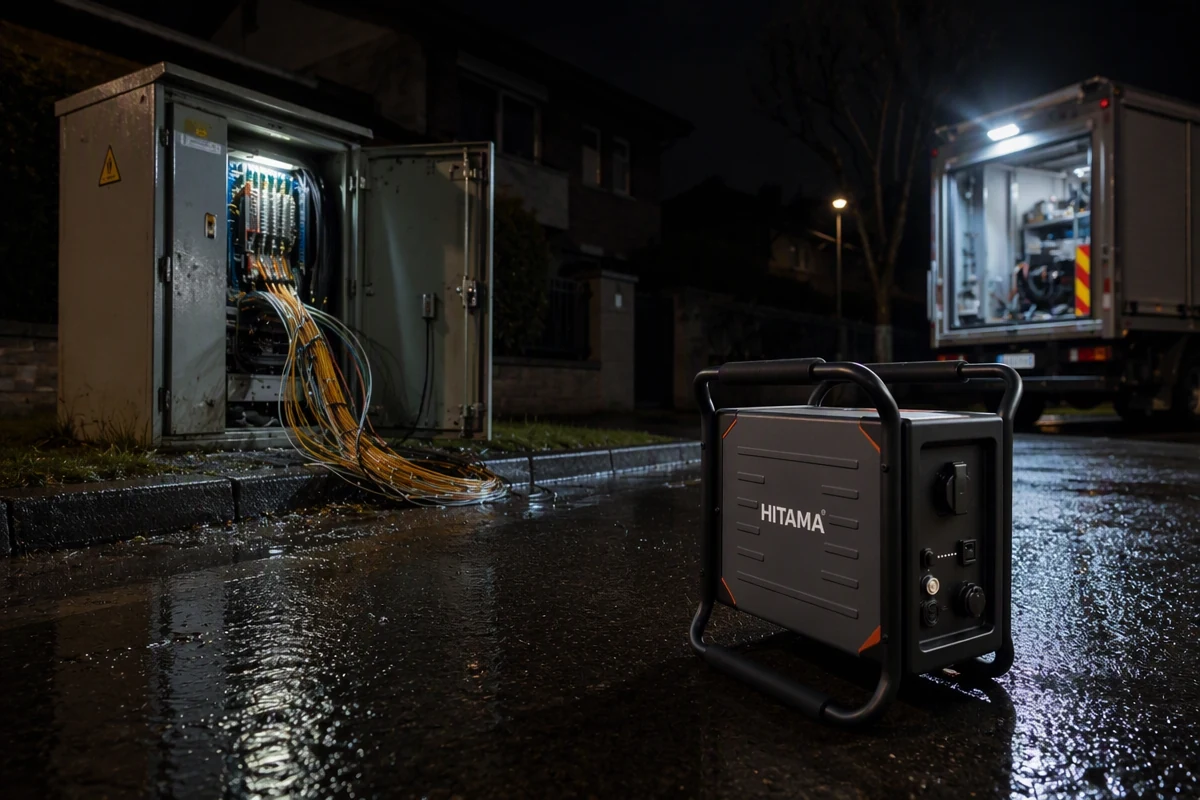
The job runs along one street, in one shift, at two levels. On the pavement: a van, an open cabinet, a unit that has to be lifted back into it at the end. Below: a chamber, a ladder, and the joint the whole night is about.
Power planning for street work is usually done as a single list. Once the work face sits under a lid, that list stops being true — not because the output is short, but because not everything on it can go down.
The unit stops at the chamber mouth
It does not follow the crew, and that is a placement fact, not a compromise. 29 kg is one lift on flat pavement. On a ladder, one hand on the rail and the other on a tool bag, it is a different calculation — and nobody wants to do it twice a night.
Everything after that becomes a cable question. The distance from the unit to the joint, how the lead is dressed across a wet kerb, and whether the plug end sits above the water line instead of in it.
Three loads, and only one has to go down
The splicer or the test set. A small draw, but it has to be steady for as long as the joint is open. That is what a pure sine output is for, not the wattage.
The light. Chamber work is lit from above or from a head torch. A lead lamp or a small area light is a continuous draw for the whole visit, and usually runs longer than any power tool on site.
The pump, when the chamber is wet. A small submersible pump runs for as long as water keeps arriving. It is the one item on the list with no end time, which is why it decides the energy question rather than the tool list.
What follows is an access rule. Only what has to be at the bottom goes down. Anything that can be worked from the surface stays at the surface.
Water at the bottom is not rain on a lid
IP54 is dust-protected and splash-proof from any direction. It is not a waterproof rating, and it does not cover immersion. A unit standing in the puddle at the bottom of a chamber is outside its specification — which is the practical reason it stays up top.
If the chamber is filling, the answer is a pump on a lead. Not a unit in the water, and not a longer cable to a unit standing closer.
With no engine there is nothing to vent at the opening. No exhaust goes into the space the crew is breathing from, and no fuel has to be carried down or parked at the kerb.
What this configuration cannot do
2.7 kWh is finite, and the pump is the variable. A chamber that keeps taking water will flatten the unit faster than any tool list suggests. An honest plan names a second source or a time limit before the shift starts.
Recharging is a task, not a top-up. From a normal 230 V socket at 500 to 1,500 W, a full unit takes hours. That happens back at the yard between shifts, not between two joints.
It is not an installed supply. Nothing here replaces a service connection, covers an unattended overnight load, or changes the confined-space procedure the crew works to.
Two units answer a different question. P25-D gives 5,000 W and 5.4 kWh at 230 V. That is a load answer, not an access answer, and the ladder does not get shorter.
Send us the chamber list — what has to go down, for how long, and whether water is coming in — and we will size it against the access, not the total.