
Three units, three phases, one box
Anyone bringing a 400 V three-phase supply to site has two routes: a diesel generator that produces three-phase power, or three single-phase battery units and a distribution unit that ties them together. The second route is not a compromise, but it comes with a condition you need to know before you offer it: three-phase power here is not created inside one unit — it comes from the sum of three.
On the P25 series that means three P25 units connected through the P25-T distribution unit. Each P25 supplies one phase. Take one away and a phase is missing — and with it, the three-phase supply.
This is where the conversation is decided. A customer who hears "400 V" pictures one machine. In fact he needs three. Explain that at delivery and you have a problem; explain it in the quotation and you have a plan.
What the distribution unit actually does
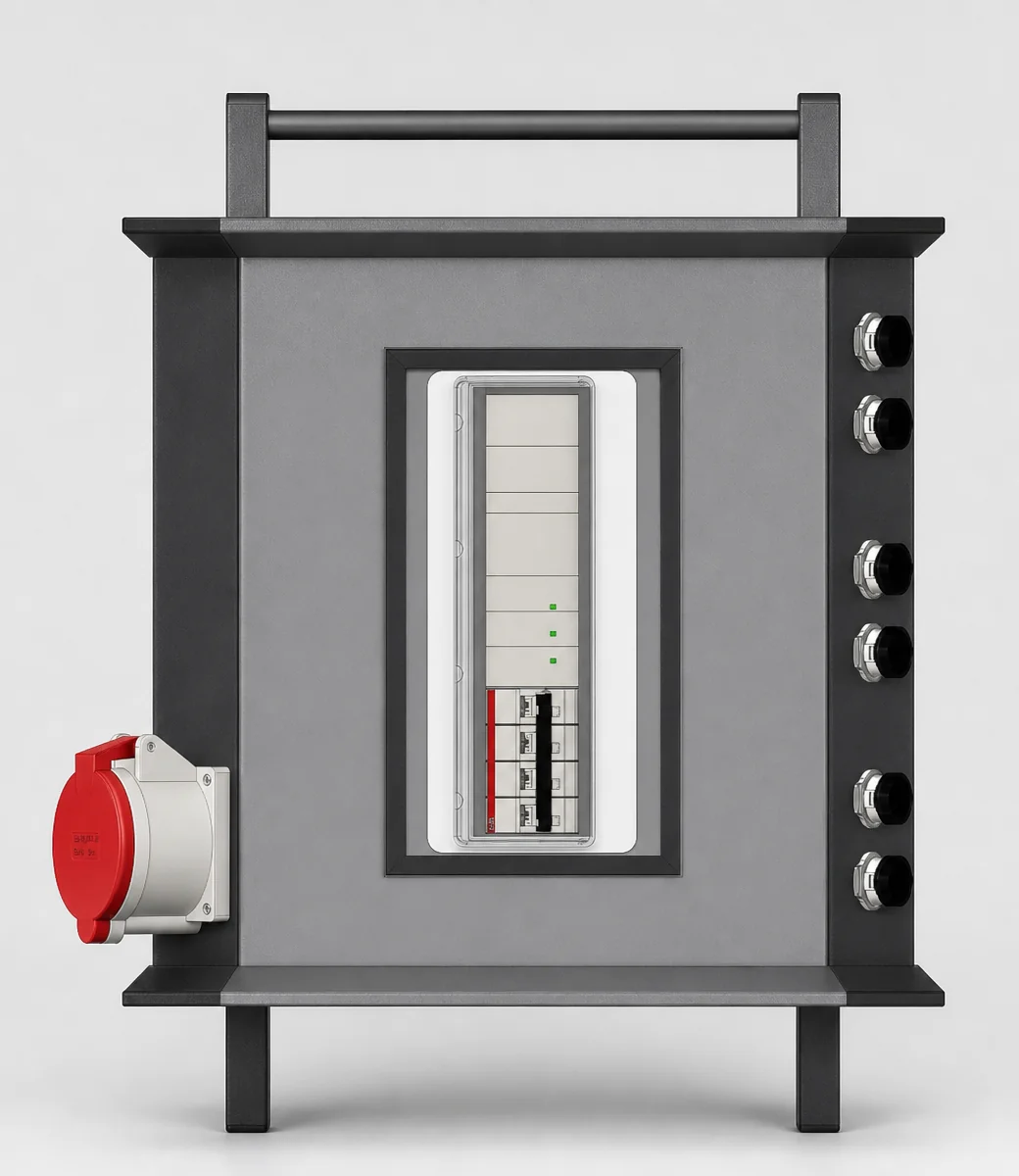
The P25-T is not a power strip with a label on it. It combines three single-phase feeds into one three-phase connection and protects each of them separately. Its three faces are strictly separated:
- Front: only the inspection window with the DIN breakers — nothing else.
- Left: the red CEE socket with hinged lid; this is where the load leaves.
- Right: six cable glands, one black and one orange lead per unit.
That separation is not a design preference but an inspection matter: anyone expecting the connections on the front has not held the unit yet. On site it is precisely the advantage — the load side is a single, clearly marked socket, and nobody plugs into a parallel lead by mistake.
The numbers that set the frame
| Configuration | Units | Output of the unit |
|---|---|---|
| P25 + P25-D | 2 | AC 230 V / 20 A |
| P25 + P25-D | 3 | AC 230 V / 30 A |
| P25 + P25-T | 3 | AC 400 V / 10 A |
The P25-T itself is rated at 7,500 W continuous, 15,000 W peak and 8.1 kWh, weighs around 90 kg and runs in triple parallel operation. The larger P36-T is listed at 10,800 W continuous, 60,000 W peak and 6.3 kWh at around 60 kg. A single P25 delivers 3,600 W continuous and up to 20,000 W peak at 21–23 kg.
The unit's three-phase output is rated at 10 A per phase. That is the number the tool list depends on — not the battery's rated power.
Where 10 A per phase is enough — and where it is not
Enough for: three-phase inverter welders in the 160–200 A range, heavy tools that only exist in three-phase, and feeding an existing site distribution board without converting machines to single-phase.
Not enough for: anything drawing more than 10 A per phase continuously — for example a large distribution board with several three-phase loads running at once. There the battery system is not the wrong technology, it is the wrong size.
Naming that limit is part of the offer. A customer who discovers later that his machine will not run does not come back; one who knows in advance what the system is dimensioned for plans with it.
What the system is not
It is not a grid connection. Anyone used to a 63 A site supply will not run every machine at once on 10 A per phase. Nor is it a diesel generator in the sense of running indefinitely: capacity is finite, and eight hours of three-phase work is calculated in kilowatt-hours, not litres.
What it is: a three-phase source without exhaust, without a fuel run and without cold-start problems — with the advantage that the three units can be carried separately after the shift. Around 90 kg for the P25-T is a pallet truck job, not manual handling; the individual P25 units stay at 21–23 kg.
More on configuration and connections: /en/p25-t.
The question that matters in the sales conversation
Not "do you need 400 V?" but: which machine has to run, and for how long? Those two answers determine whether three P25 with the P25-T fit, or whether the job is bigger than the platform. Answer both and you get a configuration; answer only "400 V" and you get a surprise.