
Two invoices, two units
Compare a generator with a battery and you usually put two invoices side by side that do not share a unit. One is in litres. The other in kilowatt hours. What is needed is a third: the tool hour – the hour in which something is actually cut, welded, drilled or lit.
As long as that unit is missing, the diesel wins every conversation. Its price is visible, the other one is not.
What we put on the table
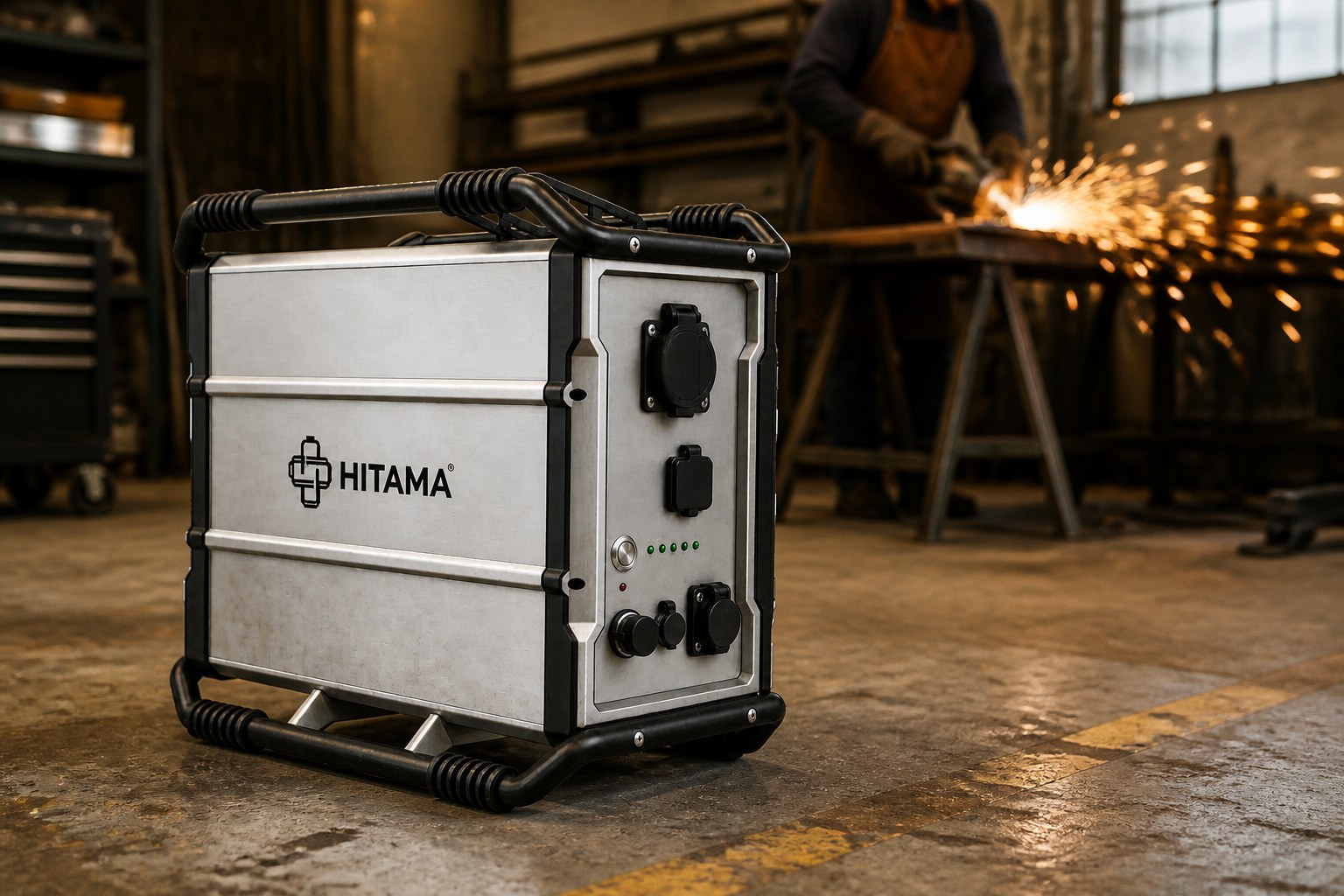
Our side is short and checkable. For P25: 2,500 watts continuous, 5,000 watts peak, 2.7 kilowatt hours, 29 kilograms. For P25-T: 7,500 and 15,000 watts, 8.1 kilowatt hours, around 90 kilograms, 400 volts three-phase. For C24: 2,400 and 4,800 watts, 2,048 watt hours.
These are manufacturer's specifications, not measurements taken in your workshop. They state what the unit is rated to deliver – not what your cut-off saw gets out of it.
Four lines that no fuel receipt carries
The fuel receipt is honest but incomplete. Four items are routinely missing.
The idle hour. A generator runs while nobody cuts: during set-up, during the break, while waiting for material. Those hours cost fuel and they are not tool hours.
Servicing. Oil, filters, spark plug, inspection fall due by operating hours, not by litres. Anyone costing only the litre price leaves them out.
Logistics. Cans, trailer, decanting, the way back. Fuel has to reach the workshop – including on the third floor.
The location. Indoors, the deciding question is not price but whether the unit can be operated there at all. Exhaust and noise are not a cost line, they are a permission line.
An example that needs no numbers
A metal workshop with a cut-off saw, a welding set and extraction has three consumers that rarely start at the same moment. The generator stands outside the door, because exhaust and noise push it there; the cable comes through the gap and the route to the socket becomes the real decision. A battery that may stand inside the hall moves that problem back to the socket – but only if its peak rating carries the start-up.
Why there are no figures from us here
We could print a table assuming a diesel price on one side and a rental rate on the other. It would be wrong in every operation where the generator is already paid for, where fuel runs on a company card, or where the hall is heated anyway.
So it is not here. Three values the operation must supply itself, and all three sit with it: litres per shift, hours under real load, service cost per interval. Without those three, you do not know your diesel price per tool hour – whichever table you use.
The calculation that remains
Diesel side: fuel plus servicing plus idle share plus logistics, divided by tool hours. Battery side: declared capacity divided by the actual draw of the tools gives the hours; add the charging window, which has to fit the workflow.
Both sides need the same reference unit. Without it, you are comparing litres with kilograms.
What belongs in a quotation
When a rental company and a site manager place two quotations side by side, four figures should appear on both: continuous output, peak output, capacity (manufacturer’s figure), weight. Without peak output, tool start-up is unplanned. Without a capacity figure, runtime cannot be calculated. Without weight, transport is unresolved.
The fifth item appears in no data sheet: whether the unit is allowed to run where the work happens.
_Product values: manufacturer's specifications. This text deliberately names no prices, consumption figures or service costs – those are individual to each operation._