
Three output classes, all up
Between January and September 2026, significantly more commercial battery storage systems went into operation in Germany than in the same period last year. Across the three classes the survey reports, from 135 to 950 kilowatts, that is 364 units in total, against 135 a year earlier.
By output class: 190 units between 135 and 270 kilowatts (70 a year earlier), 101 units between 270 and 500 kilowatts (24), 73 units between 500 and 950 kilowatts (41).
Commercial solar moved the other way
Commercial photovoltaic systems declined over the same nine months: 1,748 units in the 135 to 270 kilowatt class (2,430 a year earlier), 1,071 in the 270 to 500 kilowatt class (1,500), 629 in the 500 to 950 kilowatt class (786).
In the third quarter solar turned slightly positive: 1,166 commercial systems, roughly 15 percent more than in the second quarter. In the 135 to 270 kilowatt class the number rose from 496 to 613 units, just under 24 percent more.
So storage grows while the number of photovoltaic systems it is built for falls. That is not a contradiction, it is a shift: new capacity is moving from generation to storage.
What the figure does not contain
Two boundaries matter once you apply these numbers to a fleet.
The lower bound. The survey covers systems between 135 and 950 kilowatts. A mobile storage unit for a jobsite sits at 2.5 to 7.5 kilowatts continuous, with peaks up to 15 kilowatts. Different output class, different transport route, different business.
The connection. The Marktstammdatenregister lists systems that are connected to a grid or are intended to be. A jobsite without a grid connection is not recorded there. The jobsite with a cut-off saw, a core drill and floodlights does not appear in this statistic – not because it does not matter, but because it does not fit.
And the register records systems, not business models. How many of these units are in rental fleets is not in the number.
Why stationary systems are growing
Carbonfreed founder Marko Ibsch names two drivers in the evaluation: the economics of a company's own solar system, and the planned departure from the fixed feed-in tariff with the 2027 EEG amendment.
"What moves to the centre instead is stronger direct marketing and a more consistent alignment of new systems with market and grid signals," Ibsch is quoted as saying. "Storage is essential for that."
This is exactly where the two worlds separate. If you have a system on the grid, you optimise feed-in, self-consumption and price signals. If you are standing on a jobsite, there is no price signal. There is a socket that has to work – and a tool that is about to start.
Three questions before a fleet buys storage
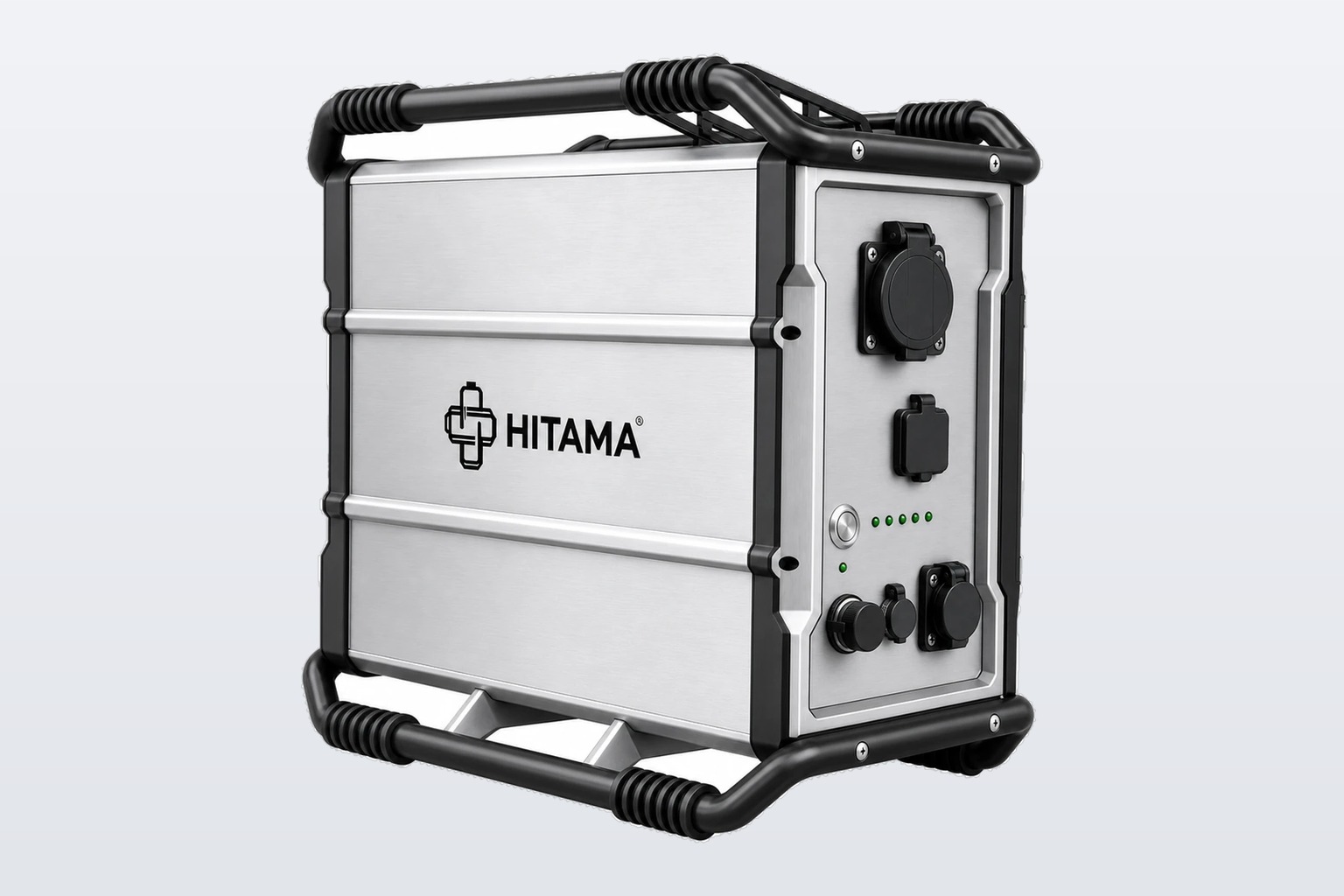
1. Peak or continuous? A cut-off saw draws more at start-up than on average. P25 is rated at 2,500 watts continuous and 5,000 watts peak; P25-T at 7,500 and 15,000 watts. Reading only the continuous rating means planning without the start-up.
2. Which voltage level? 230 volts for power tools and lighting, 400 volts three-phase as soon as a consumer asks for it. P25-T is the three-phase variant of the series. That question decides which tools are even candidates, before output is discussed.
3. What does the solution weigh? P25 is rated at 29 kilograms – carried by two people, moved by one on the trolley. P25-T is around 90 kilograms. That is not a data-sheet number, it is a number for the ramp, the stairwell and the van.
The sentence missing from the statistic
The numbers say: commercial storage is no longer a niche market. They do not say: the jobsite is supplied.
Between the two lies no trend, but a different task. And it is not decided at the grid connection. It is decided at the socket.
_Figures: evaluation of the Marktstammdatenregister by Carbonfreed, published by pv magazine on 28 October 2026. The three output classes reported there are cited. Product values: manufacturer's specifications._