
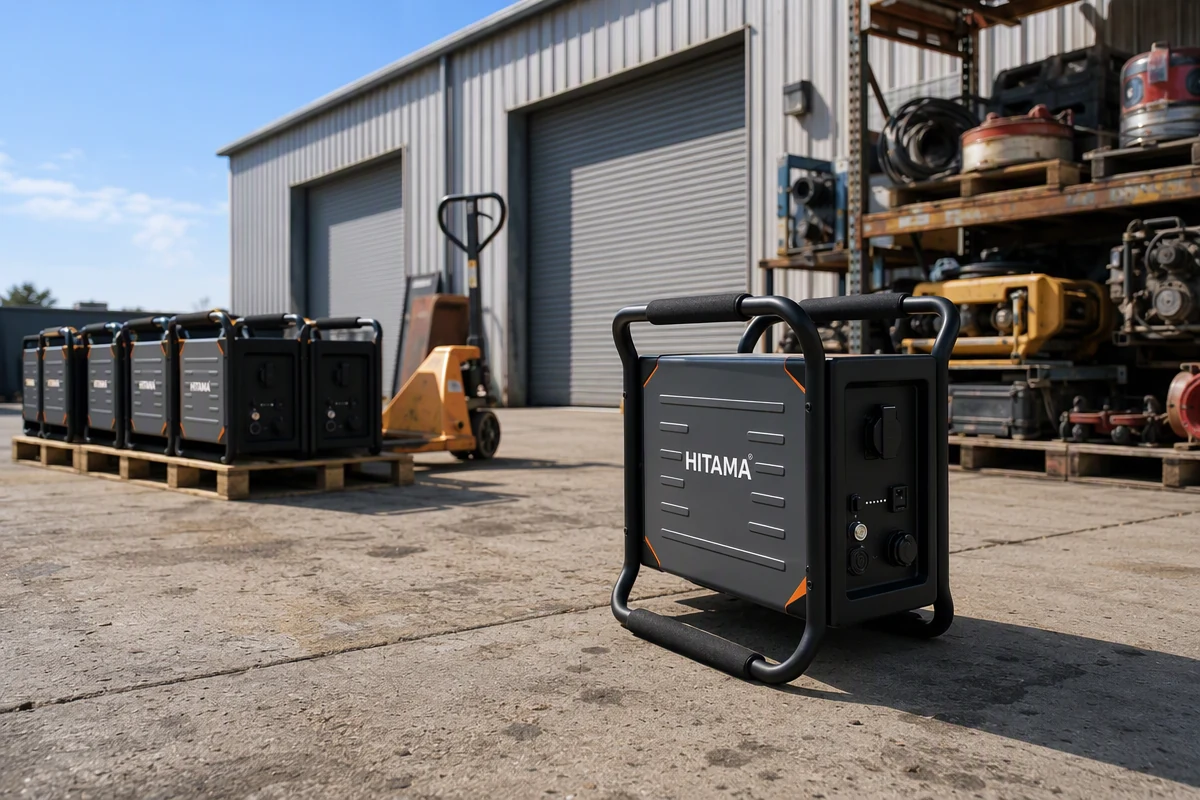
Cross-hiring a battery unit works, but it is not the transaction a generator is. A borrowed generator is one box with one outlet; a battery arrives as a set, and the set is what the site pays for. Three units with their box deliver 7,500 W at 400 V — the same three without it are three separate 2,500 W machines. Below 2,500 W, none of it matters.
Why a generator cross-hires more cleanly
A generator is one object. A depot lends it, the customer fuels it, and nothing needs agreeing beyond the rating and the plug. A battery unit is a unit, a parallel cable set, a distribution box from two units upwards, and energy that was charged at their depot rather than yours.
Energy travels invisibly. From outside you cannot see how much a unit holds, and the charge indicator reports a level, not a history. The hire note matters more than the rating.
1. What does a borrowed generator need on the note?
A rating, a fuel type, a return date. Three lines, and the fourth is a signature.
2. What does a borrowed battery need?
Configuration, accessories, charge at hand-over, and who pays for the recharge.
The configuration decides what the unit is worth
A hire level is not a model number. The same P25 appears at three levels on one HITAMA platform, and the tool list meets whichever one was written on the note.
| Configuration | Rated power | Usable capacity | Output |
|---|---|---|---|
| P25 | 2,500 W | 2.7 kWh | 230 V / 16 A, single-phase |
| P25-D | 5,000 W | 5.4 kWh | 230 V, single-phase |
| P25-T | 7,500 W | 8.1 kWh | 400 V, three-phase |
The step between levels is a cable and a box, not a bigger cell. Parallel operation adds a second unit and the hardware that lets two or three share a load. That hardware is rarely photographed, and most often left behind.
1. Which level does the tool list need?
Start from the heaviest single tool, not the sum of the site. 2,500 W covers most hand tools and lighting; a three-phase load needs three matched units and their box. The build of each level is in the P25 series.
2. What changes at 400 V?
Only three units with the P25-T distribution box produce 400 V. Two of three is not a smaller three-phase supply; it is a single-phase supply with a third machine idle.
Four lines to settle before the unit leaves
One: the configuration, written as a set. Write "three units, distribution box, 400 V", not "three units". A set described loosely comes back loosely.
Two: the accessory list, counted at both ends. Cables and box belong to the set like a key to a vehicle. Count them onto the van and off again on the same sheet.
Three: the charge at hand-over. Agree a level and write it down. A set that leaves full and returns empty costs energy and a charging slot; that arithmetic is in six units, one socket.
Four: who recharges, who services. The inlet draws 500–1,500 W at any level, so the recharge belongs to whoever owns the circuit.
The first ten minutes on site
Check the set before the tool list. Count the parts while the tailgate is open. At 29 kg one person can move a unit across a yard; loading a van takes two.
Then confirm the output stage. A 400 V load on a single-phase outlet does not fail loudly. It does not run, and the call that follows is about the tool.
Where cross-hire stops being the answer
It covers a peak, not a fleet. Two borrowed units for a fortnight answer a booking you cannot fill. They do not change what your yard turns per night; the wider picture is in our rental fleet notes.
The ceiling stays at 2.7 kWh per unit. A borrowed set is the same product as a bought one: a defined amount of energy, and no paperwork turns three units into a building supply.
Matched sets cannot be improvised. Parallel operation needs configured units and a box that distributes to the right faces — the rules are in three faces, one rule.
Questions the hire desk asks
Does a cross-hired unit run in parallel with ours?
Only if both sides are configured for it. Parallel operation is a property of the set, not the model: units delivered with cables and box share a load, while a lone unit from another depot cannot join without the same hardware.
Can one person handle a unit?
Yes on flat ground. A P25 weighs 29 kg, which one person can shift across a yard and two should lift into a van.
Is the charge level part of the hand-over?
It should be, in writing: the level at delivery, the level at return, and who recharges before the next hire. Otherwise the recharge becomes an argument.
Send us the configuration you intend to borrow and the tool list it must carry, and we will tell you what has to travel with it.