
A rack accepts a clean sine wave and still goes down when the supply is switched. The waveform gets quoted first and decides the least.
The number that gets quoted first
Every power source in this trade is asked about its waveform before anything else. Pure sine, total harmonic distortion below 3 percent — a real figure here, and worth having. A switch-mode supply in a rack, an instrument on the bench: both are happier on a clean curve than on a stepped approximation.
But a comms room does not fail on waveform. It fails on the changeover: the seconds between one source going off and another taking over. A distortion figure says nothing about that moment.
So the first question in a refit is not how clean, it is how long this may be off. Everything else is arithmetic that follows from the answer.
What the rack actually asks for
A rack's nameplate is a sum of maxima that never occur together. Each supply is rated for its own worst case; the room draws less, and unevenly, with a step at the instant the distribution is energised.
The energisation is the event worth designing for. Capacitors in a row of supplies charge at once, the breaker sees a short steep demand, and a circuit that carries the steady load all day can still trip on switch-on. Rated and peak are listed separately for that reason: a P25 carries 2,500 W continuously and 5,000 W at peak; a P36 is 3,600 W with a 20,000 W peak. One figure sizes the run, the other the start.
The loads in the room that are not yours to move
Fire detection and access control belong to the building. They stay on the building's own backed-up circuits. A portable unit is no substitute for a life-safety supply, and moving those circuits is another trade and another signature.
Cooling is a separate conversation. If the room's air conditioning is off with the room's supply, the room heats up whether or not the rack has power. −10 to 65 °C is the working range of these units, not permission to leave a closed room without cooling. A unit plugged into a socket also inherits that socket's protective conductor; it does not improve it.
A window, not a waveform
The job is a window: change over, work, restore. Measure the load that must stay up, multiply by the hours the window lasts, and the answer is one module or a pair: 2.7 kWh on a P25, 5.4 kWh as a P25-D, 8.1 kWh as a P25-T on 400 V three-phase.
Then check whether the same unit covers the second window. Charging from an ordinary 230 V socket draws 500–1,500 W; a P25 reaches 80 percent in about two hours and full in about two and a half. Two windows in one night is a charging question before it is a capacity question.
Parallel modules answer load, not time. One to three modules run in parallel at 230 V single-phase or 400 V three-phase. They do not stretch a shift the energy cannot reach.
Why the unit can stand in the room
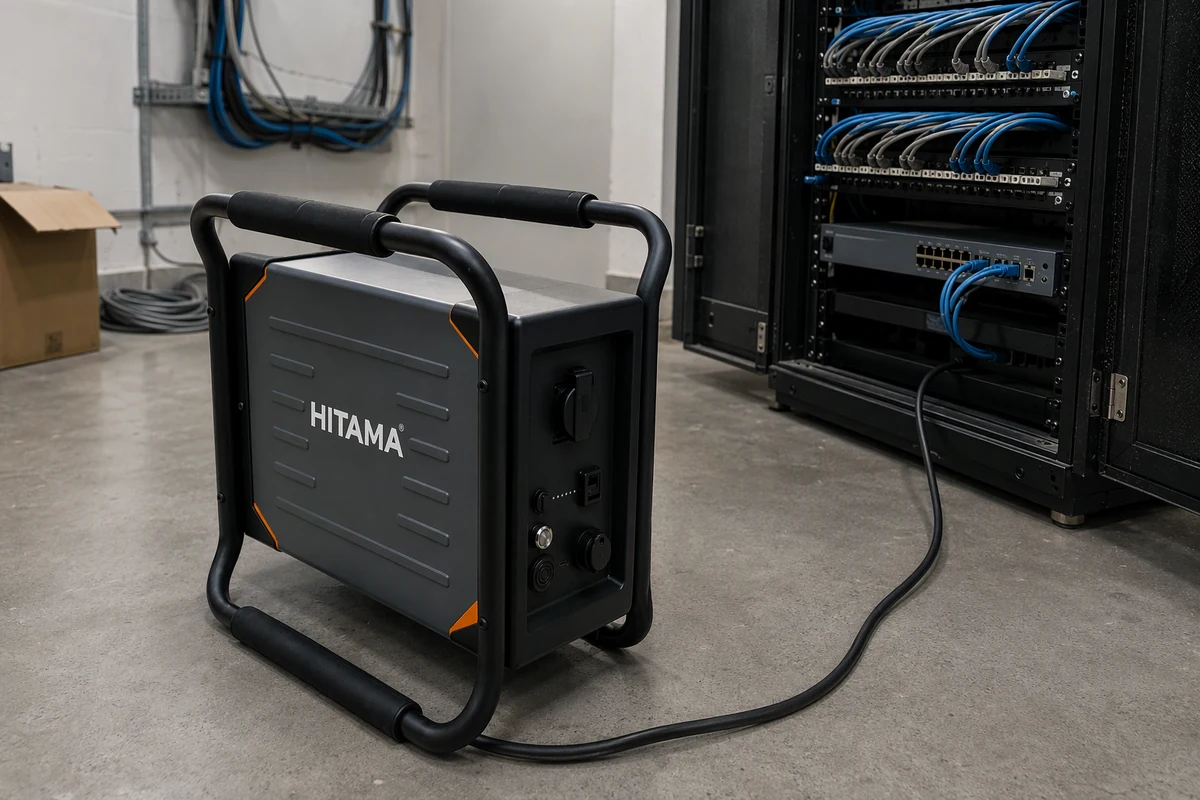
No intake, no exhaust, no fan, no moving parts. Cooling runs through the casing, so the unit can sit inside the room it is feeding instead of in the corridor with a cable through a fire door. IP54 covers the dust of a refit, and the sealed case is what makes the placement possible at all.
The cable route is part of the design. One output, one route, no branch through a door that has to stay closed. Give the unit floor space and a charging socket, and the refit stops borrowing the corridor.
What this is not
It is not a UPS. No changeover time is specified for these units, because none is claimed. Putting a live rack behind one as a replacement for the room's UPS moves the risk instead of removing it.
It is not an EMC approval for the installation. The CE marking here is the EMC directive 2014/30/EU; transport is documented under UN 3480 class 9 packaging. Neither says anything about the room's earthing or cable routing.
It is not a generator. The energy is finite. A room that has to run until the utility returns needs a fixed supply, not a box with a handle.
Send us the loads that must stay up, the length of the window, the socket available for charging and the room temperature — we will say whether the answer is one unit, a pair, or nothing here at all.