
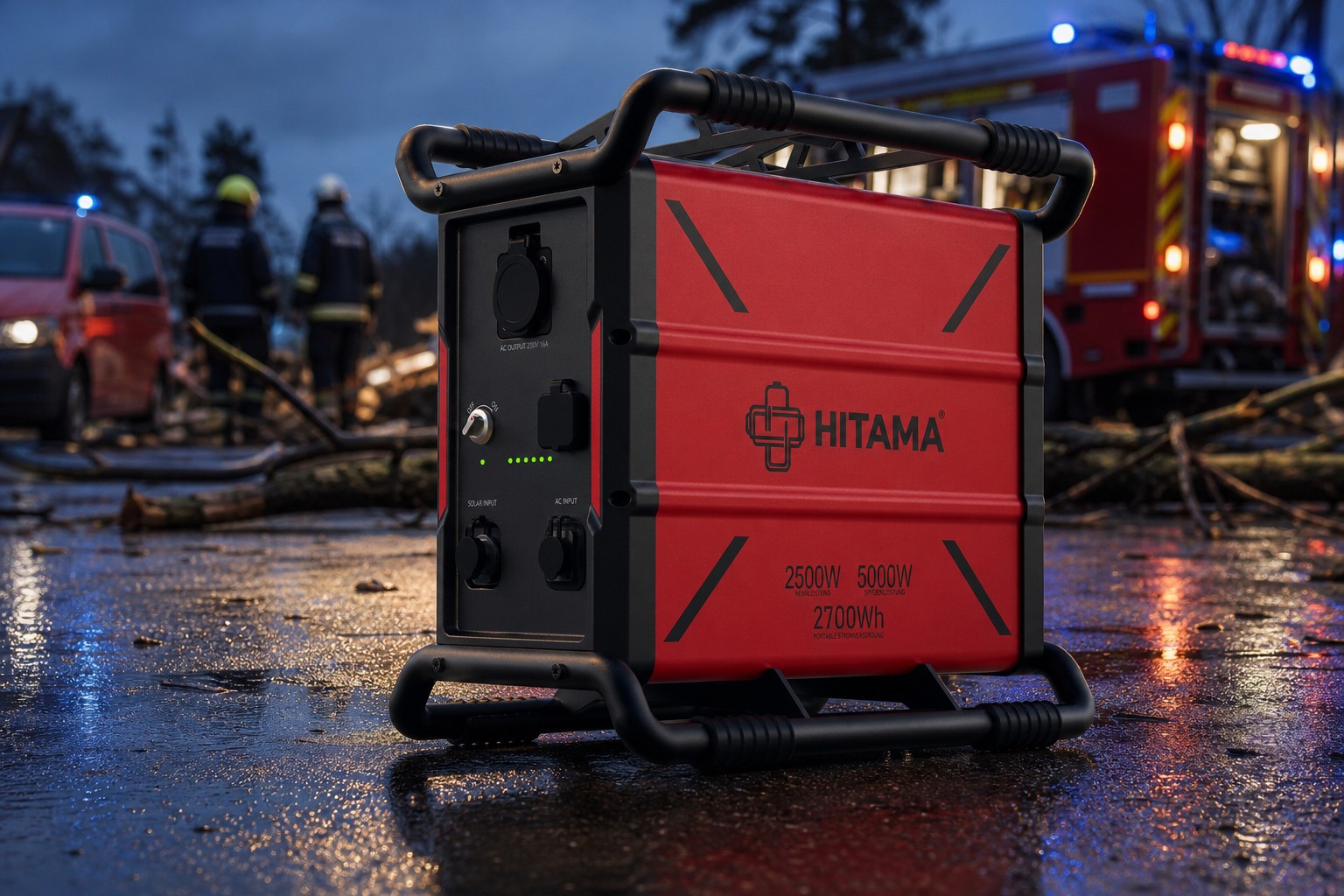
Two output figures sit on the P25 data sheet, and they are regularly confused. 2,500 W is what the sheet calls rated output. 5,000 W is what it calls peak output – with the addition "≤10 s". Those ten seconds are not a footnote. They are the actual decision variable on site.
The difference between rated and peak output is not a marketing trick but physics: a motor draws a multiple of its operating current when starting. A compressor starting against pressure, a saw in the cut, a mixer in stiff material – in those seconds the load sits far above what the unit delivers continuously. That is exactly what peak output is for. And that is exactly why it is time-limited.
Read only the rated figure and you buy too small. Read only the peak figure and you buy too large, then wonder why the unit hits its limit in continuous operation. The question to answer before ordering is not "how many watts" but: how long does the start take, and how often does it happen in succession?
One everyday example, with no invented numbers: two consumers that each run fine on their own, but start one after the other while the first is still running down, add their starting currents. Then the seconds no longer sit one behind the other – they sit on top of each other. Whoever thinks that through in advance does not need a bigger unit; they need a sequence.
For orientation on the other limits, because they sit on the same data sheet and are often passed on incorrectly: the P25 supplies 230 V single-phase at 16 A. That is a statement about output current, not about a power class – deriving "16 amps, therefore so many kilowatts" from it ignores the power factor and lands in the wrong place. 400 V three-phase is not a property of the P25: that is what the P25-T is for, three units via the distribution unit, 7,500 W combined.
And parallel operation itself is frequently misunderstood. Two units give 5,000 W rated output and 5.4 kWh usable, three units 7,500 W and 8.1 kWh. What does not change is the output: at every stage it stays 230 V at 16 A. Parallel operation adds power and energy; it does not create a three-phase supply. Anyone on site who needs to run a 400 V machine solves that with the P25-T, not with "more units".
One point remains that appears on no data sheet line: IP54 protects against dust in harmful quantities and against splashing water. It does not protect against a steam cleaner. And the fanless design – no intake tract, no moving parts in the cooling circuit – is why dust on site is a non-issue, and also why the unit should not be mistaken for an extraction system.
So what belongs on the note before ordering: the starting current on the nameplate of every consumer, the duration of the start, the order in which the machines start – and whether any three-phase consumer is involved at all. Four lines. After that, choosing the equipment is a calculation, not an estimate.
The P25 data sheet values and the P25-T configuration are here: