
Two numbers, one datasheet
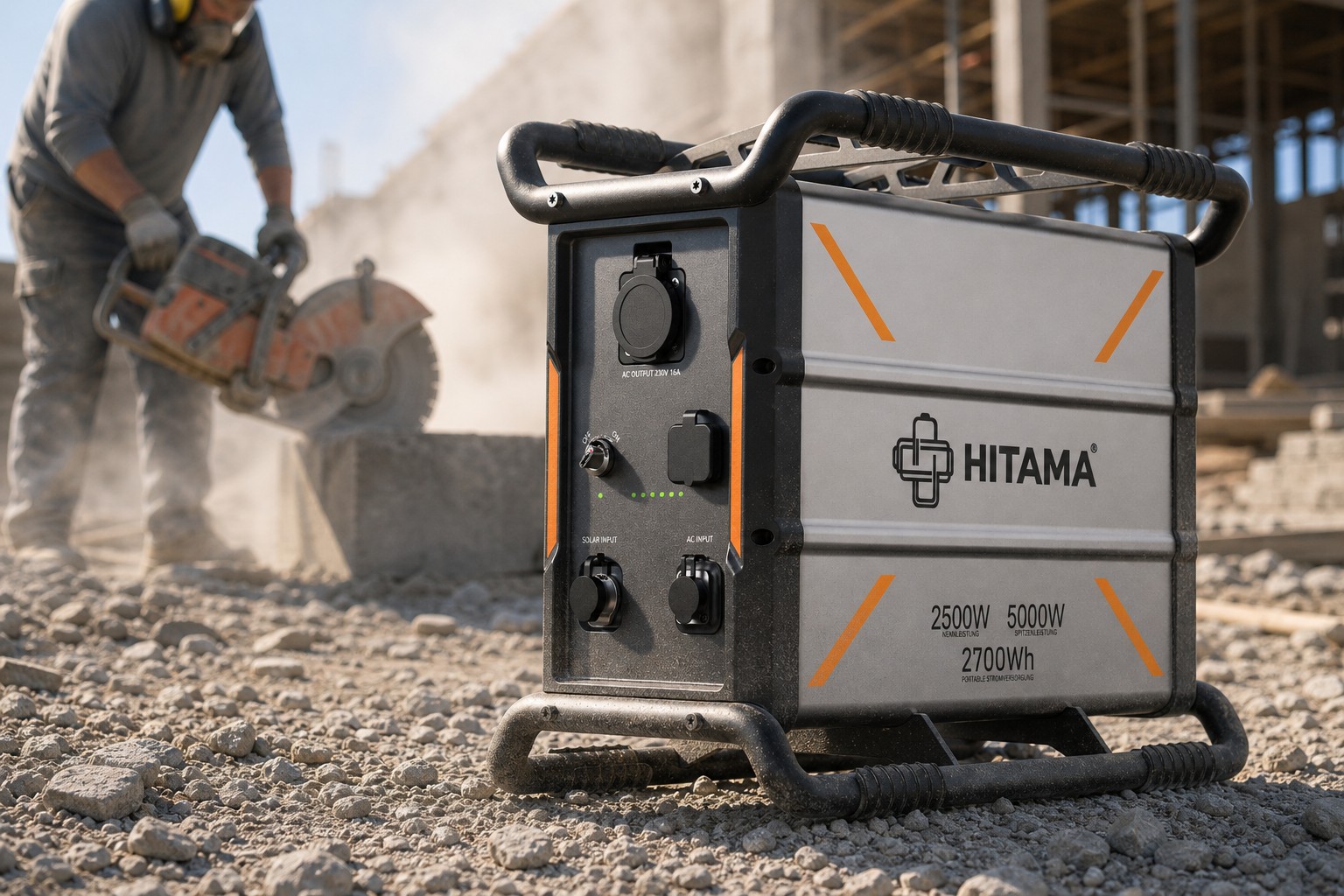
The P25 datasheet lists two power figures side by side: rated output 2,500 W and peak output 5,000 W (≤10 s).
The first describes what the unit delivers continuously. The second describes a moment. And the most important part of the second figure is not the number — it is the bracket: ten seconds.
That is not a footnote for engineers. It is the line where it gets decided whether a tool on your list actually works.
Surge is a moment, not a state
Start a wall saw or a cut-off grinder and you hear the difference: the motor pulls noticeably harder for an instant, then settles back to its working point. That is what peak output is for — the moment a mass has to be accelerated.
After that the tool runs on what it needs continuously. A cut-off saw working through wet steel section does not need two kilowatts to cut. It needs them to get going.
The consequence is uncomfortably simple: if a tool needs the peak output for more than starting, it is no longer a peak value, it is a continuous value — and then the unit is the wrong one.
Why capacity maths only works at rated power
Here it gets concrete. 2.7 kWh at 2,500 W rated output gives a good hour of running. Two figures, one division, a result you can check in the yard.
At 5,000 W it would be about half an hour — on paper. Only the unit does not run those 5,000 W for half an hour; it runs them for ten seconds at a time. Capacity counts in hours, peak counts in seconds. Put both figures in the same line and you get a result that exists on no site anywhere.
That is the most common error in equipment lists: averaging two power figures into one that does not exist.
One size up does not buy longer hours
The reflex is to go bigger. The P25-T has 7,500 W rated, 15,000 W peak (also ≤10 s) and 8.1 kWh.
Run the same calculation and you land on a good hour at full rated output — practically the same as the P25. That is not a coincidence, it is how the range is designed: the bigger unit does not buy more hours, it buys more surge.
What you actually buy with the P25-T is a different category of tool: 400 volt three-phase at 10 A, meaning machines that only exist as three-phase — inverter welders, heavy equipment on a site with no grid connection. Plus around 90 kilograms instead of 29. That is not a bigger case, it is a different transport question.
Where the seconds are not enough
There are operating states where ten seconds is too short, and you cannot see them on the machine beforehand.
A pressure washer whose pump works against a stuck relief. A compressor that restarts after every cycle instead of running through. A welder with frequent ignition attempts. In all three the surge repeats by the minute — and ten seconds, counted over an hour, stops being ten seconds.
That is not a weakness of the unit. It is a question to ask before buying: how often does this tool start in a day?
Three questions for your own equipment list
If two figures sit on the datasheet and one of them is time-limited, the only useful check is against your own tools.
First: which tool runs longest without a break? That machine sets the rated power. Everything else is secondary load.
Second: which one has the hardest start? That machine sets the peak. Usually it is not the same one.
Third: how often does it start? That number decides whether the ten seconds is a start-up or an operating condition.
Anyone who can fill in those three lines no longer needs a rule of thumb. Anyone who cannot has been assembling the list by feel — which works in the yard until somebody does the arithmetic.
What actually counts
A datasheet answers what the unit can do. It does not answer what your tool needs. Between the two sits a bracket with ten seconds in it — and very few equipment lists survive it.
All figures quoted are manufacturer specifications for the respective model, not measurements from your site.