
A number that will not move in 2027
There is one sentence that has ended the argument in municipal yards and road maintenance depots for two years: "Wait until the CO₂ price goes up — then it pays for itself." In 2027 that sentence is gone.
The German national CO₂ price for petrol, diesel, heating oil and natural gas stays within a corridor of 55 to 65 euro per tonne in 2027 — the same level as 2026. The federal government amended the Fuel Emissions Trading Act to do this, implementing a coalition committee decision of 12 May 2026. The Bundestag passed the reform in October.
The reason is not a new climate policy but a delay: the European emissions trading system for buildings and road transport (EU ETS 2) now starts in 2028. Without the amendment, the 2027 transitional price would have been derived from the average of EU ETS 1 auctions — a market a depot has nothing to do with.
Source: Energie & Management, 9 September 2026
The price push that is not coming
You can read this as good news: one year of planning certainty. You can also read it differently — and for a fleet decision the second reading is the more useful one.
Because anyone who has been waiting for the price push has tied the decision to a variable they do not control. The CO₂ price is politics. The hours a machine runs with no tool attached are operations. Only one of those two numbers is in your hands — and it is not the one from Berlin.
What actually decides in a yard
A generator rarely runs because work is happening. It runs because someone might plug a tool in twenty minutes from now.
That is the difference between operating hours and load hours, and it is the real line item. A genset holding a 230-volt rail live keeps burning through the break — it cannot do otherwise, because there is no switch that stops the fuel while the socket stays free. A battery sits there until someone takes the plug. Idle, it has nothing to burn.
This is not an argument against diesel. It is a question of how you count. If your calculation carries operating hours instead of load hours, every alternative looks bad — and diesel looks better than it is.
Where the battery does not win
It would be dishonest to claim otherwise: for many jobs in a yard a genset remains the right choice.
Three cases where a compact unit reaches its limit:
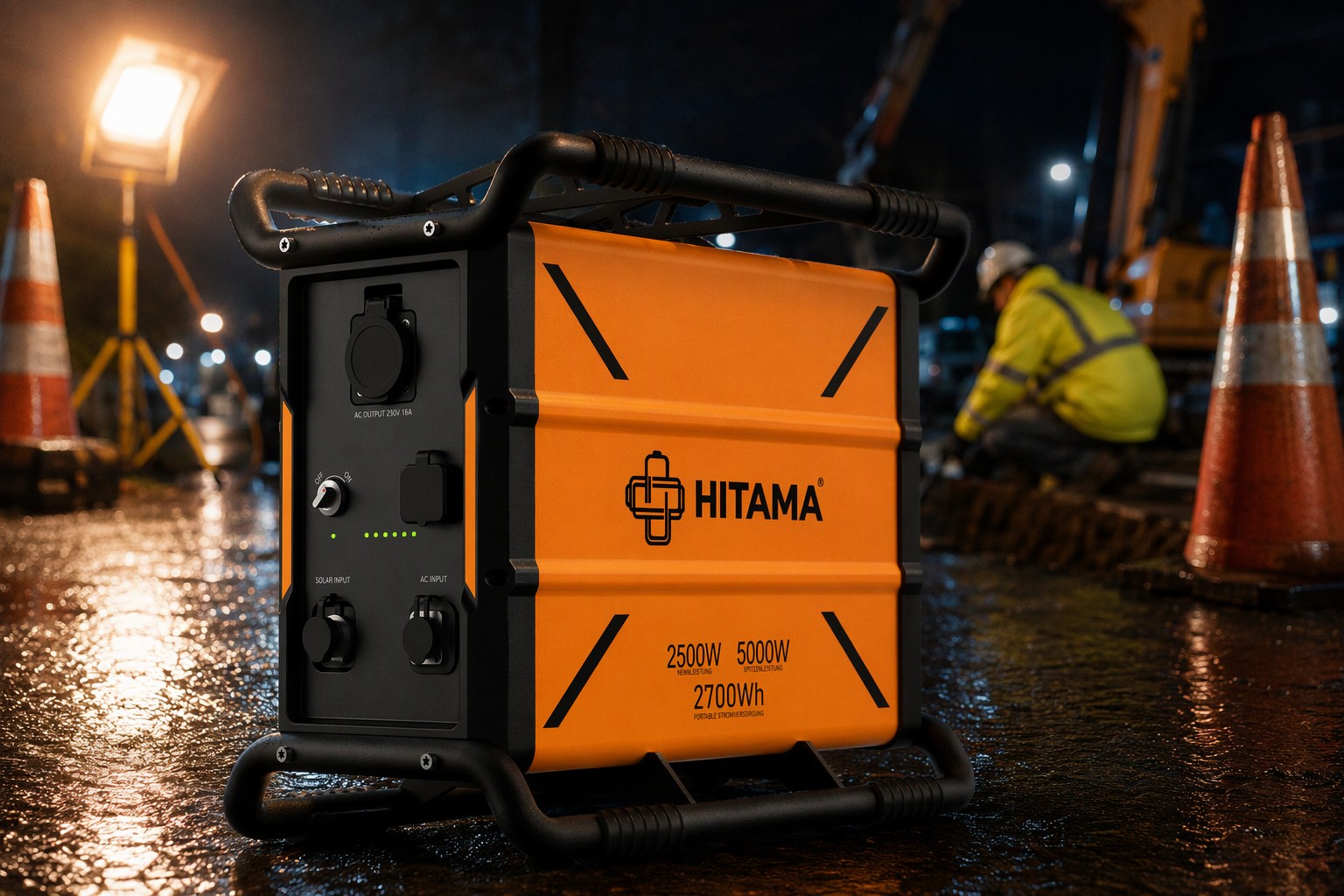
Continuous load over hours. The P25 has 2.7 kilowatt hours at 2,500 watts continuous and 5,000 watts peak, at 29 kilograms. At full rated output the capacity carries it for a good hour. Anyone running a cutter for eight hours does not need a battery, they need a different class of machine.
Genuine three-phase at high load. That is what the P25-T is for: 7,500 and 15,000 watts, 8.1 kilowatt hours, around 90 kilograms, 400 volts three-phase. That is a different device, not a bigger socket: different weight, different way of moving it, different answer to who carries it up the ramp alone.
Unattended continuous operation. Where a rail has to stay live overnight, storage is only the answer if somebody plans the shutdown.
All figures quoted are manufacturer specifications, not measurements from your site.
Three numbers for your own calculation
If the price will not help in 2027, measuring will. Three numbers are enough, and none of them needs a consultant.
First: idle hours per day. Do not estimate — keep a tally for one week. Whoever arrives in the morning and leaves in the evening can read the number off on Friday.
Second: trips for fuel. How often does someone drive off to refuel, and how long are they gone? That is not a side issue, it is working time that never appears on a site sheet.
Third: which tools genuinely need 400 volts. If it is exactly one, that changes the fleet decision more than any price forecast. If it is five, the answer is different — and at least it is a reasoned one.
What 2027 actually is
A year without pressure from the price side. That is the only statement the decision yields for a yard — and it is worth more than it sounds.
Because in 2028 EU ETS 2 begins, and the mechanism changes, not just the number. Whoever has measured by then knows what their idle hours cost. Whoever has waited by then still does not know — only more expensively.
The choice between genset and storage does not become right because the price rises. It becomes right because someone counted the hours before valuing them.