
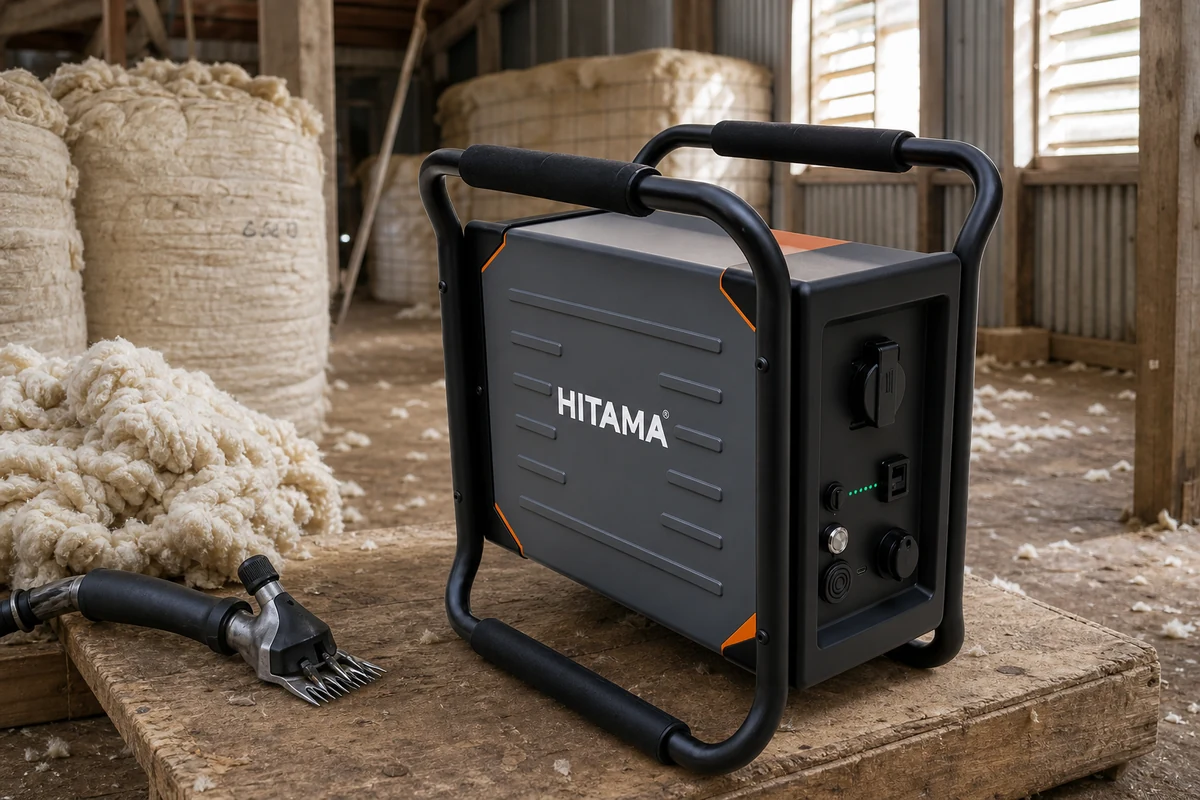
In a wool shed the limit is not the kilowatt-hour. It is the air, and the one motor that starts against a load.
The air works all day
A shed in full work is not dusty the way a quarry is. It is full of fibre: short wool, lanolin, dust out of the fleece, and the fine fluff that lifts off the skirtings and never settles. An air-cooled box with a fan and an intake pulls that in from the first hour.
There is no intake and no fan on these units. The enclosure is sealed and heat leaves through the casing: no filter to change, no grille to brush out between sheds, no bearing to pack with lanolin.
The consequence is placement, not maintenance. The unit can stand on the board among the wool, where the work is, instead of outside the door on a lead through a doorway people are walking through.
The press is the only start that matters
Twelve or twenty handpieces run almost continuously through a shed day. Each is a small motor of a few hundred watts, noisy and constant, and together they add up to less than the machine that runs for ninety seconds at a time.
The wool press is the load to size against. It starts against real resistance, several times an hour, and it is the one item in the shed whose plate you should photograph before ordering anything. Rated input is what it draws while running; starting current is what it asks for in the first fraction of a second, and that is the number a power source has to survive.
A P25 is rated 2,500 W with a 5,000 W peak, 2.7 kWh and 29 kg. If the press is three-phase, the answer is a different cabinet: the P25-T puts three units in parallel onto a 400 V three-phase output, 7,500 W rated and 15,000 W peak.
The handpieces are a rounding error
Add the handpieces, the lighting and the radio and the figure looks small next to the nameplate. It is small. A shed day is not an energy problem; a fleece does not need joules.
What it needs is that nothing stops. On a crew paid by the day, an outage is measured in people standing still: the shearer with a handpiece in his hand, the handler with a fleece on the board, the classer waiting for the next one. That cost arrives in minutes and dwarfs the difference between one model and the next.
So the rule in a shed is the opposite of the rule in a workshop. You do not trim the unit to the average; you over-provision the one start that stops the day, and accept that most of the capacity does very little for the rest of it.
Getting it there and getting it back
A shed usually sits at the end of a track, and the unit travels in the back of a pickup. Twenty-nine kilos is one person for a short carry. The C24 at 2,400 W rated, 4,800 W peak and 2.0 kWh is 23 kg, a different decision for a shed with one press and no three-phase.
Charging is a night job. On a 230 V socket input is 500 to 1,500 W; the P25 is at about 80 percent after two hours and full after two and a half. That fits an evening at the farmhouse. It does not fit a morning.
Temperature is the other honest number. The working range is −10 to 65 °C, which covers a shed in February and a shed in a heatwave, as long as the unit is not boxed in against a wall with the sun on the casing.
What this is not
It is not a shed supply. There is no fixed wiring, no consumer unit, no circuit for the shed's own installation, and no substitute for the electrician who signs that off.
It is not a hazardous-area rating. If the shed or the wool store is a classified zone, the zone drawing and the work permit decide where equipment may stand.
It is not a claim about your press. We publish figures for our machines, not for yours; the plate on the motor is the input to this calculation.
Send us the shed: the number of handpieces, a photograph of the press plate, the track, and the socket at the farmhouse. We will come back with the model, the carry weight and the charging window — and say plainly if one unit is not enough.