
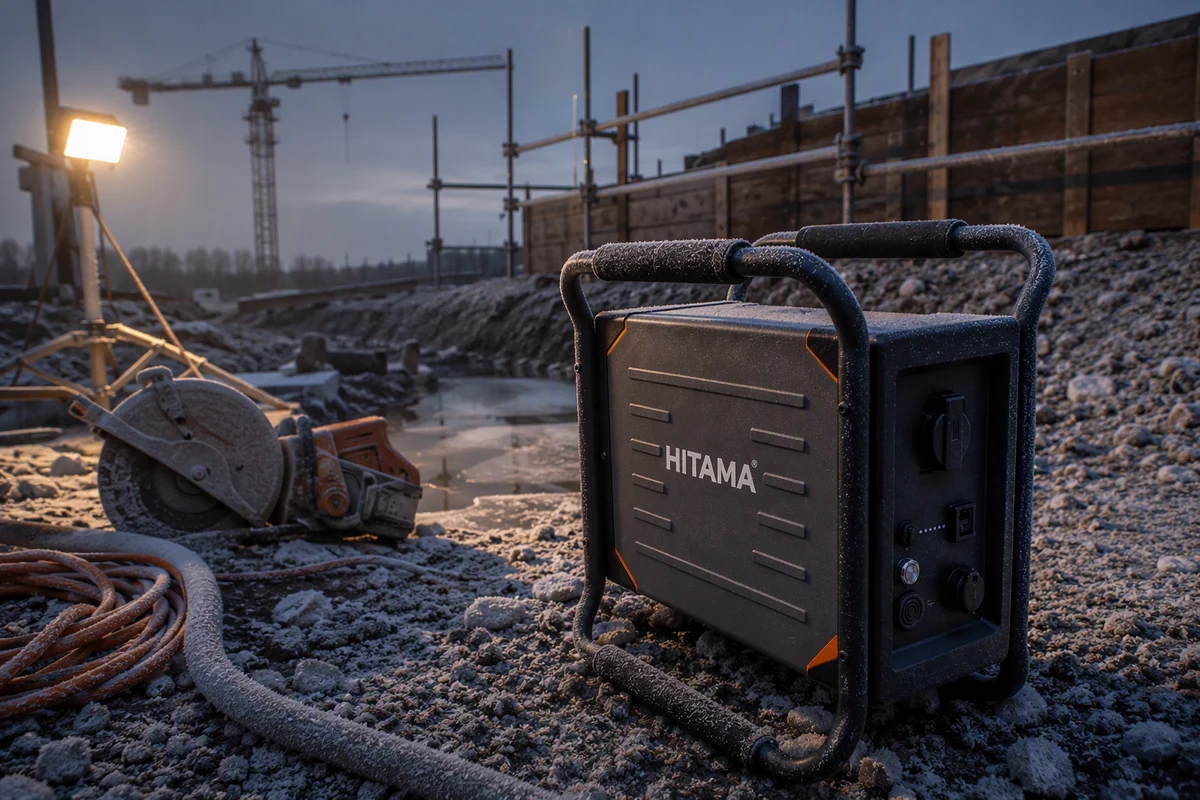
Winter does not usually stop a battery; it stops the air path around it. On a frost site the failures that cost a shift are packed intake screens, fan blades iced to their shrouds, and an engine that has to be warmed before it will accept load. HITAMA removes the first two by removing the opening.
What fails first in frost
The intake is the first casualty. Every combustion unit needs air, so every combustion unit has a hole in it. Snow carried on wind packs the screen; freezing rain glazes it. Once the screen closes, the machine derates or stops, and somebody has to leave the work to clear it.
A fan needs clearance to be a fan. Ice on a blade tip is enough. HITAMA has no fan and no moving part anywhere in the cooling path: heat leaves the enclosure through the casing wall.
Condensation is the quiet one. A unit moved from a warm store into a frost morning collects water on every cold surface. A sealed enclosure with no intake gives moisture-laden air no route to be drawn across live parts, and IP54 covers the dust and spray that come with it.
Cold adds loads; it does not remove them
A winter shift carries its own list. Lighting from half past four, a heat gun on frozen couplings, de-icing, and a welfare cabin that has to stay warm for a break. None of it is optional, and all of it can be counted.
Count watts and hours, not impressions. C24 is rated 2,400 W with a 4,800 W peak, holds 2.0 kWh and weighs 23 kg. P25 is 2,500 W rated, 5,000 W peak, 2.7 kWh, 29 kg. A heat gun or a saw draws above its running load for a second or two; the peak figure covers that second.
When the shift outlasts one battery, the answer is parallel. One to three modules can be combined. P25-D gives 5,000 W rated and 10,000 W peak with 5.4 kWh at 230 V single-phase; P25-T gives 7,500 W rated and 15,000 W peak with 8.1 kWh at 400 V three-phase. The work does not change. The number of boxes does.
The minus ten degree line
The published range is −10 to 65 °C. That is an operating window, not a comfort claim. Inside it the unit runs. Below it the unit is outside its stated range, and the answer is a heated store or a different plan, not a heavier jacket.
Inside the window the output does not change. Pure sine wave, THD below 3 per cent, the waveform a diesel set is expected to produce, which is what matters for motors and control boards.
Charging between shifts
A 230 V socket is enough. Input is 500–1,500 W. P25 reaches 80 per cent in about two hours and full charge in two and a half; P36 is full in about one and a half hours. In a frost week that means charging inside the cabin, not driving for fuel.
The yard matters as much as the site. A unit that goes back into an unheated container wet is a unit that starts the next shift wet. Let it reach room temperature before charging, and keep the socket panel closed.
What this is not
It is not a claim that cold has no effect. We publish one operating range and we do not publish a cold-derating curve, so do not size from assumption; size from the load list.
It is not rated for work below −10 °C. Past that line this is the wrong tool, and we will say so.
It is not a generator of any size you like. The range runs from 2.0 to 8.1 kWh, single- or three-phase, one to three modules.
It is not certified for more than it is. CE under the EMC Directive 2014/30/EU, and UN 3480 class 9 packaging for sea freight. Nothing beyond that is claimed.
Send the load list — the tools, the hours each one runs, and the lowest temperature the site will see — and we will size the unit and the parallel configuration against it, in writing.