
The engine is not the problem; the sizing is
A generator that is too big for its site is not a reserve, it is a cost that runs all day. A large set feeding two hand tools works at a fraction of what it can deliver, and the fuel goes out faster than the work suggests. The cheaper fix is not removing the engine but cutting it down to the job it does well.
Hybrid does not mean two systems standing side by side. One is sized for energy, the other for power: the engine refills, the battery delivers. Written down once, that division drops the generator on a fit-out or a cable trench by a class or two.
A combustion engine is efficient at one number
A diesel set is specified at a rated output, and its fuel curve only looks good near that number. Below roughly half of the rating, combustion runs cold, the exhaust path loads up, and the service interval is set by the hours the machine stood there. That is a slow failure, and it shows in the service file before it shows on site.
Noise and exhaust are sized by the engine, not by the load. A large set delivering three kilowatts is as loud as the same set delivering fifteen. On a residential street after 22:00, that is the objection.
The battery carries ten seconds; the engine carries the hours
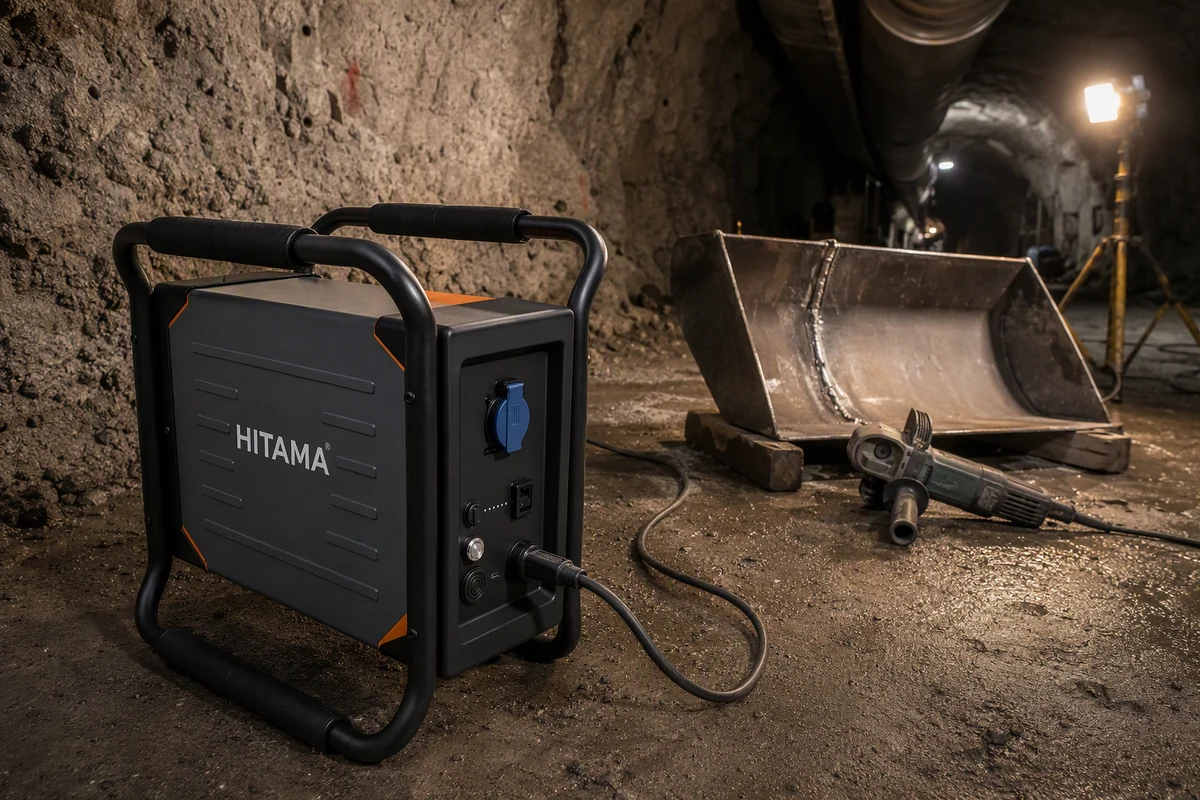
Almost every site has two numbers, and they get averaged into one. The first is the start: a cut-off saw, a compressor, an inverter welder. A P25 covers 2,500 W continuous and 5,000 W peak for up to ten seconds, with 2.7 kWh of storage, 230 V at 16 A, in 29 kg. The second is the energy over a shift, usually smaller than the first suggests.
Charging is the bridge, and it has a documented shape. A P25 accepts 500 to 1,500 W of charging input: 80 percent in about two hours, full in two and a half. That figure is the point of the hybrid — a steady, predictable load, the kind a small set runs at happily for hours, because it is never asked for a surge.
Two or three units in parallel turn that into a design variable. Two P25 as a P25-D carry 5,000 W continuous and 10,000 W peak, 5.4 kWh at around 60 kg. The engine in front does not grow with the peak, only with the average.
The arithmetic is smaller than the instinct
Take 2.7 kWh across eight hours and the average draw lands near 340 W. Add a 5,000 W start and the site looks like a five-kilowatt problem. It is a 340 W energy problem with a ten-second power problem attached, and the two are answered by different machines.
Separating them changes what leaves the yard. A small set at a comfortable fraction of its rating, one P25 absorbing the starts, and the fuel bill follows the energy instead of the peak. Nobody has to argue that batteries replace generators everywhere.
The charging window is the one figure that can break the plan. If the unit leaves at 06:00 and returns at 18:00, the refill has to fit inside those twelve hours, so a socket has to be free when the unit is. That is a logistics question, answered before the machine is chosen.
What this is not
This is not a claim that a small generator plus a battery is cheaper everywhere. Where the load is genuinely continuous and large, a correctly sized engine stays the simpler and cheaper machine. Where there is no dependable place to charge, the hybrid only moves the problem to another hour.
It is not an automatic changeover either. Who closes the contactor between the two sources belongs in the electrical plan.
And it is not a UPS. A portable unit supplies its own sockets, does not feed a building's fixed distribution, and there is a gap between mains failure and a connected load.
What can be put in writing is narrow and checkable. CE under the EMC Directive 2014/30/EU with test report A2409245-C01-R01-V1, UN 3480 class 9 packaging for sea transport, UN38.3 and MSDS, IP54 as an enclosure class rather than a certification, a sealed fanless case with no intake and no moving part, an operating range of −10 to 65 °C, pure sine output with THD below 3 percent, and a ten-point test protocol per unit.
Send the load list and the shift pattern and we will size the split with you. Which loads must start, how many hours they run, where the unit can charge — through https://www.hitama.net/en/contact — and the answer will say how small the engine can get, not how large the battery has to be.