
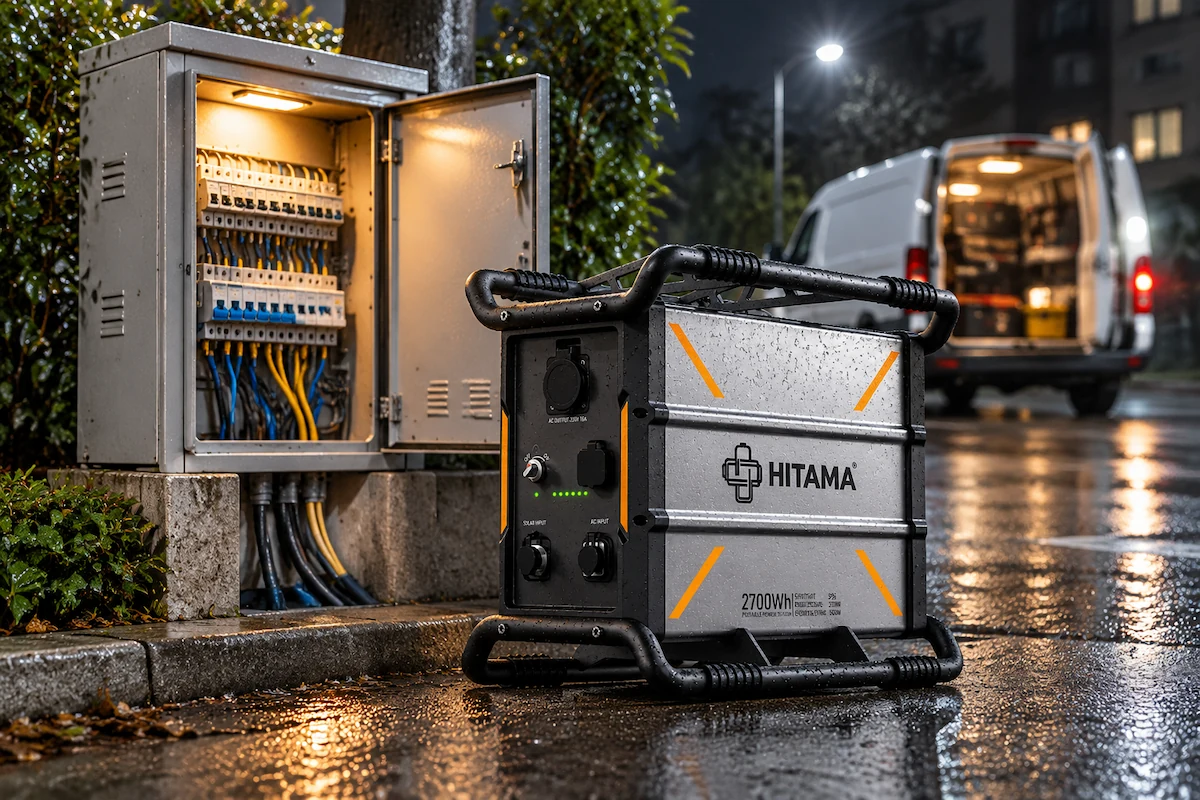
A faulted low-voltage cable takes its own socket with it. The circuit is isolated and earthed at both ends before anyone works on it, so the cabinet the crew would plug into is dead as well. One 2.7 kWh unit at 2,500 W continuous carries the locator, the jointing tools and the lights through a shift, and it cannot energise the cable under test. On planned reinforcement work the socket usually still exists.
The isolation is the job
A faulted cable is worked on dead, by rule. Prove dead at the point of work, earth both ends, then the jointing starts. The board that fed the cable is the one the crew would otherwise plug into, so the socket goes out with the circuit.
The protective device got there first. A fault that trips an LV board removes the voltage before the van arrives: the crew arrives at a job with no local power.
So the crew brings its own source, which moves the question from permission to arithmetic — a shift covered in our other telecom and utilities notes.
1. Why can the test instrument not run from the network's own supply?
Because the test requires the network dead and earthed. An insulation test puts a voltage on a conductor already disconnected from the installation. Feeding the instrument from that installation puts the supply back onto the thing being proved.
Four stages, four different loads
Locate. A prelocator and a laptop draw little and run for an hour or two while the route is walked: small load, long duration.
Joint. A crimper works in bursts, a heat gun runs continuously while a sleeve shrinks, and the light stays on. This is where the demand sits. Test and restore afterwards is the instrument again, briefly, and back into the van partly empty.
2. Which stage decides the size of the unit?
The joint, nearly always. Two numbers matter: the continuous draw while the sleeve shrinks, and the burst when the crimper starts. One unit holds 2,500 W continuously; if the burst is above that, the answer is a second module — two in parallel from the HITAMA P25 series give 5,000 W and 5.4 kWh at 230 V.
3. What decides whether one unit finishes the night?
The sum, not the peak. Multiply each stage's measured draw by its hours, add them, and compare the total with 2.7 kWh. A night that looks heavy on the tool list is often two hours of heat gun and six hours of a small light.
The loads that are not 230 V
Three-phase gear is a separate supply. A 400 V pump or test set is not covered by a single-phase unit at any rating. The three-module arrangement puts 400 V three-phase at 7,500 W and 8.1 kWh on the sheet, with a different vehicle and lift.
What the unit cannot do on a fault
No backfeed, no changeover. It feeds its own outlets only and cannot energise the cable being worked on; what separates it from a UPS is in the comms room refit note.
Not the network's standby. 2.7 kWh is a shift of tools, not a night of a substation's auxiliaries.
IP54 is splash, not immersion. A chamber with water in the bottom is a placement decision, gas testing is a separate procedure, and no Ex rating is claimed. The radio site note makes the same point.
29 kg is a two-handed lift: onto a van bed yes, down a ladder into a chamber no.
What goes on the sheet before the van leaves
Measure with a clamp meter, not from the plate. Write down what each stage draws and how long it runs, and the configuration follows. Then count the recharge: a 230 V socket feeds it at 500 to 1,500 W, so a unit back at 30 percent needs the evening, not a coffee break.
| Figure | Value |
|---|---|
| Continuous output, one unit | 2,500 W |
| Stored energy, one unit | 2.7 kWh |
| Two units parallel, 230 V | 5,000 W / 5.4 kWh |
| Three units, 400 V three-phase | 7,500 W / 8.1 kWh |
| Recharge input, 230 V socket | 500–1,500 W |
Questions from the pit
How long does one unit last on a fault job?
Around nine hours at 300 W, three at 900 W. 2.7 kWh divided by the measured draw is the whole calculation, and the draw comes from a clamp meter, not the plate.
Can the unit feed the test set while the cable is earthed?
Yes, and that is the arrangement it suits. It supplies its own outlets with no connection to the network under test, so the instrument runs while the cable stays earthed. One 2,500 W output covers instrument and lights together.
How do you recharge between two faults in one night?
From any 230 V socket, at 500 to 1,500 W. 2.7 kWh takes under two hours at the top rate, closer to five and a half at the bottom. A second unit travelling while the first recovers is often simpler.
Send us the job sequence — stages, measured draws, hours per stage and the distance from the van to the pit — and we will say whether it is one unit, a pair, or nothing: [contact](/en/contact).