
A planned isolation is not a switch-off. It is a timetable of loads, each with its own tolerance in minutes, and that timetable decides the unit long before the total kilowatts do.
The building does not go dark at once
Every shutdown is written as one line in a programme — supply off, 08:00 to 14:00 — and executed as a dozen separate decisions. One circuit can stay dead six hours; another cannot be dead six minutes.
What matters is not a load schedule but an outage budget per circuit. Fridge, warden call, lift, corridor lighting, door access, boiler controls. Those minutes come from the building's risk assessment, not from a datasheet.
The first page has two columns: what stays alive, and for how long.
The small loads are the ones that size it
Circuits with no tolerance stay where the building's design already put them. A lift on a protected supply, a fire alarm panel — none of it moves to a portable unit because the day is inconvenient.
What is left is a list of small, stubborn loads. A warden call panel, a router, a cycling compressor, a door controller. Individually unimpressive; collectively the reason the building cannot simply go dark.
Here arithmetic beats opinion. 300 W for nine hours is 2.7 kWh — one P25, 2,500 W rated. Double the draw and the same unit covers four and a half hours, before the temperature of the riser is considered.
A compressor decides more than its label
The fridge catches people out. A compressor's plate figure is a running figure; the start is a multiple of it, which is what the peak column is for. P25 is rated 2,500 W and peaks at 5,000 W; P36 is rated 3,600 W and peaks at 20,000 W.
Cycling matters more than the rating. A compressor running four minutes in twenty draws far less over an hour than its plate suggests — the reason a logged night beats a calculated one.
Sensitive electronics sit on the same list. The documented output is pure sine wave with THD below 3 percent: a figure to hand the warden call owner, not an assurance.
Indoors changes the shortlist
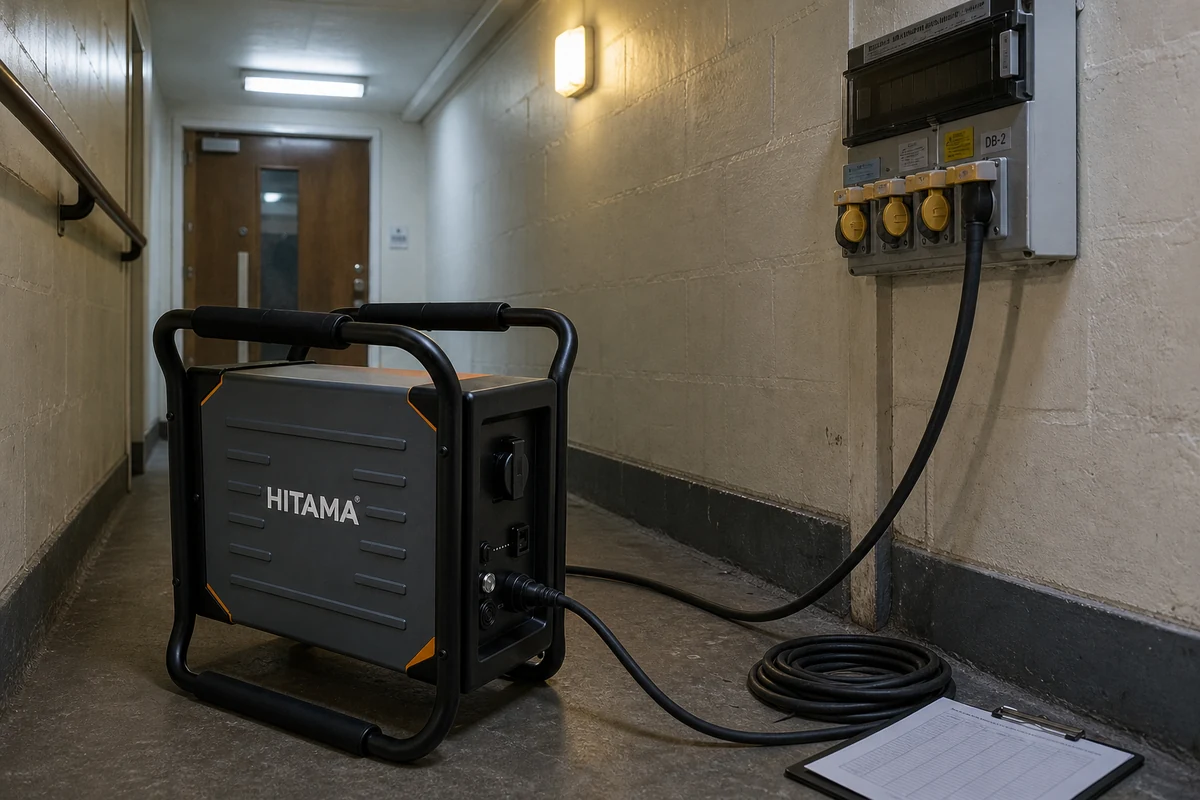
A communal corridor is not a yard. No exhaust, no intake, no fan: a sealed, fanless case stands in a hallway overnight without a hose out of a window or a carbon monoxide argument at handover. IP54 covers refurbishment dust and mop water.
Noise is a design fact here, not a figure. No engine and no fan; the number that counts belongs in the building's own assessment.
Placement is a fire-door question as much as an electrical one. Out of the escape route, off the carpet, where the night duty can see it. A unit nobody can reach at 03:00 does not exist.
Charging fits inside the day. From a 230 V socket the input draws 500–1,500 W: P25 returns to 80 percent in about two hours and full in 2.5, P36 in about 1.5.
Check the schedule backwards
Take the table in reverse before the morning. Circuit, measured draw, hours, multiplied; then the rated figure against what runs at once, and capacity against the hours nobody is on site.
Where the total passes one unit, modules parallel — one to three, 230 V single-phase or 400 V three-phase. Three modules at 400 V is a different job with a different distribution box, settled at the survey and not at 07:40.
What this is not
Not a standby supply for life-safety systems. Fire alarm, lifts, medical gas alarms and anything else on a protected supply stay there; a portable unit neither replaces them nor makes an installation compliant.
Not a UPS. There is a transfer, a plug, a walk. Loads that cannot see a break of a few seconds need equipment designed for that.
Not medical electrical equipment, and carries no certification for that role. CE under the EMC Directive 2014/30/EU and UN 3480 class 9 packaging are the documented marks; nothing else follows from them.
Not an argument that a supply may be left off. The isolation is still a permit, a risk assessment and a signature.
Send the outage table — circuit, draw, hours — and we will map it against the model range, including the cases where one unit is the wrong answer.