
The adjective has no unit
"Silent" is a claim about an ear, and an ear is not a measuring instrument. The word appears on tender lines and in hire catalogues without a reference and without a distance, which is why a site that must stay under a limit at the nearest dwelling cannot plan a night shift on it.
A dB(A) value without its conditions is only slightly better than the word. It looks like a measurement, so nobody asks what produced it: idle or loaded, one metre or the fence, a quiet yard or traffic. Four honest numbers come out of one machine.
A decibel is always somebody else's measurement
The decibel is a ratio, and a ratio needs a reference before it states anything. Sound pressure is quoted against a fixed reference, and the A-weighting behind it is a filter shaped like human hearing. The figure belongs to a defined measurement, not to the object.
Distance is the cheapest variable here, and it is the one left out. For a compact source radiating freely, doubling the distance takes roughly six decibels away and halving it adds roughly six. A value quoted at one metre and a limit applied at the boundary are two different quantities, separated by a factor nobody printed.
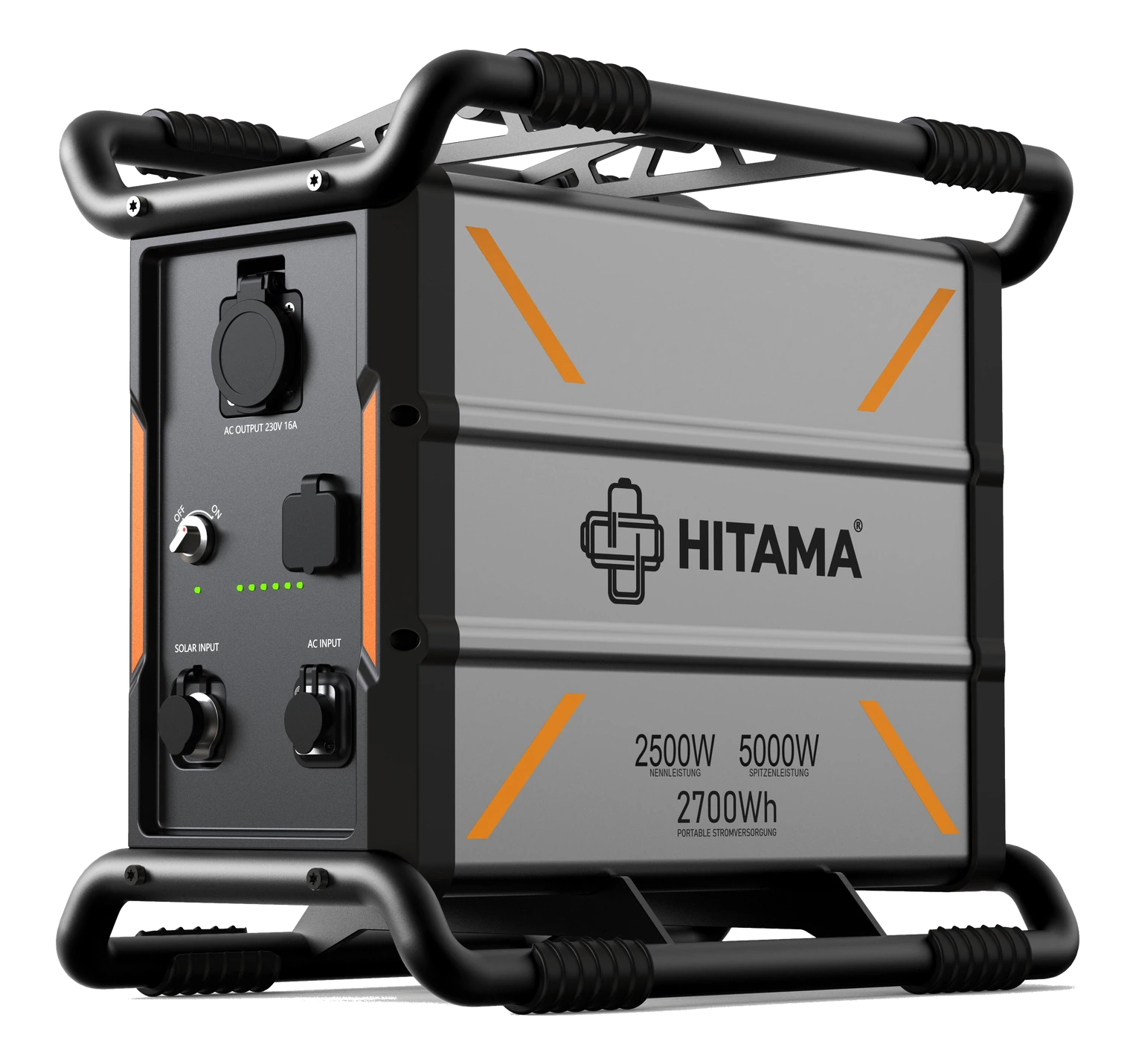
Two units add about three decibels, and ten add about ten. Parallel operation is a power decision that becomes an acoustic one: a second P25 lifts the peak from 5,000 W to 10,000 W for the same ten seconds and puts a second housing in the same place.
What belongs on the handover sheet
A noise figure that cannot be checked at handover is marketing. The line worth having carries four things: value, weighting, measuring distance and load state. With those four a fitter can repeat the measurement on site and land in the same order of magnitude.
The load state is the part fleets underestimate. A unit with nothing plugged in is a laboratory condition; a unit running a 1,500 W tool is what the neighbours hear, and that gap is usually wider than the gap between two models.
Where the sound comes from once the engine is gone
Our housings have no fan, no intake and no moving part, so the case carries no continuous source of its own. That is a mechanical statement, not an acoustic promise: no exhaust pulse, no refuelling, no air path pulling dust into the electronics. What remains is everything plugged into it.
The tool is usually the loudest thing on site, and it always was. A cut-off saw was never covered by a generator's noise figure either, though the generator was blamed for it.
Placement is the argument that changes a permit, and 29 kg is what makes it possible. At 2.7 kWh and 29 kg a P25 stands at the work face instead of behind a barrier, with no exhaust to route and no canister to carry. Moving a source from three to twelve metres off a boundary is worth roughly twelve decibels on paper, usually more than the difference between two machines of one class. What replaces them is cable, and cable is a load: thirty metres of 1.5 mm² costs about five percent of the voltage and turns the rest into heat.
What this is not
This is not a headline dB(A) figure we are printing here, deliberately. One number would have to carry a distance, a load and a background belonging to our bench, not to your site. What we can defend is narrower: no continuous source in the housing, and every figure arriving with its four conditions.
It is not an acoustic enclosure, and not a substitute for a barrier where a permit asks for one. IP54 is a housing grade for dust and splash, not a noise rating, and a sealed box is not a silent box. Nor is it a UPS or a connection into fixed building wiring: it supplies its own outlets, and on genuinely loud work the schedule moves the level at the boundary, not the source.
What to send us before the order
Start from the line you have to meet, not from the machine. The limit at the nearest dwelling, the hours it covers and the distance from the work face settle more than any rating plate. Send the tool list with the loudest item marked, the working hours and a photo of the position.
Then the power side can be answered with your numbers: whether one P25 at 2,500 W continuous covers the shift, whether two in parallel to 5,000 W make the position quieter or louder, and how the recharge runs at 500 to 1,500 W, roughly two hours to 80 percent. Write to us at <https://www.hitama.net/en/contact>.