
The sentence that never arrives
A rental company sends a message in November. Not a large order, not a tender – just a question: could the outlets be arranged differently, because two tools hang on the unit at once and the cable currently runs across the handle. Or whether the units could carry a fixed number on the housing, because someone searches for one every hour in the yard.
The question is fair, specific and cheap to answer. It can still take three weeks. Not because it is difficult, but because it travels.
Four stations, four translations
When the supplier is a brand that has the unit built elsewhere, the message passes through four rooms.
First room: sales. Your question becomes an enquiry. It loses the tone it was asked in – the explanation of why the cable runs across the handle is the first thing to go.
Second room: product. Someone checks whether the change fits the range. This is not malice; a range survives by keeping variants limited.
Third room: production. Only here does anyone know whether a fixture has to be rebuilt, whether a drilling jig has to be recut, whether the change affects a series or a single batch.
Fourth room: back. The answer returns the same way, translated again.
Four stations can say no four times. But only the third one knows the price of yes.
Whoever owns the line answers differently
HITAMA is the brand for industrial mobile energy storage from Shenzhen Yusong Technology – we are the manufacturing, not the intermediary. That does not change the engineering. It changes the distance.
Someone standing at the line can answer the same question in one sentence, because the answer carries three things at once: what is feasible, what tooling requires, and what lead time follows from it. Those are exactly the three items our own answer to OEM and ODM enquiries names – configuration, voltage and quantity in, those three assessments back.
That is not a promise about speed. It is the observation that between question and answer there is no translation left to lose something.
Three questions that come before price
First: what exactly should change? An outlet arrangement is a different question from printing on the housing, and both are a different question from a different voltage. Pack all three into one sentence and the answer is unusable.
Second: how is the minimum order quantity defined? We print no number for it, deliberately: the same quantity means something entirely different depending on whether it applies per model, per series or per order. While the definition is open, every number is incomparable – ours included. Settle the definition first, then the number.
Third: is the territory protected? A rental company that introduces a variant and finds it in a shop window three streets away six months later has lost more than revenue – it has lost the positioning work. That question belongs in the first conversation, not the third.
Why a voltage is not a socket
The most common change request is 400 volts three-phase, because mixers, cut-off saws and extraction run on it. It is also the most commonly underestimated.
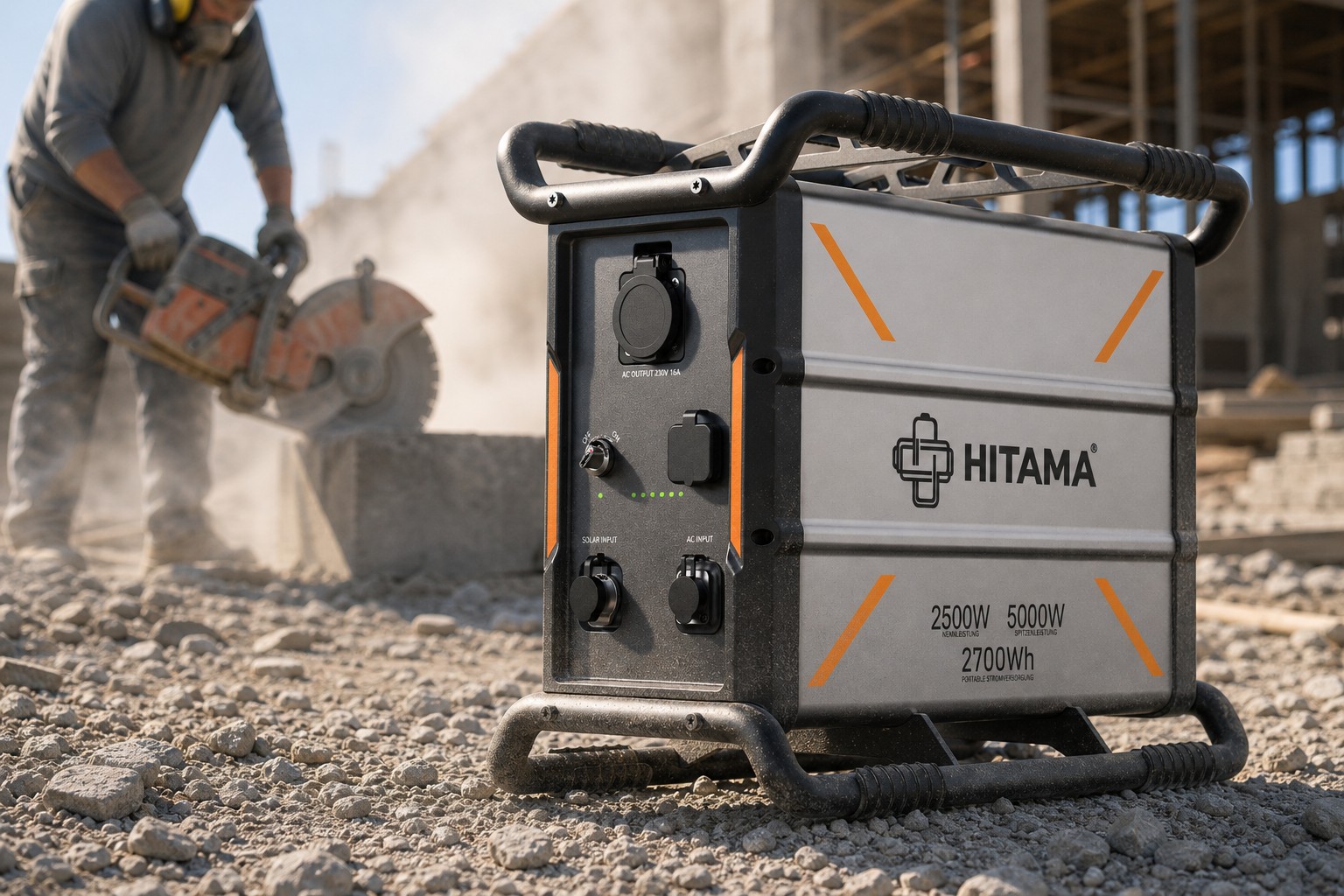
Our own published figures show why. P25: 2,500 watts continuous, 5,000 watts peak, 2.7 kilowatt hours, 29 kilograms. P25-T: 7,500 and 15,000 watts, 8.1 kilowatt hours, around 90 kilograms, 400 volts three-phase. These are manufacturer's specifications, not measurements taken in your operation.
Between those two lines sits not a different socket but a different class of machine – different weight, different way of transporting it, and a different answer to who carries it up the stairs alone. Frame that as a socket request and you get either a no or a quote that does not fit.
The difference between an answer and a commitment
A brand can promise. Only production can schedule. That is the whole difference, and it shows up in one question worth taking into any first call: what is the name of the person who owns the line?
Get a name and the path is short. Get a department and the answer is a translation – and translations reliably lose exactly the detail you asked about: the cable across the handle.
What a rental fleet brings along
Three details decide feasibility before anyone discusses money: the voltage and starting current of the tools, the quantity per year rather than per order, and where the unit has to run – indoors or out, dusty or not, at what temperature.
Bring those three and an enquiry becomes a decision. Leave them out and you get an interim answer – which always costs a week.