
The first year is the only honest year
A diesel really is the cheaper machine in year one, and a model that hides it is not worth reading. The purchase is smaller, the fuel is bought by whoever needs it that week, and nobody has to plan a charging bay. What goes wrong is pricing a five-year horizon with one-year habits: the first column is measured, and the remaining four are assumed to look the same.
The curves separate immediately after the invoice. Three of them move against each other — what the unit is still worth, what it costs to keep it running, and what the energy inside it costs once the rules around that energy tighten. None of the three appears on a quotation, which is why the cheapest machine in year one is so rarely the cheapest in year four.
The unit is worth what can be measured on it
A used diesel is priced on running hours, service history and emissions class, and all three only move one way. Hours accumulate, the service file gets thinner at every change of owner, and the emissions class is a step function: the day a stage is superseded, every unit below it is repriced at once.
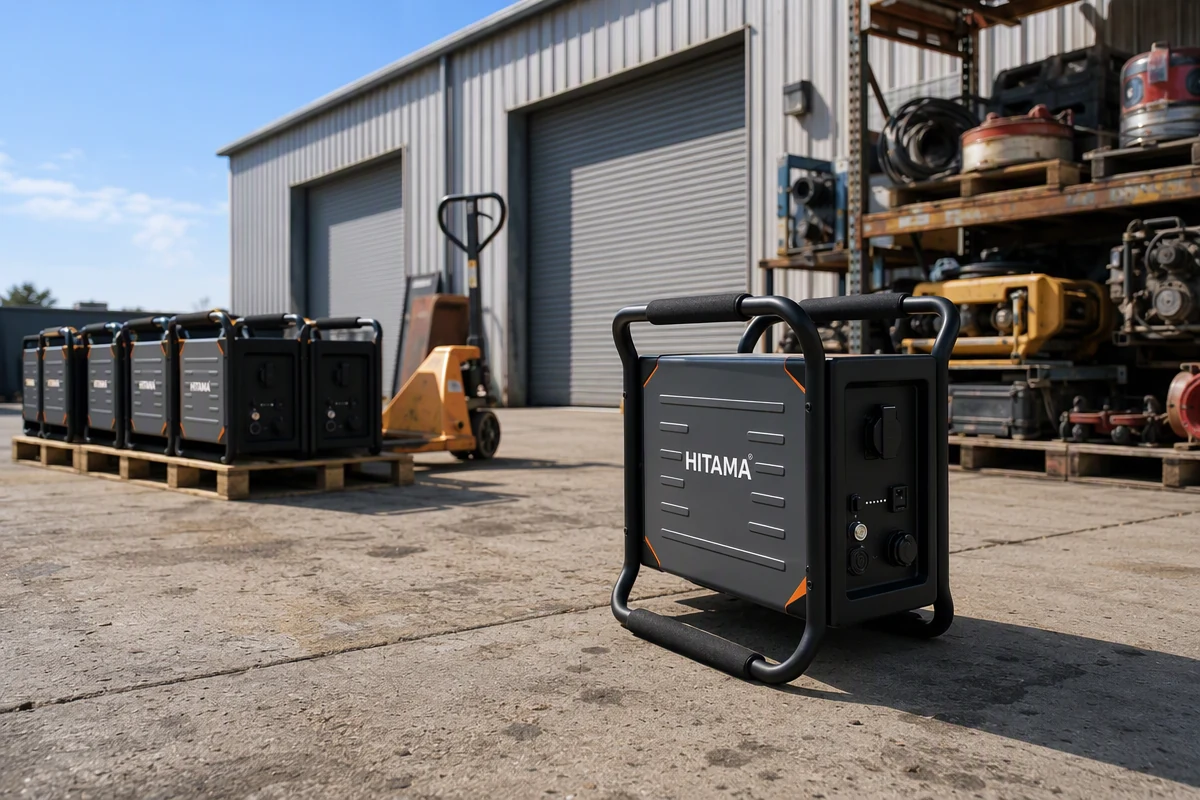
A battery is priced on a capacity that can be measured in an afternoon. State of health is a number a tester prints, and it does not depend on how well the paperwork travelled. Two P25 in parallel as a P25-D carry 5,000 W continuous and 10,000 W peak, 5.4 kWh between them at around 60 kg.
Maintenance is a calendar cost, not an hours cost
The expensive part of a diesel is not the fuel, it is everything that has to happen whether or not the machine works. Oil and filters on an interval, fuel ageing in the tank, an injection system that punishes a dirty can. A unit that stands in the yard all winter still needs most of that before it goes out again.
A sealed, fanless unit takes the air path out and with it a whole service category. No intake, no fan, no filter clogging in dust, no moving part in the cooling circuit: what survives on the list is inspection, charge and connectors. What it does not remove is labour. The 2.7 kWh in a P25 has to be put back, at 500–1,500 W of charging input, 80 percent in about two hours and full in 2.5 hours. The charging window is a cost line, and it belongs in the model.
The third curve is not on the invoice
Carbon cost does not arrive as an item you can decline; it arrives as a number that gets revised while the asset is still in service. A price reviewed annually turns a fixed fuel budget into a five-year exposure, and it lands hardest on the machine that burns something. On a battery the same cost sits upstream in the electricity price, which is a different curve with a different direction.
The point is that it is the only one of the three guaranteed to be re-set inside the ownership period. A model that holds it constant for five years describes a market that no longer exists.
What the model needs before it can answer
Four inputs decide the crossover, and only one of them is on the datasheet. Hours per year, load per shift in watts, the length of the refuel or recharge window, and what the unit is assumed to be worth at the end. The load figure is the one most often wrong: not the sum of the rating plates, but the watts that actually run, and a 2,500 W continuous unit with a 5,000 W peak for ten seconds covers a surge a continuous figure cannot.
What this is not
This is not a claim that a battery is cheaper on every site. Below a certain number of hours the diesel wins on every column and keeps winning; a machine that runs one shift a month does not earn back its charging logistics. Nor is this a price list: we publish no prices, lead times or minimum quantities, and no figure here is a quotation.
What we can put in writing is narrower and checkable. CE under the EMC Directive 2014/30/EU with test report A2409245-C01-R01-V1, UN 3480 class 9 packaging for sea transport, UN38.3 and MSDS, IP54 as an enclosure class and not a certification, an operating range of −10 to 65 °C, and a ten-point test protocol per unit with serial number and firmware recorded.
Send the four inputs and we will run the model with you. Hours, load, window, residual assumption — through https://www.hitama.net/en/contact — and we will say where the crossover sits in your fleet rather than in ours.