
The limit is written at the fence
The figure on a night permit is measured at somebody else's window, not at your machine. The authority did not write down what your supply may produce; it wrote down what may be audible at a defined point outside the site at a defined hour. The subject of the permit is the night, not the device.
A limit at the boundary is a statement about sources, and in a diesel night the source is the engine. Exhaust pulse, cooling fan, a canopy that radiates after two hours, a refuelling stop at 23:00 — that is what the neighbours hear, and that is what the paper was written against. Our housings have no fan, no intake and no moving part, so the case adds no continuous source of its own; that is a mechanical statement about an enclosure, not an acoustic promise, and we will not turn it into a decibel figure that travels without its conditions.
A permit removes tools before it removes watts
The first thing a night permit deletes is not capacity, it is your tool list. A cut-off saw at 02:00 is the same objection with or without an engine on site. Sites that plan a permitted night in kilowatts plan the wrong quantity; the shift is written in permissible hours of specific work.
A quiet supply does not launder a loud tool. The saw has to be scheduled on its own terms, and what the station changes is only the size of the argument around it. Once the loud items are out, the remaining list — LED lighting, hand tools, a blow-down, radio and phone charging — is small, continuous for six or eight hours, and that is the trap: modest watts that never stop.
What a night window costs in kWh
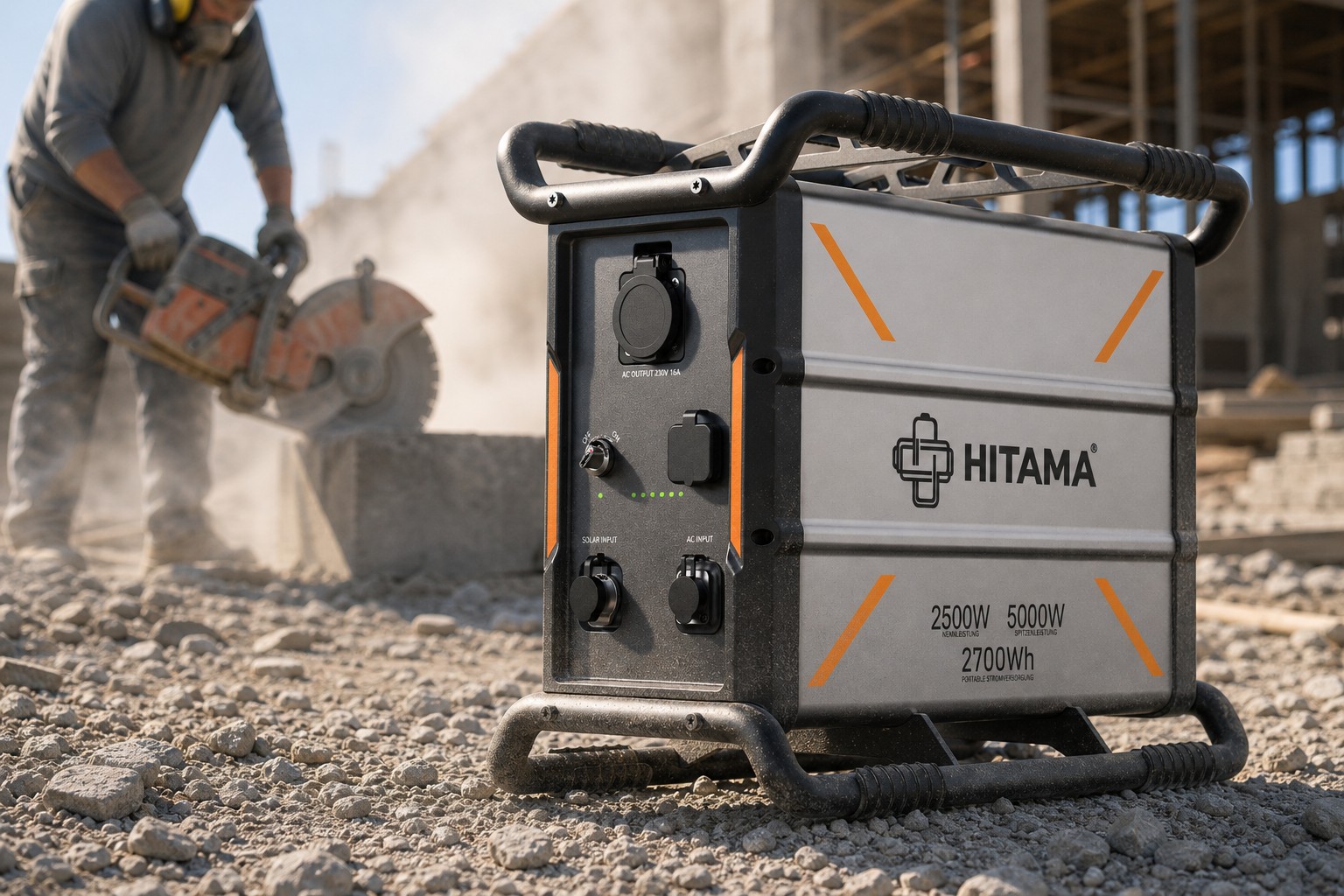
Capacity is a division, and the divisor is the quiet load, not the biggest tool. A P25 holds 2.7 kWh behind 2,500 W continuous and 5,000 W of peak for up to ten seconds. At 400 W of lighting and small loads that is under seven hours on paper — and paper is where the figure should stay until the duty cycle has been measured at the position.
Peak answers a start question and no energy question. The same 5,000 W starts a compressor and then hands over to the continuous rating; it adds no hour to the night. Where the window needs hours, the answer is capacity: the P25-D at 5,000 W and 5.4 kWh, the P25-T at 7,500 W and 8.1 kWh on 400 V three-phase at 10 A when the permitted work is itself three-phase.
Charging is the part of the night you can move
The charger is the only load that sits inside a quiet window without an argument. Charging input is 500–1,500 W; a P25 reaches 80 percent in about two hours and full in 2.5 hours. That window is movable work, and it can run at the position overnight while nothing else is allowed to make a sound.
A charge window that is not planned is a shift lost in the morning. A unit expected back on hire at 07:00 after a night that ended at 05:00 was never available for the next shift. And a live 230 V 16 A socket at 04:00 is a site question: whether that circuit exists at the position decides the night earlier than the machine does.
What this is not
This is not a claim that the station is silent. We do not print a dB(A) value that travels without weighting, distance, load state and background level, because a number like that is an adjective with a unit attached.
It is not a UPS and it does not feed a building. There is a gap between mains failure and the unit taking load, and the station supplies its own sockets, never a fixed distribution board. IP54 is dust protected and splash resistant, not immersion proof and not for explosive atmospheres; the operating range is −10 to 65 °C. None of that replaces the permit.
What to send us before the order
Send the permit line and the tool list, not the wattage you already have in mind. With the value on your permit, the distance to the boundary you have to respect, the hours of the window and the tools you intend to run inside it, we can say which configuration covers the night and which part of the plan belongs in a conversation with the authority instead. Write to us at https://www.hitama.net/en/contact.