
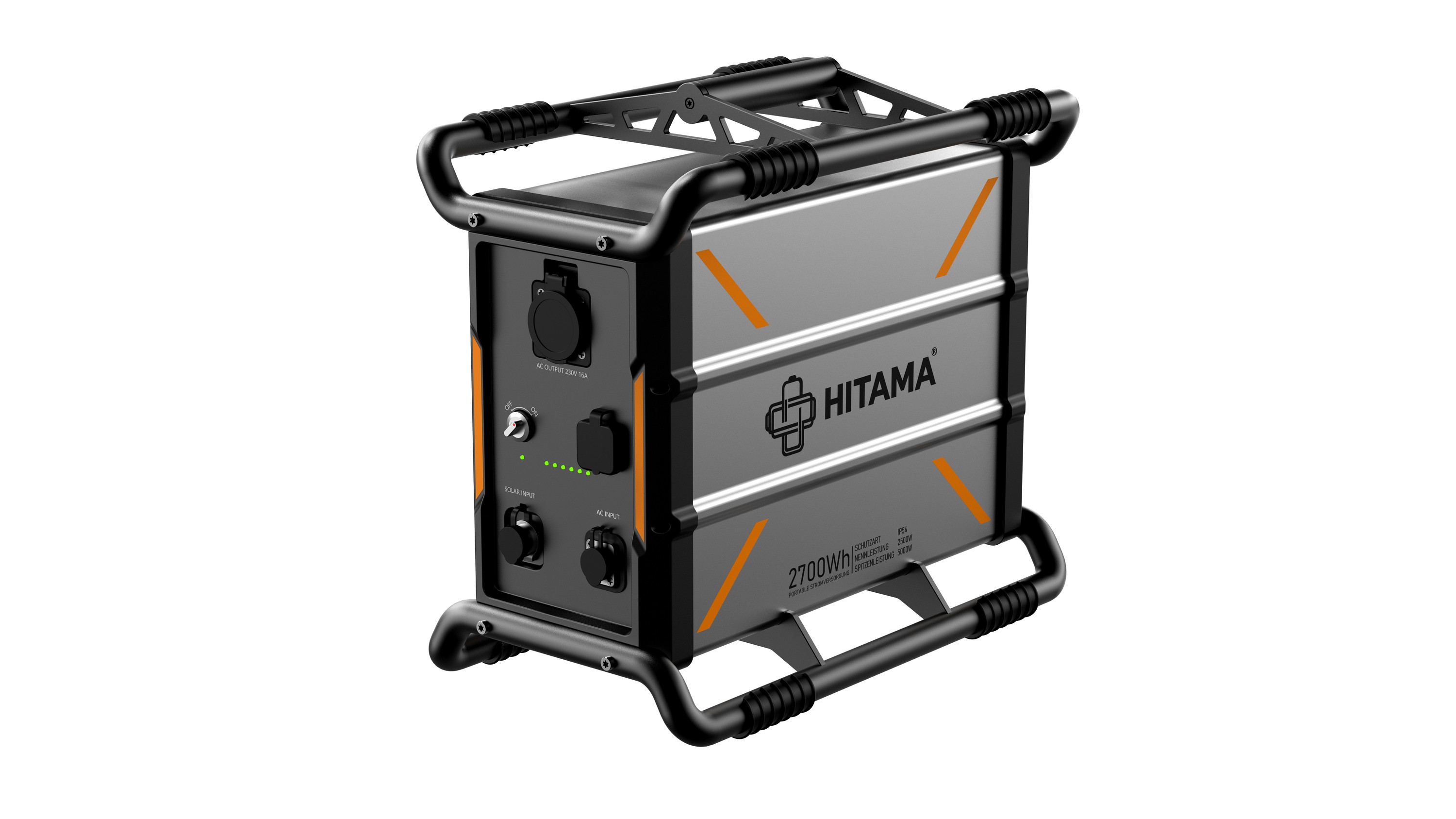
A roof is a mounting decision, not an energy decision. An array standing on the ground beside a farm building can be angled better than one bolted to a roof — and it still delivers nothing the battery cannot accept.
The roof was never the energy part
Most solar-on-site arguments are roof arguments. On a roof or on a frame in a field, the same kilowatt-hours reach the pack through the same two numbers: what the array delivers in a day, and what the unit accepts while it delivers.
Portable equipment moves the question, it does not answer it. A P25 weighs 29 kg and goes where the work is, so the array can stay where the sun is. That is a logistics advantage, worth nothing until the daily arithmetic closes.
The arithmetic is small. A 2.7 kWh pack is one shift of a few tools or one night of a few lights, not a farm's energy budget — and the array has to refill it before the next one.
The charger caps what the array can deliver
The charging input of the P25 is specified at 500–1,500 W. Whatever feeds it — a socket or a PV inverter on a 230 V lead — has to live inside that window. An array that makes 3 kW at noon does not put 3 kW into a 2.7 kWh pack.
Panels beyond that window buy kilowatt-hours nobody stores. The surplus is not banked, it is simply not taken. Two panels matched to the input window do more for a night shift than four spending noon against a limit the charger set.
Charging is quick when the power is there. From a socket the P25 reaches 80 percent in about two hours and is full in 2.5 hours. On an array those two hours exist only when the sun does.
Only the day is a workable unit
Panel nameplate is a laboratory figure at a fixed irradiance and cell temperature. What decides whether the machine is ready tomorrow is kilowatt-hours into the pack per day, at your site, in your month, at your angle — a local planning value or a measurement, never the figure on the carton.
Two clocks have to overlap. Work and sun keep different schedules: the load runs morning and afternoon, the array peaks at midday. A unit out with a crew cannot charge at the same time, so a site needing both carries a second unit or accepts evening charging.
Days without sun belong in the design. Three overcast days in December are normal, not exceptional. A plan that closes only in clear weather has no reserve, and the reserve has to come from a socket, a second unit or a shorter load list.
Size for the month you work through, not the year
An annual yield figure flatters a winter job. The same array in June and in December is not the same machine. If the work runs into the dark months, size on the worst month you intend to work through and accept that the array looks oversized in July.
Seasonal work inverts the answer. For irrigation the sunniest and the busiest weeks coincide — the one case where a modest array carries a real duty cycle, because load and yield rise together.
Where the panels stand costs cable
Thirty metres of 1.5 mm² is a load before it is a connection. The copper bringing the array's output to the charger carries a voltage drop, paid every hour the sun is up. Distance between array, unit and work face is a sizing input, not a layout detail.
Everything outdoors is a wind load. Frames, ballast and tie-downs fail first, and none of it is electrical. A panel lying flat after a storm is a kilowatt-hour that never arrived.
What this is not
This is not a claim about panel-to-battery electronics. What we document is the charging input: 500–1,500 W from a 230 V source. The array, its inverter and its protection are a separate design that has to match that window; a supplier who skips the match sells panels, not a power plan.
It is not autonomy, and it does not replace your connection. A 2.7 kWh unit with an array is a working day with a refill, not a farm running itself through a grey week. The rated figures — 2,500 W continuous, 5,000 W peak for up to 10 s, 230 V 16 A — describe what the unit supplies. It feeds its own sockets, not a building's fixed installation; IP54 is dust-protected and splash-proof, and there it stops.
If you are working out whether a free-standing array can carry a specific job, send us the month, the site and the tool list you actually run — those numbers settle on paper long before anyone buys a panel: https://www.hitama.net/en/contact