
What this decision is really about
Anyone adding portable power to a rental fleet or a dealer range is not making a product decision but a fleet decision. The difference is substantial:
- An end customer decides on one unit for one deployment.
- A fleet has to cover many deployments with changing operators, changing environments and changing return dates.
Most datasheets are written for the first case. This checklist is for the second.
Part 1 — Designing the fleet
How many base units, how many extensions?
If your fleet works with one power class, it grows wrong at the edges: too small for large sections, oversized and unused for small ones.
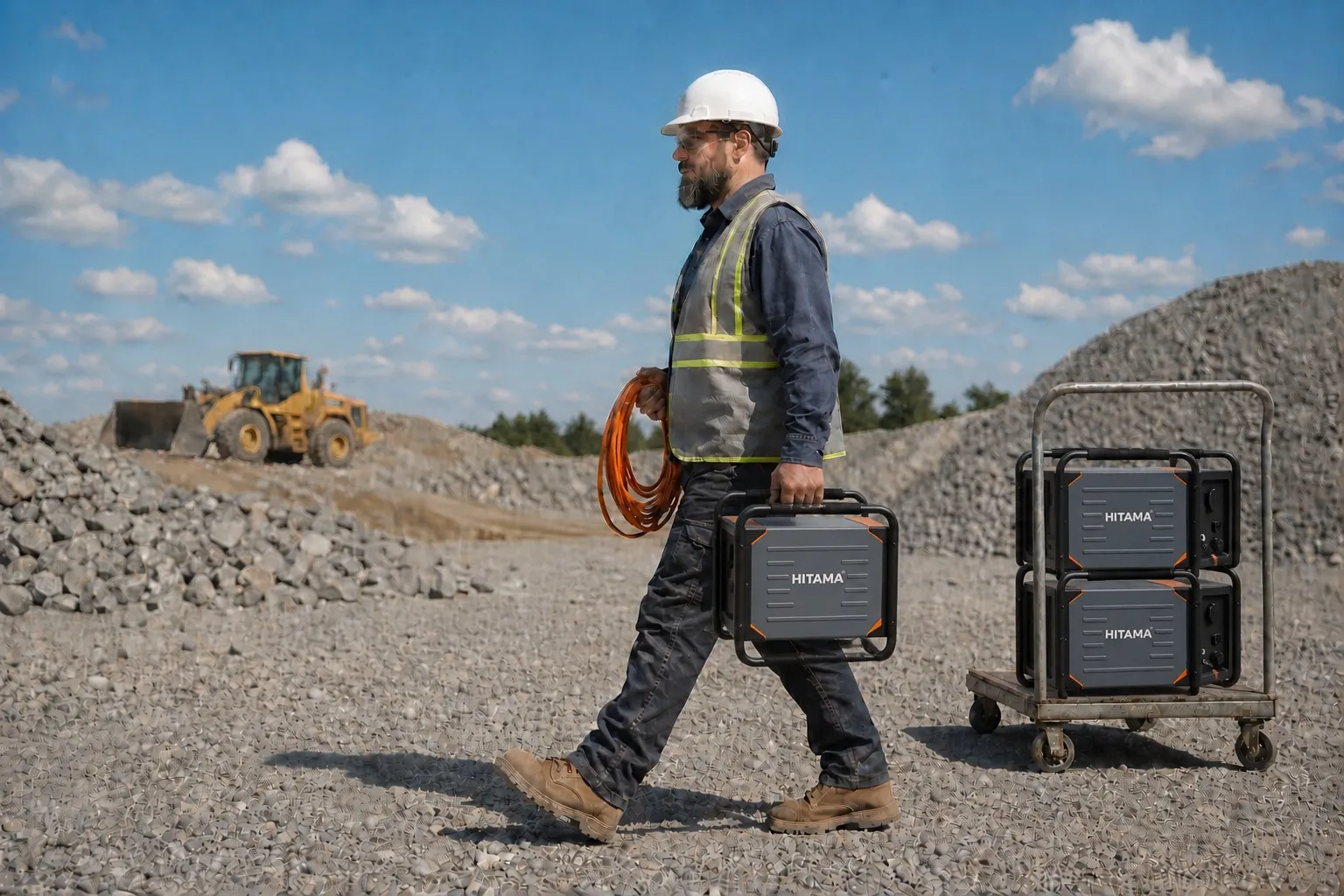
So check whether the units are parallel-couplable. HITAMA P25 series units are: 2,500 W single, 5,000 W with P25-D, 7,500 W as 400 V three-phase with P25-T — at 230 V / 16 A and 29 kg per unit.
For a rental fleet this creates three advantages that show up directly in utilisation:
1. One series instead of three — training, spare parts and stock stay manageable.
2. Scaling at the rental object — the customer takes two or three units when the section requires it.
3. Hand transport stays possible — 29 kg per unit means no lifting equipment has to be organised for set-up. On rented sites that is often the difference between "gets used" and "stays in the container".
What happens if one unit fails?
With a monolithic large unit a failure is a total failure. With a couplable series the deployment stays workable and only the affected unit goes to the workshop. Check this before you size — in a damage case it is no longer a design choice.
Part 2 — Fitness for operation in a rental set
| Requirement | Why it weighs differently in rental | Question to the supplier |
|---|---|---|
| Behaviour under dust and moisture | Rental units see more sites than owned units | Which degree of protection, and how is it cooled? |
| Maintenance-light construction | Maintenance depends on changing operators | Are there moving parts in the cooling circuit? |
| Spare parts supply | An idle unit earns nothing | Which parts are consumables, and how fast are they available? |
| Handling | Set-up and dismantling time is unpaid time | Weight per unit, handles, footprint |
| Connection variety | One unit has to fit many tool types | 230 V single-phase, 400 V three-phase, number of outlets |
| Scalability | A small section must not tie up a large system | Couplable? Up to which total output? |
Part 3 — The six points that should be in writing before any order
This list is deliberately manufacturer-neutral. Ask every supplier to answer it — including us.
1. Rated and peak output, separately, with the duration of peak output in seconds. "Briefly" is not a figure.
2. Usable energy at a stated depth of discharge. Gross capacity without depth of discharge says nothing about deployment.
3. Construction and cooling: fanless through the enclosure or active with an air intake — and whether there is an intake duct that can clog.
4. Spare parts logistics: which components are consumables, with what lead time, and who handles service in your region.
5. Weight, dimensions and footprint per unit — plus whether units can be combined with each other.
6. Documentation in your language: operating manual, safety notes and the figures your renters can read themselves.
Point 6 is the one that most often leads to complaints in rental. A unit whose safety notes exist only in a language the operator does not read creates liability and accident risks that have nothing to do with the unit.
Part 4 — What to check yourself before choosing a range
- Fit with your rental structure: does the unit complement your existing site distribution boards — or does it pull a second type of distribution board after it?
- Resaleability: can the series be resold unit by unit, or only as a complete system?
- Utilisation forecast: what rental duration do you expect, and does the unit's energy cover a typical rental period without recharging?
Part 5 — A sequence that produces a defensible decision
1. Pick two typical rental cases from your history — one small, one medium.
2. Build a load profile for both (simultaneity, inrush, deployment duration).
3. Put both load profiles to each supplier as a sizing enquiry, not as a price enquiry.
4. Lay the answers to the six points in Part 3 side by side.
5. Only then discuss commercial terms.
Step 3 is the important one: a sizing enquiry shows you in a single answer whether the supplier understands your application. A price enquiry shows you only a number.
---
Do you run a rental fleet or a specialist dealership and want a trial unit for two typical rental cases? Send us your load profiles — we will work through the sizing with you. Prices on request, because the configuration depends on your rental portfolio.