
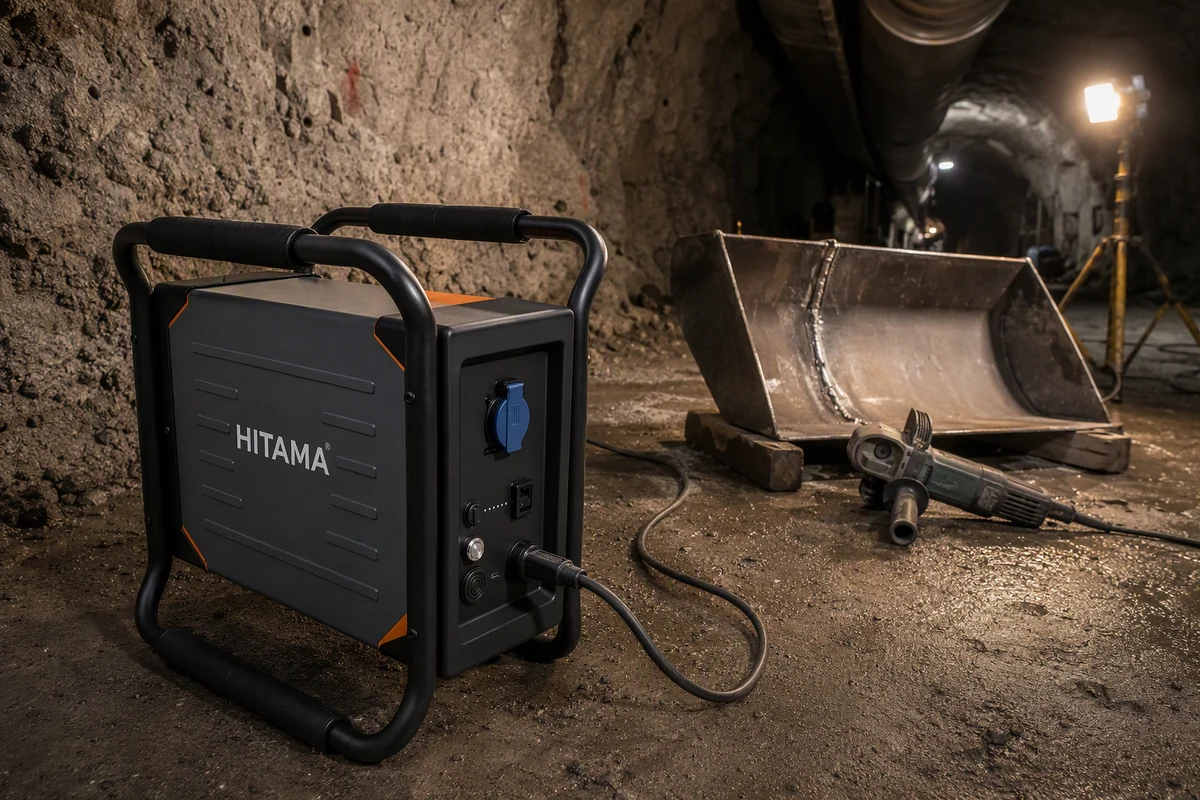
In a development heading, a generator is not one load. It is a second one on the airway. The ventilation plan already states how much air moves through the drift and what that air has to dilute. A combustion unit parked in the drift spends from the same account.
The heading has one way in
Exhaust is charged against airflow, not against the fuel budget. A ventilation plan is drawn around the equipment that burns something, and anything added afterwards either fits that number or changes it.
The service bay is usually the last item on the list. A weld on a bucket, a socket for hand tools, light over a gearbox: the work appears at the end of a drift after the plan is fixed, and it is raised as an electrical question when it is an air question.
A sealed unit stays out of that calculation. HITAMA has no intake and no exhaust at the machine. Nothing is drawn from the heading, nothing is discharged into it, and the airflow stays available for equipment that has no alternative.
Dust is the second bill
An intake is a filter with a lead time. Underground, a filter is a part you store, change and account for, and a cooling path that draws air through the casing turns dust into a maintenance item.
There is no fan and no intake in the cooling path. Heat leaves through the casing: no impeller, no bearing, no filter to schedule. In a dusty drift that removes a task instead of adding one.
IP54 is the claim, and it is a limited one. Protected against dust in quantities that would interfere with operation and against splashing water — not a sealed-for-life statement. The working range is −10 to 65 °C, and a refuge or a hot sump may sit outside it.
What the bay draws
The list is shorter than expected. A 160–200 A inverter welder, a 230 V socket for grinders and lights, a charge point for cap lamps. P25 is rated 2,500 W with a 5,000 W peak and 2.7 kWh: the peak covers the strike, the rated figure covers the shift.
Four hundred volts is a phases question. A 400 V welder or motor does not run from a single-phase unit, whatever its wattage says. P25-T combines three modules to 400 V three-phase at 7,500 W rated, 15,000 W peak, 8.1 kWh — pure sine, THD under 3 percent, so weld sets and chargers share a strip.
Where the weld is heavy, the peak column does the work. P36 is rated 3,600 W with a 20,000 W peak from 2.1 kWh; P36-D doubles it to 7,200 W and 40,000 W, and P36-T reaches 10,800 W and 60,000 W at 400 V three-phase from 6.3 kWh.
Getting it to the drift
The drift sets the size before the load does. P36 is 21–23 kg and P25 is 29 kg, a two-person carry. The P36 family stays manageable as it grows, around 40 kg as a double and 60 kg as a triple; the P25 triple is roughly 90 kg, which is a trolley or a flat wagon.
Charge at the portal, work on the shift. The 230 V socket input draws 500–1,500 W. P36 charges fully in about 1.5 hours; P25 reaches 80 percent in about 2.
One to three modules is a configuration, not a second machine. Each unit ships after a ten-point process across incoming inspection, a burn-in rack and final inspection; CE under the EMC Directive 2014/30/EU, and UN 3480 class 9 packaging for sea freight.
What this is not
It is not ventilation. It replaces nothing in the ventilation plan and it is not a substitute for airflow through a heading. It only stops being a consumer of that airflow.
It is not explosion-protected equipment. The certifications it carries are CE under the EMC Directive and UN 3480 class 9 packaging. No Ex rating is claimed, and it is not for an atmosphere where one is required.
It is not a mine supply. It feeds its own outlets. It cannot be wired into a fixed installation, and it is not a standby supply for the drift's distribution.
Send the load list — the machines and their rating plates, the hours per shift, the voltage, the drift width and how the unit will be moved in. We will size the configuration from it and tell you what it carries and what it does not.