
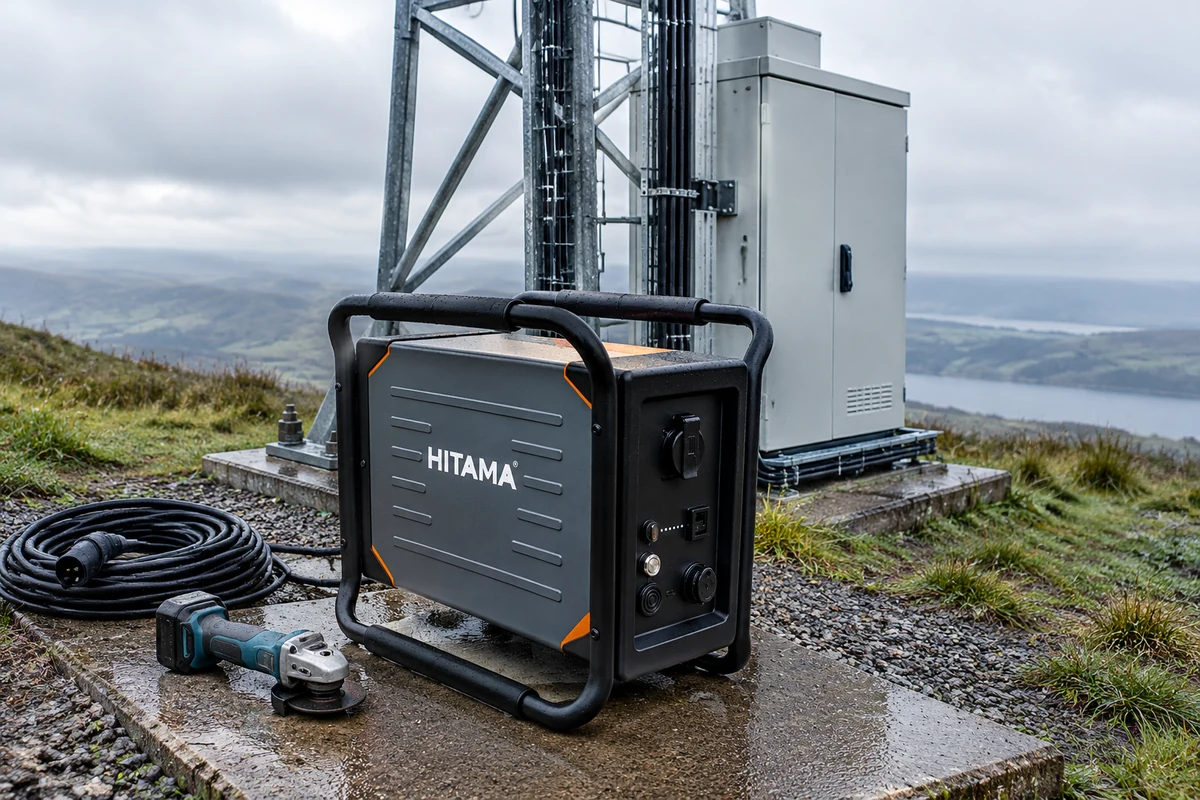
A radio site is energized all year and still gives a visiting crew nothing to plug into. The mast is live, the cabinet is warm, the monitoring says the site is healthy. None of that is a socket, and the tools still need 230 V.
Live is a state, not an outlet
A healthy site is a statement about the radios. The rectifier shelf is populated, the ways are assigned, the alarm panel is quiet. Nothing in that picture includes an outlet for a heat gun and a grinder.
The nearest socket belongs to the network. Freeing a way means taking a circuit off its monitoring and putting it back — a permission and a procedure, not a favour between two vans. A portable unit keeps the tool circuit outside the site's installation.
The count starts at the vehicle. Heat gun, torque driver, impact wrench, grinder, test set, laptop, work light, chargers. Written down with plate watts, that list is the sizing exercise.
What the climb decides
Weight is a specification when the last stretch is on foot. The track ends, the gate is locked as often as not, and the last hundred metres are carried. C24 is 23 kg, P25 is 29 kg, P25-D around 60 kg on a trolley.
Two modules are two trips. Parallel units solve output, not handling. Where access is the constraint, a three-module frame is a decision about manpower rather than watts.
Whatever goes up stays up for the shift. A unit left in the vehicle is a cable run and a wet walk back. That is settled before loading, not at the gate.
Small loads, long shifts
The mast does not draw the current; the tools do. Test equipment and a laptop are a few hundred watts, and they dislike a dirty wave: output is a pure sine wave with total harmonic distortion under 3 percent.
A heat gun is not a motor. A resistive tool draws close to its plate figure and no more, while a grinder pulls a multiple of running current as it comes up to speed. Hence two columns: P25 is 2,500 W rated with a 5,000 W peak from 2.7 kWh, C24 2,400 W with a 4,800 W peak from 2.0 kWh, P36 3,600 W with a 20,000 W peak from 2.1 kWh.
Duration runs out before output does. A full shift on a light load is a kilowatt-hour question, not a kilowatt one. P25-D puts two modules in parallel for 5,000 W and 5.4 kWh when a grinder and a heat gun run for hours.
Four hundred volts is a separate question. If a three-phase tool or hoist is on the list, no single-phase unit covers it at any rating. P25-T combines three modules to 400 V three-phase, 7,500 W rated and 15,000 W peak from 8.1 kWh.
Weather, dust and the shelter
Salt and dust have nowhere to go, because nothing is drawn in. No intake, no fan, no filter to load. Heat leaves through the casing, so clearance around the unit matters. IP54 is splash protection.
Measure the temperature where the unit stands, and recharge at the depot. −10 to 65 °C is the working range, and a sealed shelter in direct sun is not the air temperature in the car park. From a 230 V socket the input draws 500–1,500 W: P25 reaches 80 percent in about two hours and full in 2.5, P36 in about 1.5. On a site with no socket, that window belongs to the evening before.
What this is not
It is not the site's standby supply. There is no changeover and no connection to the rectifier plant. Nothing here keeps the radios on air; that is the network's own provision.
It is not a UPS. There is a gap between the mains going and the unit being plugged in, and a live test sees it.
It is not part of the installation. It feeds its own outlets and cannot be wired into the fixed distribution.
IP54 is not submersion, and no Ex rating is claimed. The certifications are CE under the EMC Directive 2014/30/EU and UN 3480 class 9 packaging for sea freight.
Send the load list — every tool with its plate watts and starting method, the hours on site, the distance from the vehicle to the mast, the temperature inside the shelter, and whether a 230 V socket exists for recharging. We will size the configuration against those numbers and tell you where it stops.