
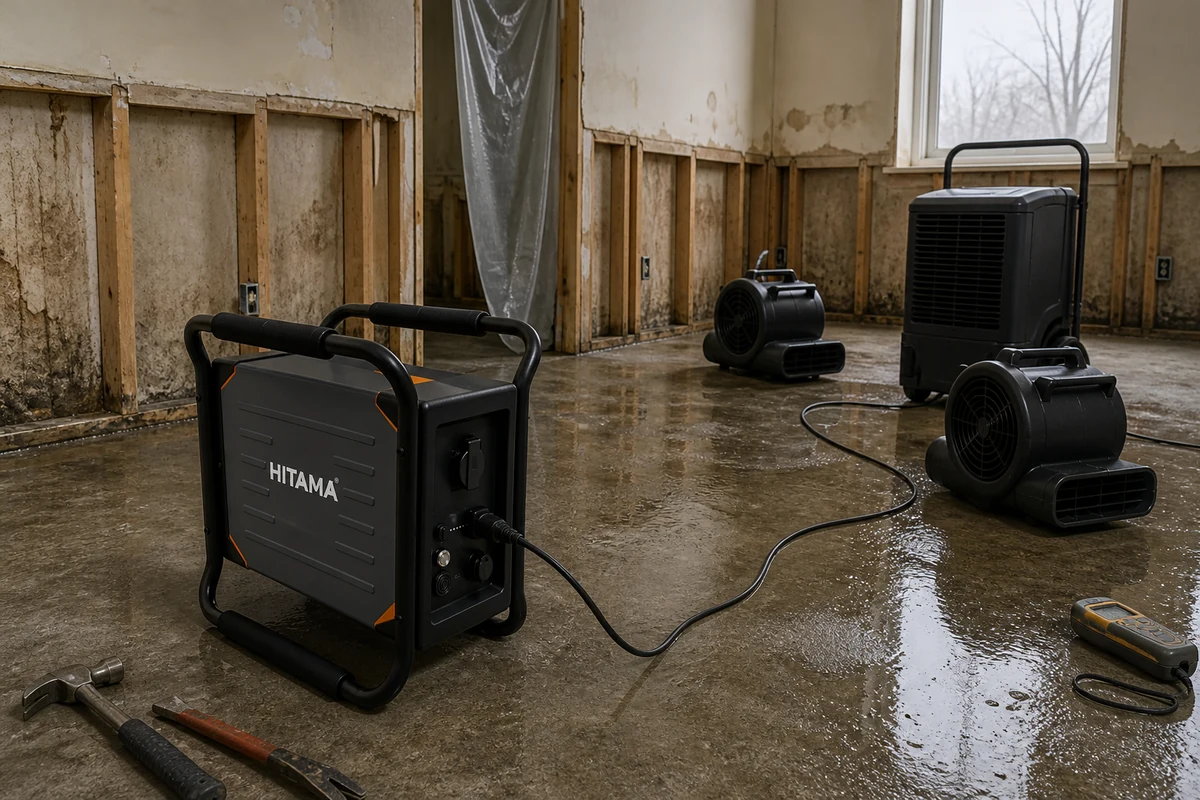
Water damage is dried on a temporary supply, not on the building's own. The incident is over within the hour. The drying runs for weeks, and in between sit an electrician's diary and a consumer unit that cannot be energised.
The load is small; the tail is long
A drying set is not a heavy load. A refrigerant dehumidifier and two air movers — the standard trio for a flooded ground floor — sit inside what a domestic circuit would carry.
What makes it a power problem is duration. The equipment runs through the night, through the weekend and through the week an assessor needs to see a trend, with nobody standing next to it.
Sizing starts at the rating plate. Add the running watts and multiply nothing but time. P25 is rated 2,500 W with a 5,000 W peak and holds 2.7 kWh. P25-D pairs two modules: 5,000 W rated, 10,000 W peak, 5.4 kWh. The peak figure covers a motor's start; the rated figure covers the hours.
The supply is usually the casualty
Circuits that stood under water come off first. They stay isolated until they are tested and cleared. That is the correct order, and it is not the drying contractor's call.
Nothing is wired in, and the two schedules do not match. Drying has a window that opens when the water is extracted; reconnection has a queue that opens when an electrician is free. The unit stands on the floor and feeds its own outlets — no consumer unit, no isolator, no temporary supply application.
Overnight, sealed, unoccupied
A drying job is unattended by design. The occupier is in a hotel or with relatives. The building is locked. Whatever runs at 03:00 runs alone.
Combustion indoors is an exhaust decision. A petrol unit on a sealed ground floor needs its exhaust routed outside and checked, and with the windows shut that is a constraint, not a formality.
HITAMA has no intake and no exhaust. The enclosure is fully sealed: no fan, no moving part in the cooling path, heat leaving through the casing. Nothing is ducted out, and nothing draws damp air or dust through the machine.
IP54 and the −10 to 65 °C range are the lines that matter. Damp screed, splash from a pressure washer and standing water in a hallway are ordinary conditions here; a drying chamber held warm stays inside the operating envelope.
Placement, rotation, configuration
Put the unit in the wet room, not the hallway. Three extension leads through doorways lose more to cable runs and trip hazards than a larger machine gains.
Rotate on charge state, not on the clock. The 230 V socket input draws 500–1,500 W. P25 reaches 80 percent in about two hours and full charge in two and a half; P36 charges fully in about one and a half. Two units and a socket in the van is a working rotation.
Pure sine matters when the load is electronics, and parallel covers bigger floors. Drying logs, moisture meters and the assessor's laptop share the supply; output is pure sine with THD under 3 percent. One to three modules combine — P25-D at 230 V single-phase, or P25-T at 400 V three-phase, 7,500 W rated, 15,000 W peak, 8.1 kWh.
The file has to answer what ran, and for how long. A known capacity and a documented recharge reduce that to one line. Every unit ships after a ten-point test across incoming inspection, a burn-in rack and final inspection; CE under the EMC Directive 2014/30/EU, and UN 3480 class 9 packaging for sea freight.
What this is not
It is not a dehumidifier, and it is not a reconnection. It supplies power; the drying equipment does the drying. It does not test circuits, does not make a damp installation safe to energise, and does not replace an electrician's sign-off.
It is not a building supply. It feeds its own outlets. It cannot be wired into a consumer unit, and it is not a standby supply for the fixed installation.
It is not rated beyond IP54, or outside −10 to 65 °C. A hotter plant room is not its working environment.
Send us the load list — the equipment, the rating plates, the hours per day, and whether the building will be occupied overnight. We will size the configuration from it and tell you what it carries and what it does not.