
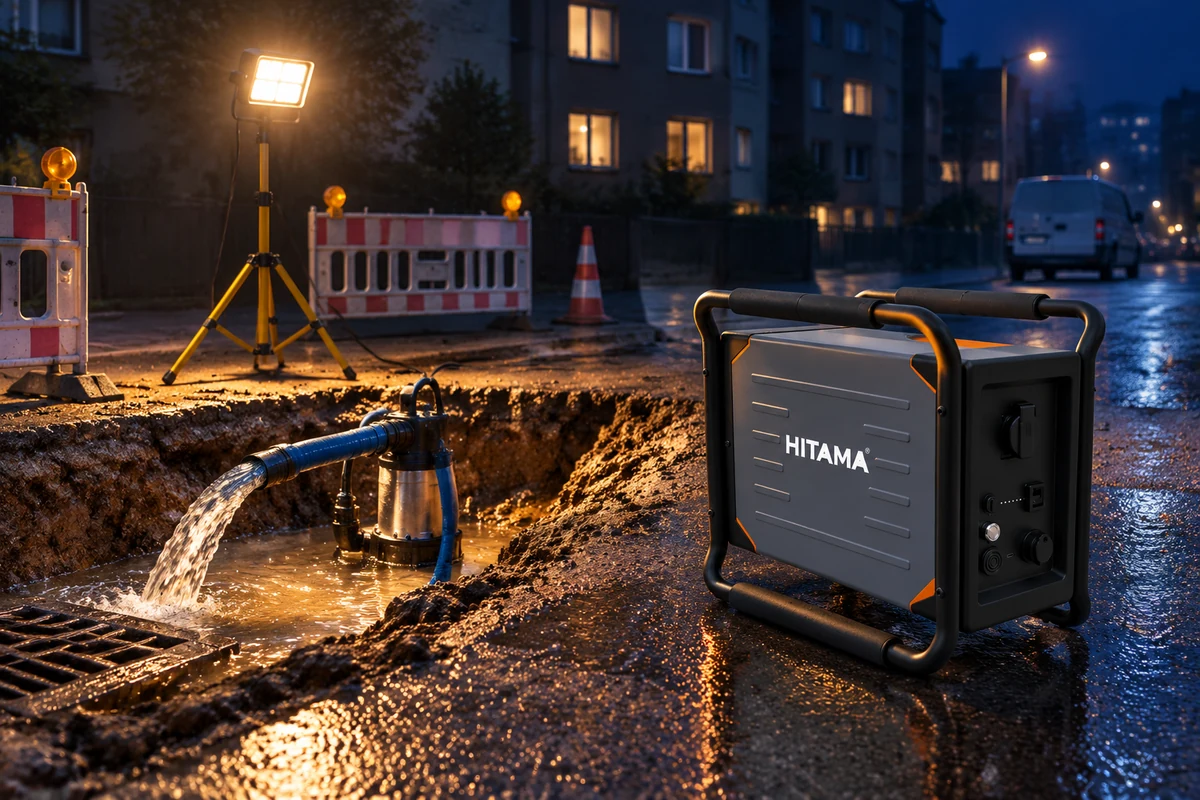
A night permit allows the work. It does not decide how the work is heard. In a residential street the second question arrives before the first lift of the breaker: what will be audible at 22:30, and who answers for it. Most disputes about night work are not about whether the job was allowed. They are about one sound that had no business being there.
What the measurement actually catches
Enforcement measures the site, not the tool. A reading at the boundary adds up everything running at that moment — the breaker, the pump, the compressor, and an engine that is running because something might need it in twenty minutes.
An engine is the wrong shape of sound. It is continuous, partly tonal, and it does not pause between tasks. A breaker is loud but intermittent; the ear and the meter both forgive a burst in a way they do not forgive a note that never stops. A generator left idling through a ten-minute job can cost more goodwill than the job itself.
The job is shorter than the shift
Night work is usually small and specific. A valve replacement. A cable pull. A pump that has to run until the water is down. A lift that needs power for two hours. The equipment list is modest; the engine is sized for a shift that does not exist.
Put the power where the work is. A battery unit stands at the excavation, inside the barrier, beside the tool — no cable run back to a van, no exhaust pointed at a doorway, no canister refuelled at two in the morning. The unit is fanless and sealed to IP54, so dust, spray and a wet pavement are ordinary conditions rather than a reason to move it somewhere less convenient.
What the numbers look like
The P25 is rated at 2,500 W continuous with 2.7 kWh stored, at 29 kg. For a night job that is a working budget rather than a supply: a submersible pump and site lighting for a few hours is an ordinary ask. A breaker running until dawn is not.
Where the load is heavier, the platform stays the same. Two units in parallel give 5,000 W at 230 V; add the distribution box and a third unit and the same arrangement moves to 400 V three-phase — 7,500 W with 8.1 kWh behind it. The output is a pure sine wave, which starts to matter once the tools have electronics in them.
Charging is a daytime task. From a 230 V socket the units take 500–1,500 W, so refilling takes hours rather than minutes. Plan it the way a fuel run used to be planned: before the shift, not during it.
The fallback nobody wants to use
Keeping a generator on site is a decision, not a default. If it stands there, it will be started — for the quick job, for the last hour, for the thing nobody planned for. A unit that covers the whole night removes the reason to keep an engine fuelled and idling at the barrier.
What this is not
It is not silence. The tool still makes the noise it makes. What disappears is the engine note underneath it, the exhaust at the barrier and the refuelling stop in the middle of the night. If the complaint is about the breaker itself, a battery does not answer it.
It is not unlimited. The store is finite, the unit has to be recharged, and a hard-starting motor is a different problem from a running load. IP54 covers dust and spray; standing water and an explosive atmosphere are outside it.
And it does not replace the conversation. The permit, the boundary reading and the phone call from the neighbours remain yours to manage. The unit only removes one of the reasons they call.
Tell us what runs between 22:00 and 06:00 — the tool, the pump, the lighting — and we will work out whether one unit covers the night, or the job needs two.