
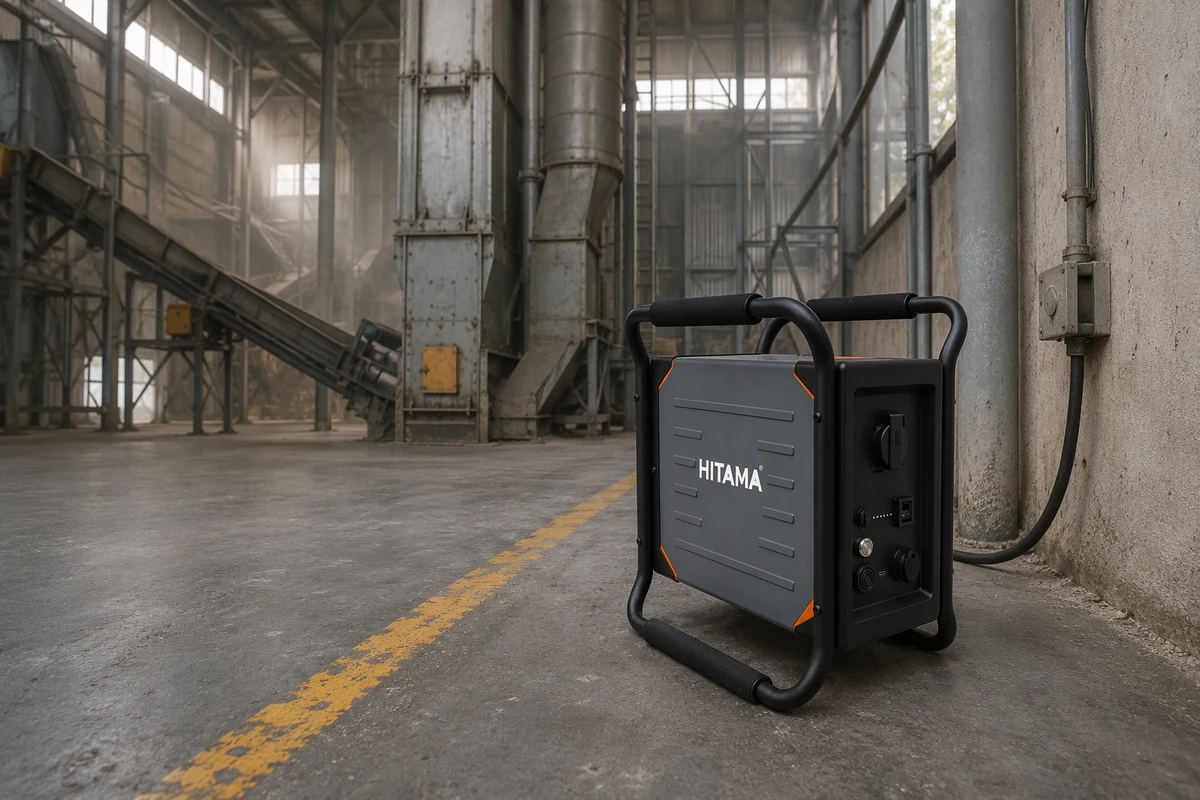
A classified dust area is settled by a drawing and a permit, not by a wattage. Position has already decided most of the answer before the model range is reached.
The drawing comes before the load list
Every grain intake, feed mill and bucket elevator pit has one document that outranks any datasheet: the site's own hazardous-area assessment. It draws a boundary around the places where dust can be released and names what may stand inside it.
Most maintenance work sits outside that boundary. A cooler, a bag filter house, a loading bay: the task is next to the classified area, not in it. That line, not the kilowatts, is the first decision.
Cable is what gets forgotten — a socket inside the line, a lead crossing it at floor level, a charger left in the pit overnight.
Two documents, two different questions
CE under the EMC Directive 2014/30/EU answers an electromagnetic question. It records that the machine was assessed for emissions and immunity under that directive. It says nothing about a dust atmosphere, and it is not a guarantee for every receiver nearby.
UN 3480 class 9 is a packaging certification for sea transport — how the unit travels, not where it may stand once it arrives. IP54 is an ingress rating, and its first digit is about dust protection, not explosive dust.
Inside the line, the approval that applies comes from the scheme the assessment names. If that document does not exist, no datasheet replaces it.
What the sealed case buys outside the line
Outside the boundary the question changes, and this is the case the design was built for. No intake, no exhaust, no fan, no moving parts: the unit cannot pull the dust it stands in through itself, there is no filter to clog and no airflow to lose when the air is thick.
That is a placement advantage, not a zone certification — a unit that stands in a dusty room without becoming a dust collector, and is wiped down at the end of a shutdown instead of stripped. Heat still leaves through the case, so clearance belongs to the installation.
A shutdown is a sequence of permits
Power follows the permit, not the plan. Unit in at the gate, set down outside the line, cable covered where forklifts cross, charging point kept outside the line overnight.
The loads are modest and stubborn: hand tools, task lighting in an enclosed pit, a vacuum for a filter house, a welding set on a hot-work permit.
Sizing starts with what runs at once and how long the permit lasts. P25 is rated 2,500 W and peaks at 5,000 W; P36 is rated 3,600 W and peaks at 20,000 W for tools that start hard. Capacity follows: 2.7 kWh on P25, 2.1 kWh on P36. Where the total passes one unit, modules parallel — one to three, at 230 V single-phase or 400 V three-phase — settled at the survey, not at the gate.
Charging is scheduled like any other task. From a 230 V socket the input draws 500–1,500 W; P25 returns to 80 percent in about two hours and full in 2.5, P36 in about 1.5. The output is a pure sine wave with THD below 3 percent, a figure worth having in writing for anything on the permit with a control board.
Handover is where the file thins out
At the end of a shutdown nobody asks where the unit stood, which is why position, cable route and charging socket belong next to the load list. Keep the zone drawing with it: the two together let someone else repeat the decision without re-arguing it.
What this is not
Not a hazardous-area certification. The documented marks are CE under the EMC Directive 2014/30/EU and UN 3480 class 9 packaging. Neither those nor IP54 makes the unit suitable inside a classified dust area; there, the approval that applies is the site's.
Not a substitute for the risk assessment, the hot-work permit or the dust-control plan — a sealed case does not remove the need to control dust, and a coated case is still a coated heat exchanger.
Send the zone drawing and the load list — measured draw, start behaviour, permit duration — and we will mark which positions fall outside the line and which model covers them.