
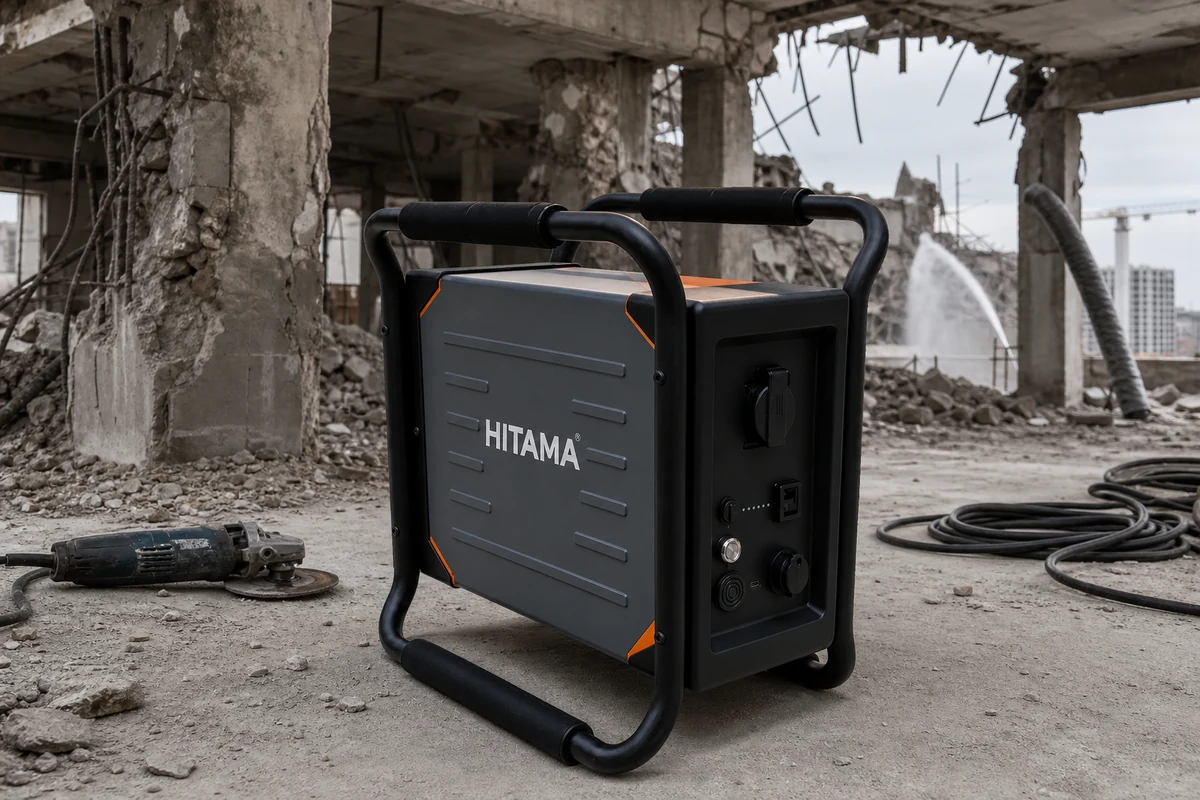
A demolition site loses its supply months before it loses its walls, and nobody from the utility is coming back to that address. The power plan belongs to the strip-out, not to the day the machine arrives.
The meter leaves before the building does
Every demolition job has two dates that get quoted in meetings: the handover of the keys and the day the first wall comes down. The one that decides the power question sits between them, and it is usually in nobody's programme.
The service is disconnected while the building is still standing and still being worked in. Tenants out, meters out, and from that morning no socket in the building belongs to anyone.
The quiet phase is the power phase
Strip-out does not look like construction. Recip saws, grinders, a hoist motor, a work light in a stair core with no window, a pump in a basement that has started to take water: a few hundred watts each, spread over four floors, moving every hour.
Nothing on that list needs a generator, and a generator cannot stand in a stair core anyway. A sealed unit goes up in the hoist with the tools. The end panel is a hinged cover over the 230 V outlet, a switch, a row of charge lights and two closed input ports — one cable out, and the unit stands against a corridor wall instead of outside the fence.
Dust suppression outlasts the breaking
Breaking a frame makes dust for weeks, and the suppression is a pump and a spray bar, not a machine. It runs while the attachment runs, and it is the load the neighbours notice the hour it stops.
A pump is a start, not a wattage. The plate gives what the motor draws while running; what a power source has to survive is the first fraction of a second, rotor still stationary. Read the plate, then ask for the start method. Basement dewatering belongs on the same list, and it is the one item that does not stop at the end of the shift.
Nothing can be fastened to a building that is coming down
There is no distribution board to install, because the wall it would go on is scheduled for removal. All power is carried in and carried out, or locked in a container at the compound and wheeled to the gate.
That makes kilograms a design parameter. A P25 is 29 kg, 2,500 W rated, 5,000 W peak, 2.7 kWh. Where the shift needs a three-phase tool the site needs a different cabinet: the P25-T puts three units in parallel onto a 400 V three-phase output, 7,500 W rated and 15,000 W peak, around 90 kg as a set.
And it makes charging a transport question. The units take 500–1,500 W from a 230 V socket; a P25 reaches 80 % in about two hours and is full in two and a half. Whether that fits depends on the walk from the compound socket to the floor the units are working on.
The air is the other constraint
A stripped building is a dust environment before it is a demolition site: plaster, insulation, concrete dust off the saws, and the fine material that lifts every time a bag is moved.
There is no intake, no exhaust and no fan. The enclosure is sealed to IP54 and heat leaves through the casing, so nothing clogs in the first week and no bearing runs dry. The unit stands inside the cordon next to the tool, not outside it on thirty metres of lead. The working window is −10 to 65 °C; below that the machine is outside its specification, and tarpaulins do not change that.
What this is not
It is not power for the demolition machine. A high-reach excavator, a crusher or a shear runs on its own fuel.
It is not an installation. No transfer switch, no fixed distribution and no connection to the building, because the building is the thing being removed.
It is not a way to move the disconnection date. And it does not make a dust atmosphere classified as explosive safe to work in: IP54 and CE under the EMC Directive 2014/30/EU are not an explosion-protection rating for a zone.
Send the load list for the strip-out phase — tools, nameplates, start methods, floors, and where the compound socket is. We will size the units against the phase that actually has no supply.