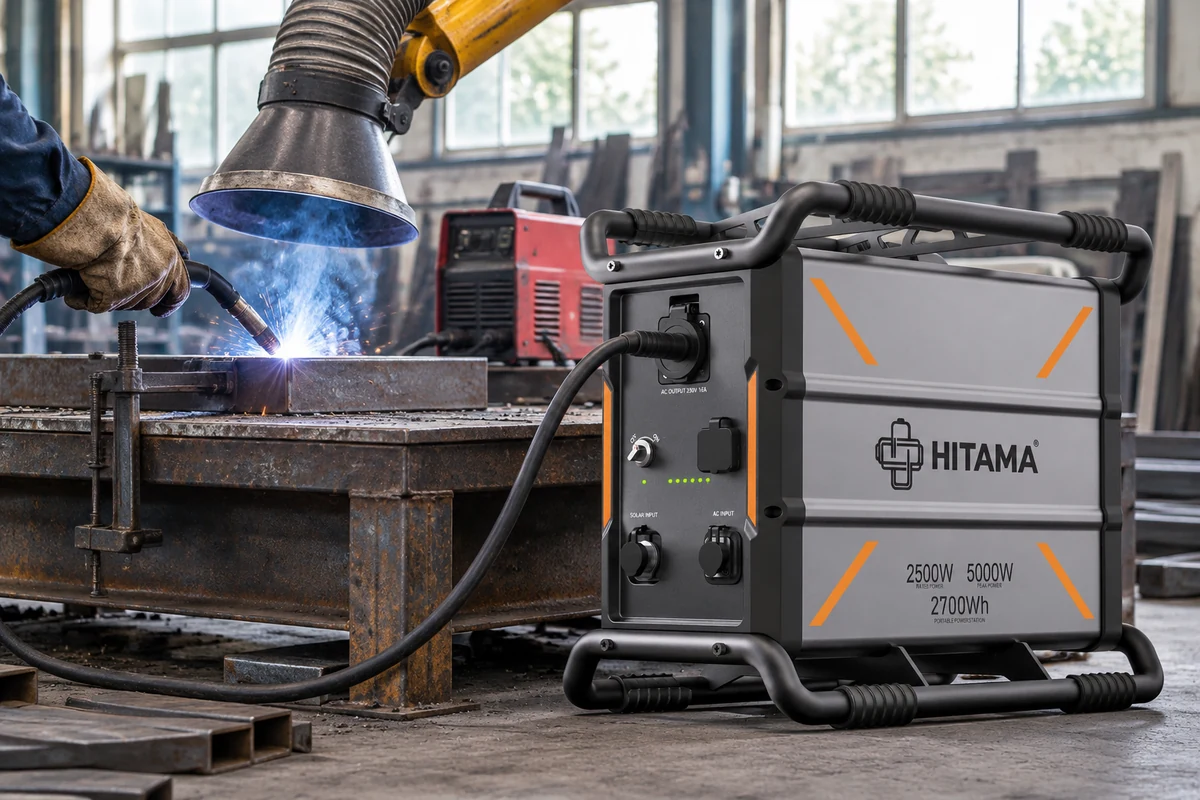
Arc time is minutes; extraction time is hours. The load that decides a welding day's energy is the one nobody wrote on the list.
The item that never makes the list
Every welding job starts with a current. Electrode, diameter, passes — that number walks from the procedure straight into the power question, because it has a dial on the machine and a column in the paperwork.
The extraction unit arrives without a number. It is booked like the screens and the fire blanket, read as part of the room, not the circuit.
That is a scheduling mistake before it is a sizing mistake. The welder draws hard for seconds. The extractor draws quietly for the shift, including the hours when nobody is welding — and hours are what a battery counts.
Two clocks on one socket
The welder is a peak problem. An inverter set takes its current in bursts: ignition, the moment the arc establishes, then a working draw while the rod lasts. Short, repeated, spike-shaped.
The extractor is an energy problem. Its motor runs from the first fume until the bay is clear again, measured in hours, not in rod lengths. Multiply its plate by the shift, then compare that with the welder's bursts multiplied by their minutes. The order usually surprises the welder's owner.
Both sit on the same 230 V 16 A output. One socket, one state of charge, two duty cycles asking for different things at once.
The hose decides where the unit stands
Extraction duct is short and it dislikes bends. A flexible run with two elbows is already compromised, so the unit ends up beside the workpiece, indoors.
An engine needs somewhere to put its exhaust. At the workpiece, inside a fabrication bay, there is nowhere. The welding cable can be extended; the duct cannot.
A sealed housing is what makes the position possible. No intake grille, no exhaust, no moving part in the air path, IP54 against the dust and spray of the bay. The unit stands where the hose needs it, not where the door is.
The hour after the last rod
The arc stops before the fume does. The workpiece is still hot, the coating is still burning off, and the room has to clear before the next trade walks in. That is extraction with nothing left to extract, and it belongs to the working day.
The same hour is the charging hour. From a 230 V socket the P25 accepts 500–1,500 W and reaches 80 % in about two hours. An overnight stop at a socket covers the next shift; skipping it shows up as a short day, not a fault.
Size the peak, then the hours
Read two plates before choosing anything. Welder plate and duty, extractor plate and running hours, then lighting and the small tools that are always on. Peak comes from one column, energy from the other.
Then match the step to the finding. 2,500 W rated and 5,000 W peak for a single P25, 5,000 / 10,000 W as P25-D, 7,500 / 15,000 W as P25-T on 400 V three-phase, with one to three modules in parallel. Inverter welders in the 160–200 A class are specified against the three-phase configuration with a distribution box.
Output shape matters at the margin. Pure sine, THD below 3 %, so the extractor motor and the welder electronics see a waveform close to the wall socket.
What this is not
It is not an extraction system. Capture, duct design, filter class and exposure limits belong to the extraction supplier and the workplace assessment.
IP54 is not a zone rating. Two digits say dust-protected and splash-proof; they do not classify an atmosphere or replace an area drawing.
It is not a promise for every welder. The documented figure is the 160–200 A inverter class in the three-phase configuration; larger sets, engine-driven sets and multi-operator bays need their own calculation.
And it is not a UPS. No transfer time, no changeover, no fixed installation. If a pass must not be interrupted, that is a process decision taken before the unit arrives.
Send the load list — welder, extractor, lights, and the hours each one runs — and the answer comes back in two numbers: the peak you have to cover, and the hours you have to carry.