
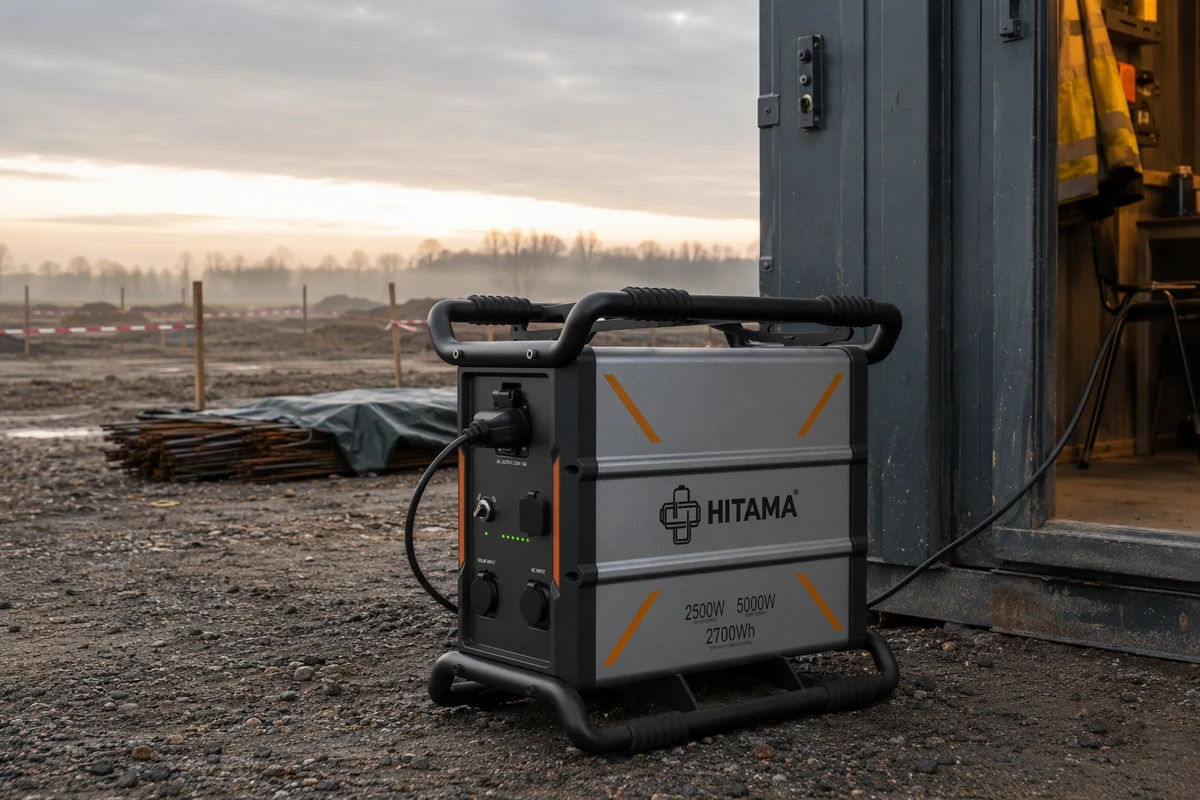
On a new plot the first load is not a tool. It is the cabin where the crew eats, dries its gloves and keeps the drawings dry — and it never appears on a load list.
The cabin draws before the first tool does
On the first morning there is no meter, no board and no supply contract. There is a container, a strip light, a socket for the kettle, a heater for the drying rail, a charger for the radios. Those loads start on day one and continue until the plot has a fixed connection.
The tools come and go; the cabin does not. A breaker runs for twenty minutes, a core drill for an hour. The cabin runs from the first arrival to the last departure, every working day, then holds the overnight load. Its hours are the site's hours.
Two cabins, two machines, one plot. Most plots grow a second container within a fortnight, and the load list doubles with it. Decide one parking place and one charging schedule early.
It is a kilowatt-hour problem, not a peak problem
Nothing in a welfare unit looks like a heavy load. A few hundred watts of heating, some lighting, a kettle for two minutes. Over eleven hours that becomes a daily energy figure, and it is the only number worth calculating.
Start with the duty cycle, not the nameplate. Meter the cabin for a week, heating logged separately. The split decides the machine: the same 2.7 kWh unit carries a cabin drawing around 400 W for a full shift, and is empty in under two hours with a 1.5 kW heater running continuously.
A peak rating is a ten-second number for a motor start, not a daily one. The cabin's problem is duration. Most site power plans fail here: built from a list of nameplates, never from a list of hours.
The cabin is also where the unit can sit
A sealed housing with no intake and no fan changes the placement question. Heat leaves through the housing; there is no exhaust to route, no combustion air to supply, no filter to clog. The unit can stand in the cabin's locked compartment or under the roof beside the door, where the cable is needed.
A combustion unit there means exhaust at the door, a fuel can inside a container and a refuelling step before the shift. On a plot with no yard and no store, those three items usually decide the question.
The temperature window belongs to the same decision. The rated range is −10 to 65 °C. A heated cabin keeps the unit inside it; an unheated one in January does not, and that is a first-week item.
Charging is an appointment, not a pause
The question is not how long the unit runs. It is where the 230 V socket is at half past five. The charging input takes 500–1,500 W from a standard socket. A P25 reaches 80 percent in about two hours and full charge in two and a half; a P36 in about one and a half.
On a plot without a meter, that socket is somewhere else: the contractor's container, a temporary supply at the gate, the van at the depot. If the unit rides home every night, weight decides more than capacity, and the smallest model — 23 kg — is the one carried without an argument.
An intention is not a window. A charging slot that exists only in the site meeting is no slot at all. The handover sheet should say who takes the unit, where it is plugged in and when it comes back.
What this is not
It is not a building supply. No fixed installation, no permanent distribution, no substitute for the connection the plot is waiting for. It is not a UPS. There is no transfer time. It is not an explosion-protected device. CE under the EMC Directive 2014/30/EU and IP54 cover electromagnetic compatibility and ingress protection; neither is a zone certification. It is not a heating system. If the cabin's heating is electric and continuous, the honest answer is a larger supply, two units in parallel, or a different heat source.
Send us the cabin's load list — heater, kettle, drying cabinet, lights, chargers — with the hours the plot is occupied. We will tell you whether this is one unit, two in parallel, or a heating problem no battery should be asked to solve.