
A dryer is bought on heat and paid for in fan hours. Only one of those two sits on the socket.
The plate on the dryer does not describe a load
A dryer's rating plate describes a machine, not an electrical load. Most of the energy that removes water arrives as heat from a burner; the electricity turns the fan that pushes air through the grain. Two numbers, two suppliers, two bills — and the site's power question is only ever about the second one.
So read the motor, not the dryer. The fan motor's plate gives the running draw and the starting method; the burner is a fuel question. Anyone sizing a generator from the dryer's headline figure is pricing a load that was never electrical.
The same split decides the backup. When the supply fails mid-batch the grain does not care which part stopped. What matters is whether the air keeps moving, because a batch left wet and warm is the expensive failure, not the stopped burner.
The start is a different number from the run
A fan motor does not ask politely. Direct-on-line starting pulls several times the running current for the first moments, and that surge is what trips a borrowed circuit or an undersized supply.
Rated and peak are listed separately for a reason. A P25 carries 2,500 W continuously and 5,000 W at peak; the C24 is 2,400 W with 4,800 W peak; the P36 is 3,600 W with a 20,000 W peak. Match the fan's surge to the peak column and its running draw to the rated column. One figure cannot do both jobs.
A three-phase fan needs the three-phase set. P25-T is three modules at 7,500 W and 8.1 kWh on 400 V three-phase; P25-D is a pair at 5,000 W and 5.4 kWh on 230 V single-phase. No adapter turns a single-phase unit into a three-phase supply.
The cool-down is the hours nobody plans
When the burner stops, the fan does not. Grain has to cool before it goes into the store, and cooling is fan time with no heat behind it — often the longest uninterrupted run of the day, and it usually lands in the evening.
That block decides the capacity. 2.7 kWh on a P25, 5.4 kWh as a P25-D, 8.1 kWh as a P25-T: multiply the fan's running draw by the hours it must turn, cool-down included, and the answer is one unit, a pair, or a set. Rated output on its own answers nothing.
Charging has its own window. 500–1,500 W from an ordinary socket, about two hours to 80 percent and two and a half to full on a P25. If the shed's socket is the only one, the next batch starts when the charge finishes, not when the grain is ready.
Why the unit can stand in the shed
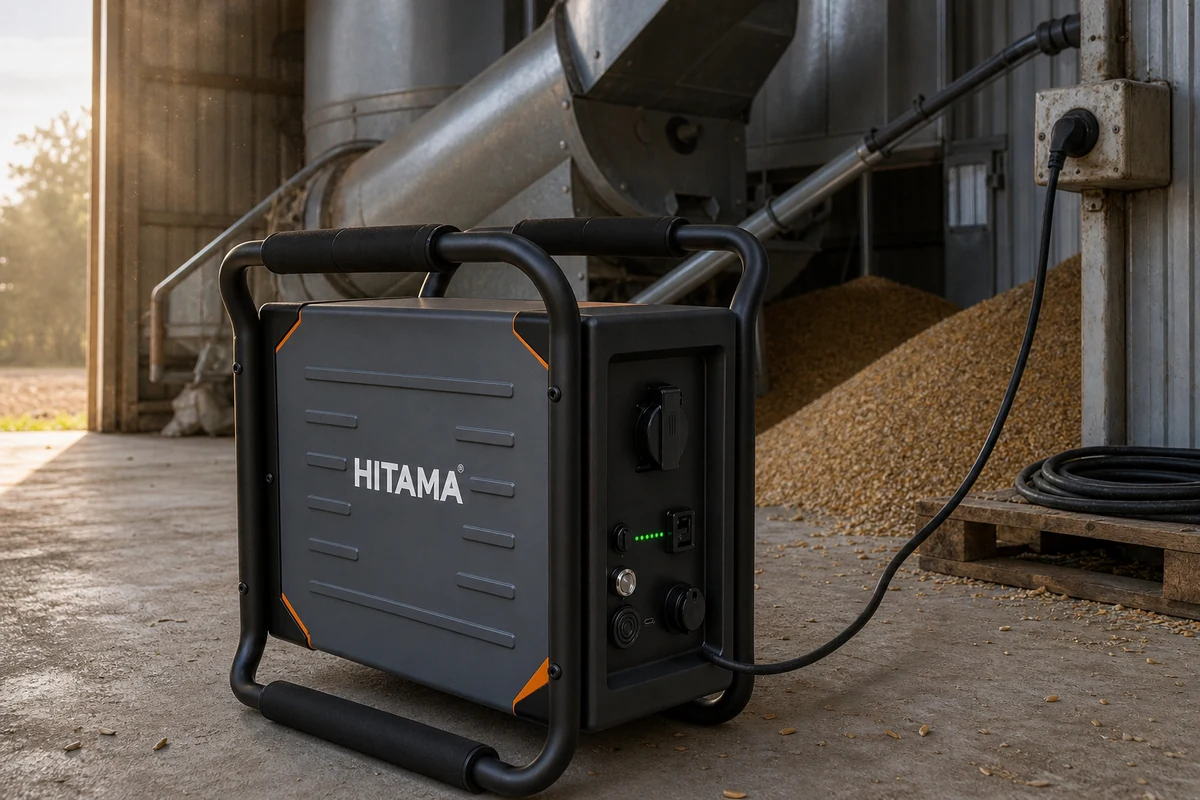
Chaff and dust rule out most engines. No intake air, no exhaust, no fan, no moving parts — cooling runs through the casing. That is what lets the unit stand beside the dryer instead of outside it, with no duct to run and no plume in a shed full of dust.
IP54 and −10 to 65 °C are the numbers that matter here. Ingress protection against chaff, and a working range that covers an October night with the doors open. Neither is a fire rating, and neither is an approval for a dust atmosphere.
The waveform matters for the controller. Pure sine output with THD below 3 percent is the specification the dryer's control board and any chart recorder care about — not the figure on the dryer's own plate.
What this is not
It is not a heat source. Electricity does not replace the burner: this covers the fan, the controls and the handling that already run on electricity, and nothing else.
It is not an explosive-atmosphere approval. The CE marking carried here is the EMC directive 2014/30/EU and transport is documented under UN 3480 class 9 packaging. Grain dust is a site question that neither answers.
It is not a harvest-long supply. The energy is finite. A fan that has to turn for a week needs a fixed supply, not a box with a handle.
Send us the fan motor's plate, how it starts, the hours it must turn including the cool-down, and where a socket is available — we will work out whether that is one unit, a pair or a three-phase set.