A weld that has cooled is not a weld that has passed. The shift that follows the welder has its own load list, its own clock, and one working condition nobody plans power around: darkness.
The work starts when the arc stops
The welder leaves at the end of the pass. The joint is complete, the slag is off, and the site treats the work as finished. It is not finished. It is waiting.
The inspection crew arrives into a different shift. They bring a yoke, a lamp, a can of particles, a laptop and a folder of records — none of it on the load list written for the welding. That is a scheduling problem before it is a sizing problem: one plan was built around a single arc, the other around a lamp for hours and a magnet for seconds.
Darkness is a working condition
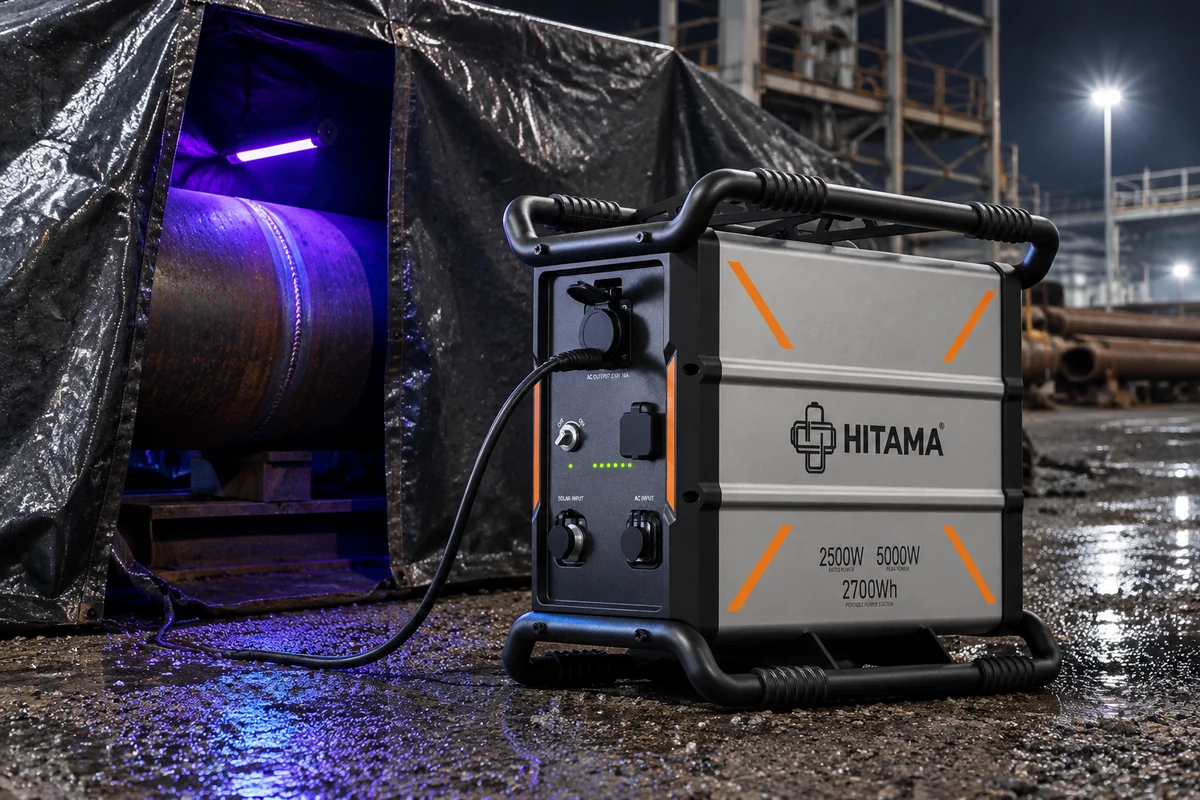
Fluorescent magnetic particle testing is read under low ambient light. The booth is tarpaulin, blackout sheet and a lamp with a filter on it. The darker the surround, the easier the indication reads — and the indication is the point of the shift.
An engine inside that enclosure breaks two rules at once. Its exhaust goes into a space with no ventilation, and its own light sits in the middle of a surface being read for contrast.
So the unit stands outside the sheet, or at the seam, with the door open behind it. A placement decision, taken before the first examination, not after the first complaint.
The load list of an inspection shift
The yoke is not the load. It energises for a few seconds per indication, then it is off again. On the plate it looks like the heaviest item in the kit; it is the least of the problem.
The UV lamp is the load. It runs from the first prepared surface to the last record, in hours, and it cannot be switched off between indications because the eye has to stay adapted to the dark. The white light every setup needs is the second one, on more often than anyone expects.
A rating answers the first number; a battery answers the second. 2.7 kWh is the figure that decides whether the lamp is still on at 04:00, and 2,500 W rated with 5,000 W peak is what carries the yoke and the small tools on top of it.
Two clocks, one socket
The examination clock belongs to the procedure. A percentage of the joints, or every joint, or the ones the supervisor marks — the count is fixed elsewhere and the night is built around it.
The charging clock belongs to the unit. From a 230 V socket the P25 accepts 500–1,500 W and reaches 80 % in about two hours, full in about two and a half. A shift that ends at six has to be on that socket by half past, or the next crew starts with a lamp that dims early.
On a spread with several crews, that is the real constraint. Two units on rotation beat one unit and an argument about overtime — one to three modules in parallel, on 230 V single-phase or 400 V three-phase, once the site is bigger than one booth.
Where the unit can stand
No intake, no exhaust, no fan is what makes the position possible. Heat leaves through the housing, so the machine needs no air path and does not put one into the booth. The particles, the developer and the grit stay outside a sealed body rated IP54.
The documented working window is −10 to 65 °C, and pure sine with THD below 3 % is the waveform the lamp electronics and the laptop were built for.
What this is not
It is not inspection equipment. Procedure, technique, acceptance criteria, qualification of the inspector and the light level the method requires all belong to the inspection body, not to the power supply.
IP54 is not a zone rating and it is not ATEX. Two digits describe dust and splash; they do not classify an atmosphere, and nothing here authorises the unit inside a classified zone.
And it is not a UPS. No transfer time, no changeover. If a record must not be interrupted, that is a process decision taken before the unit arrives.
Send the kit list — lamp, yoke, laptop, work light, and the hours each one runs — and the answer comes back as two numbers: the peak you have to cover, and the hours you have to carry.