
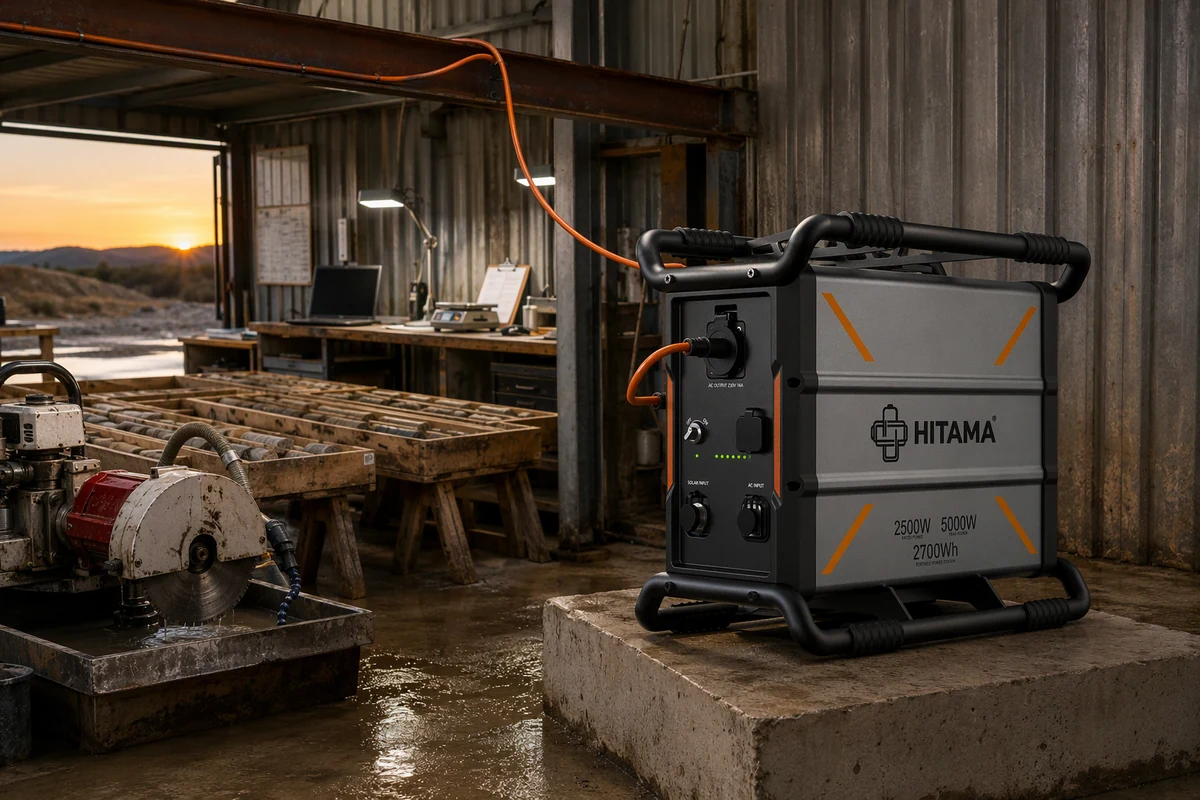
A rig finishes a hole and moves on. The metres are not finished — they are in a box, and the box has not been cut yet. The gap between the hole and the next one is where an exploration programme loses days, and it is a power question before it is a scheduling one.
The bottleneck is downstream
Drilling is the visible cost; the shed is the constraint. A crew paid by the metre, a rig on standby and a saw that has to be fed before the next hole is worth starting — the queue does not appear in the daily report until it is two days long.
If the shed stops, the next hole is scheduled on hope. Three things stop it — water, access and charge — and only the third one is a capacity question.
A wet room, not a workshop
Core cutting is a wet process. The blade runs in a water tray, the slurry leaves the tray, and the floor is wet from the first cut to the last. Layout follows from that: saw at the low end, trays out of the splash line, cable overhead.
The unit is not part of the wet zone. IP54 covers dust and splash from any direction. It does not cover a tray of slurry, a hose left running or a floor that turns into a puddle — so the machine stands on a dry bench end, and the cable drops from above instead of lying in water.
No intake, no exhaust, no fan is what lets it stand inside the shed at all. Rock dust and water mist are in that air every shift; a sealed case with heat leaving through the housing puts no air path into the room, and no exhaust where two people are working.
Two loads, two clocks
The saw is a start-current question. A three-phase head brings its motor up against a wet blade and a stone; the figure that matters is the peak at the switch, and it is over in a second or two.
The bench is a duration question. Lights over the logging table, a laptop, a scale, a drying oven if the programme runs one — small numbers that are on from the first box to the last, and on again after the saw has stopped.
A 400 V saw pulls the answer toward P25-T: 7,500 W rated, 15,000 W peak, 8.1 kWh, three modules on 400 V. A 230 V saw sits inside one P25: 2,500 W rated, 5,000 W peak, 2.7 kWh.
Ninety kilos is a building decision
P25-T is about 90 kg; one P25 is 29 kg. At the end of a track that is not a footnote — it decides whether the shed has to be reachable by vehicle, or whether two people carry the supply in with the core boxes and carry it out again at demobilisation. Saw voltage first, then access, then capacity, is the order that survives the second week.
Parallel operation is what keeps that flexible. One to three modules on 230 V single-phase or 400 V three-phase, so a shed that grows from one saw to two does not need a second purchase to match.
The shift ends before the light does
A core shed runs one shift, and the evening is the charging window. From a 230 V socket the P25 accepts 500–1,500 W and reaches 80 % in about two hours, full in about two and a half; the P36 is full in about one and a half.
A second unit is not spare capacity. It is the reason the first one can be on the charger at 18:30 while the night's logging still has light.
The documented window is −10 to 65 °C, so an unheated container in a cold season is inside the specification as written, and pure sine with THD below 3 % is the waveform the bench instruments were built for.
What this is not
It is not rig power. A drilling rig is a different load class with its own supply and its own approvals; nothing here is proposed as rig supply.
It is not an installation. No wiring into the shed, no distribution board, no earthing design — if the shed has a permanent supply, that supply is the answer and this is the fallback.
IP54 is not washdown and not a zone rating. Two digits describe dust and splash; they do not make the unit immersible, and they do not classify an atmosphere.
Send the shed's kit list — saw voltage, bench lights, oven, laptop, cores per day — and the answer comes back as two numbers: the peak at the switch and the hours the bench needs.