
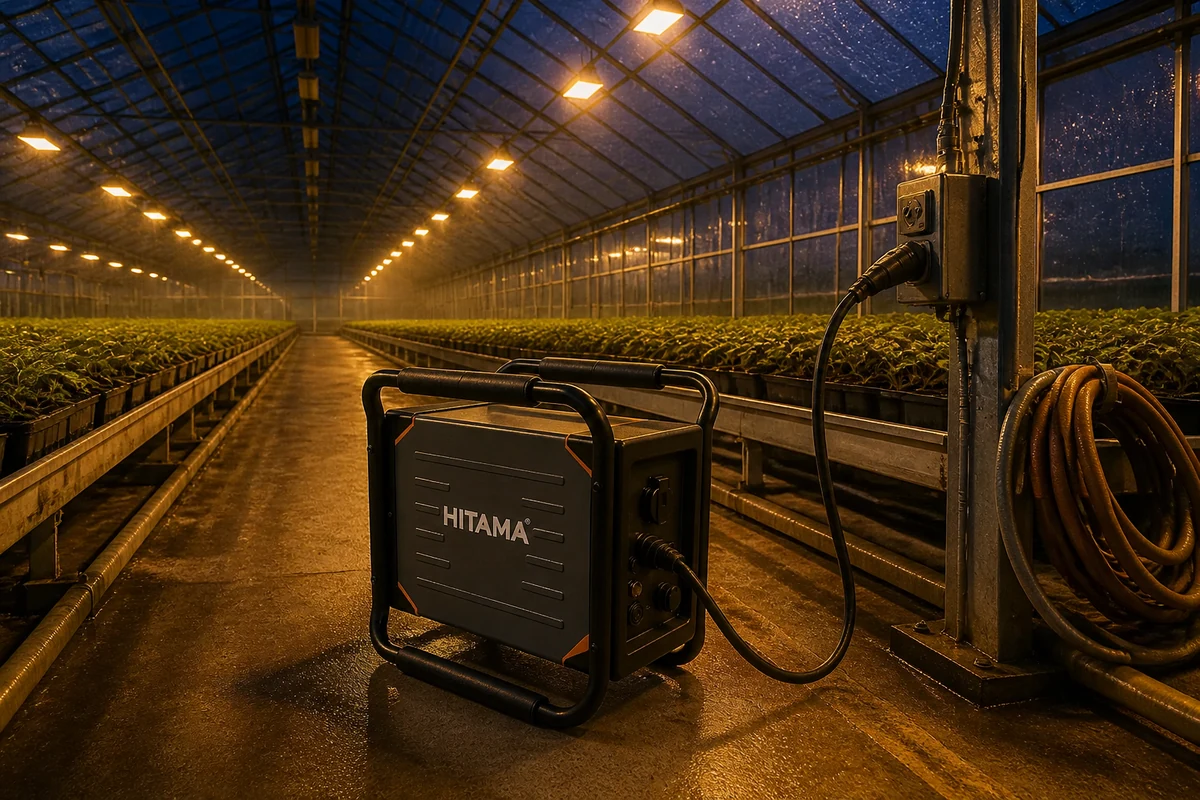
A lit glasshouse runs on a calendar, not on the weather. The load cannot be moved to a cheaper hour, a calmer night or a drier week — and that changes what the unit has to be.
The hours are set before the season starts
The lighting window is agreed with the grower, not with the energy supplier. A photoperiod is chosen per crop and per week of the year, and once that schedule sits in the controller the hours run whether the house is warm or the wind is blowing.
The date of the switch sits in the crop plan, not in a fuel log. A lit crop is timed against a market window, and a week of missed hours is a week of growth that does not come back. Nobody on such a site asks whether the unit can wait until Thursday.
That changes the sizing question. On a construction site the peak arrives when a tool starts and vanishes when it stops. Here the load is a fixed number of hours against a fixed nameplate — a duration, covered by capacity and a charge window, not by a larger peak rating.
Why a combustion engine cannot stand in the row
A closed glasshouse has nowhere to put combustion products. The air inside the envelope is the air the crop is transpiring into, and a flue that ends inside the house returns the exhaust to the canopy at a different height.
Sealed, no intake, no exhaust, no fan, no moving parts. The P25 sheds heat through its casing, so it stands in the working aisle beside the crop, and the run to the lighting circuit never leaves the building.
The dark hours are the discharge window
The lighting runs when the sun does not — exactly when nothing else on the property produces. No yield in that window, and nobody awake to swap a unit halfway through it.
The charge window is daylight you were counting on for something else. From a 230 V socket the P25 accepts 500–1,500 W and reaches 80 % in about two hours, full in about two and a half; the P36 is full in roughly one and a half.
So the plan is a midday charge slot, or enough capacity to charge every second day. Two or three modules parallel on 230 V single phase, so one can leave for charging without the row going dark.
Where the 400 V question lands
If the lighting is fed from a 400 V three-phase circuit, the question is which combination reproduces the phases, not how many watts. The P25-T delivers 7,500 W rated and 15,000 W peak on 400 V three-phase from 8.1 kWh, as three modules in parallel — decided at the door, not in the aisle.
Weight belongs to the same decision. A P25 is 29 kg and one person carries it down a path. A P25-T is around 90 kg and has to fit the doorway, the gravel track and, in a nursery, the gap between beds.
Heat at the ridge, weight at the door
The working window is −10 to 65 °C, and a glasshouse uses both ends of it. Under the ridge the air can sit at the top of that range while the crop zone stays cooler, so position is a temperature decision before it is a convenience one.
IP54 and a sealed casing cover spray drift and condensation; they do not make the unit a washdown appliance. Off the floor grid, away from the drain line, out of the arc of a jet.
What this is not
It is not a UPS. A clean sine at THD below 3 % describes the waveform, not how fast the unit takes over from a failed supply. Where a circuit cannot tolerate a gap at all, that is a different device and a different conversation.
It is not the house's fixed installation, and it is not area-certified equipment. CE under the EMC Directive 2014/30/EU and UN 3480 class 9 packaging for transport say nothing about explosive atmospheres. Every unit leaves the factory through the same ten-point test, and that is where the paperwork ends.
Send us the fixture list — how many, nameplate per fixture, hours per night, and the phase of the lighting circuit. We will size the modules and the charge window against your dark hours, not a rule of thumb.