
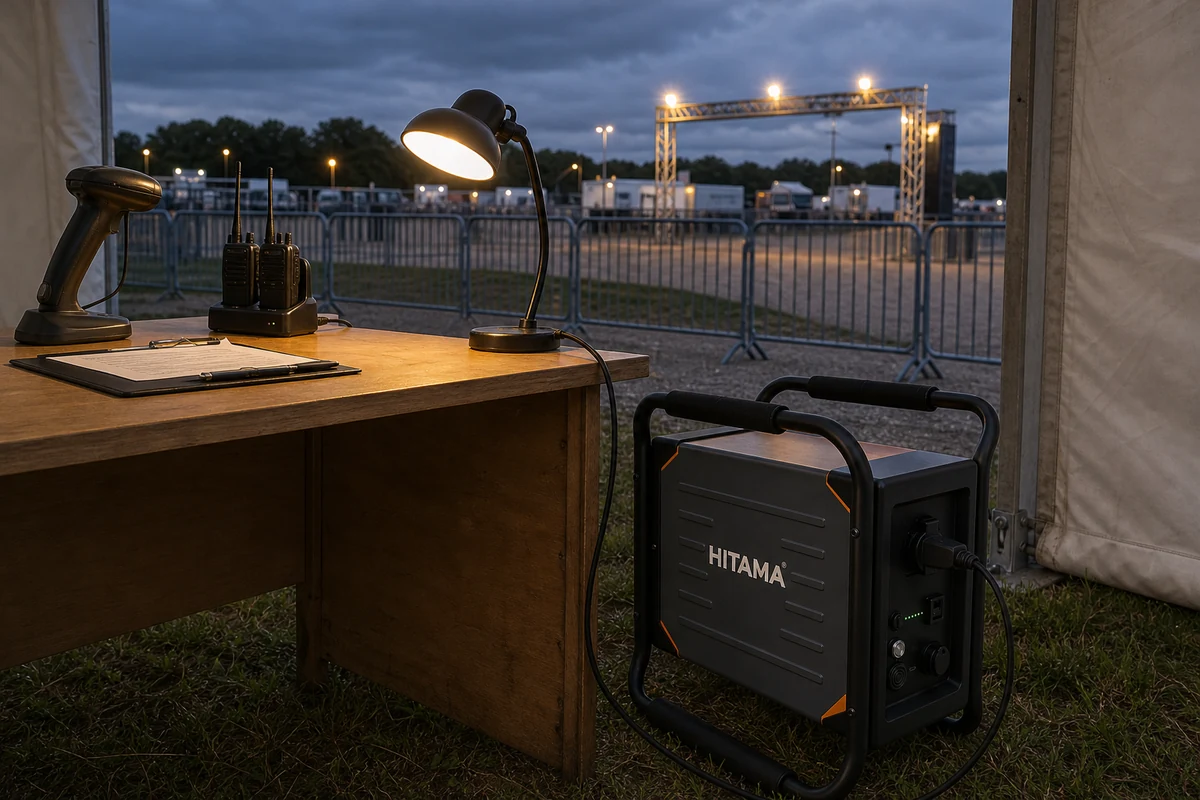
The supply that decides whether an outdoor event opens is not the one behind the stage. The gate, the accreditation desk and the radio chargers come alive days before the first ticket is scanned, and nobody gives them an hour in which to be switched off.
The stage is a peak. The gate is a floor.
A stage load has a shape. Sound check at two, doors at seven, headline at ten: the peak is known, watched, and the whole supply is designed around that curve.
The gate has no curve. Scanners, handheld radios in cradles, a printer, a laptop, one lamp. A few hundred watts running from the first accreditation check to the last egress, every day of the build and every day of the show.
Where the queue stands, a generator cannot
The desk sits where the public arrives — the one place on site where exhaust, a hot casing and a fuel can are all unacceptable, and usually the place nearest the neighbour who can already hear the site.
No intake changes what is allowed there. P25 is sealed: no intake, no fan, no moving parts, heat leaving through the casing. Nothing is drawn in from the tent, and no exhaust is routed past people standing two metres away.
The run is a metre, not thirty. The outlet is on the machine, so no lead is taped across the walkway the queue is using.
Duration is the specification
2.7 kWh is a budget, not a week. P25 is 2,500 W rated and 5,000 W peak from 2.7 kWh in a 29 kg housing. The desk uses neither figure; what matters is how many hours of ordinary load fit inside that budget, and what happens when they run out.
The recharge is a handover, not a charge. From a 230 V socket the input draws 500 to 1,500 W — about two hours to 80 percent, two and a half to full. Somebody still carries a full unit to the gate and a flat one back: 29 kg, one person, a van, and a decision about which hour of the night that happens in.
Two modules answer a different question. One to three run in parallel at 230 V single-phase or 400 V three-phase. At a gate that must not close, the second unit is not bought for the extra watts; it is bought so the desk keeps running while the first goes away to charge.
The failure is silent, so make it visible
When the gate loses power, nothing happens. No bang, no alarm. Scanners drop to paper, radios go quiet one at a time, and the queue outside simply gets longer.
A lamp is the cheapest instrument on the site. On the same outlet as the scanners, it answers "is the gate live" by being looked at, rather than by testing a scanner against a ticket that may be wrong too. A unit arriving at the desk is signed for the same way: percentage on the display, outlet tested, lamp on.
The build week is the rehearsal
Contractor access is the same desk. During build-up the scanners are already checking in trucks, plant operators and crew, so a failure in the build week is already an access-control failure, not a warning of one.
The evening decision is made at the office. The gate has no socket. The unit that carries it tomorrow is charged tonight wherever the site office is, which makes the overnight task a transport schedule before it is a charging one.
What this is not
It is not show power. PA, lighting and video sit on the production's own supply and its own distribution; nothing here replaces that.
It is not a UPS. No changeover time is specified because none is claimed, and it does not bridge the gap while a distribution is switched.
It is not the venue's installation. It feeds its own outlets and cannot be wired into a fixed distribution; the temporary installation and its earthing stay with the event's electrical contractor.
It is not escape lighting, and it is not a permission. Statutory escape lighting and alarm sounders remain on the venue's own provision, and whether a battery may stand at a public gate is decided by the event's electrical plan and the conditions attached to the permission.
Send the gate schedule and the desk's load list — hours staffed per day, what is plugged in, and where the nearest 230 V socket is at night. We will size the days against those figures and tell you where the plan stops.